HEATING / AIR CONDITIONING REFRIGERANT(for HFO-1234yf(R1234yf)) ON-VEHICLE INSPECTION
PROCEDURE

 1.INSPECT REFRIGERANT PRESSURE
This method uses a refrigerant recovery unit set to locate problem areas. Read the refrigerant pressure when the test conditions are established.
Test conditions:
Temperature at the air inlet with the air recirculation switch set at RECIRC is 30 to 35°C (86 to 95°F).
Engine is running at 1500 rpm.
All doors are fully open.
Blower speed control switch is set to HI.
A/C switch is on.
Gauge readings (Reference):
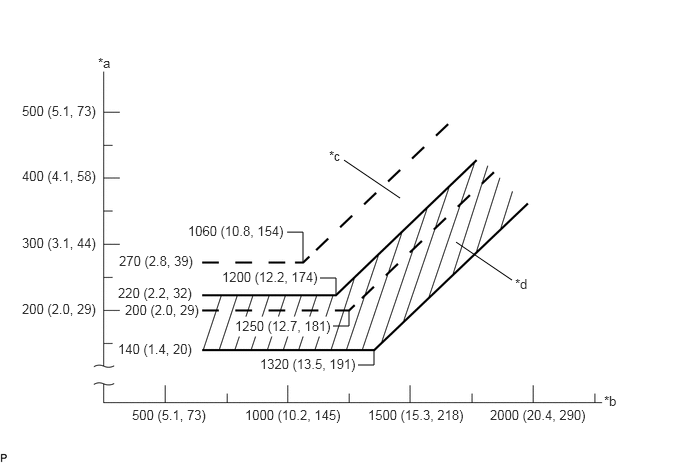
| *a | Pressure on Low Pressure Side kPa (kgf/cm2, psi) | *b | Pressure on High Pressure Side kPa (kgf/cm2, psi) |
| *c | Blower High Zone | *d | Blower Low Zone |
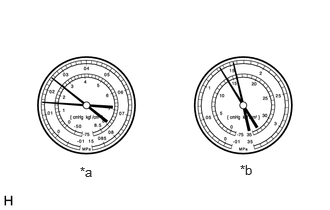
| *a | LO |
| *b | HI |
Normally functioning refrigeration system.
- Gauge Reading:
Pressure Side Refrigerant Volume Low 150 to 250 kPa (1.5 to 2.5 kgf/cm2, 22 to 36 psi) High 1370 to 1570 kPa (14.0 to 16.0 kgf/cm2, 199 to 228 psi)
The A/C system periodically changes between normal and improper function due to moisture in the refrigerant system.
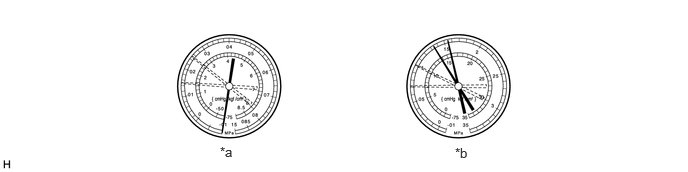
| *a | LO | *b | HI |
| Symptom | Probable Cause | Diagnosis | Corrective Action |
|---|---|---|---|
| During operation, pressure on low pressure side cycles between normal and vacuum | Moisture in refrigeration system freezes at expansion valve orifice, causing temporary stop of cycle. However, when melted, normal state is restored. | ·
Dryer is overly saturated ·
Moisture in refrigeration system freezes at expansion valve orifice and blocks refrigerant circulation |
1.
Replace cooler dryer 2.
Remove moisture from cycle by repeatedly evacuating air 3.
Supply appropriate volume of new refrigerant |
The A/C system does not function effectively due to insufficient refrigerant.
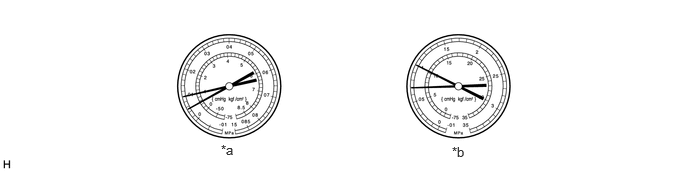
| *a | LO | *b | HI |
| Symptom | Probable Cause | Diagnosis | Corrective Action |
|---|---|---|---|
·
Pressure low on both low and high pressure sides ·
Cooling performance insufficient |
Gas leakage from refrigeration system | ·
Insufficient refrigerant ·
Refrigerant leakage |
1.
Check for gas leakage and repair if necessary 2.
Supply appropriate volume of new refrigerant 3.
If indicated pressure value close to 0 with gauge connected, create vacuum after inspecting and repairing location of leakage |
The A/C system does not function effectively due to poor circulation of the refrigerant.
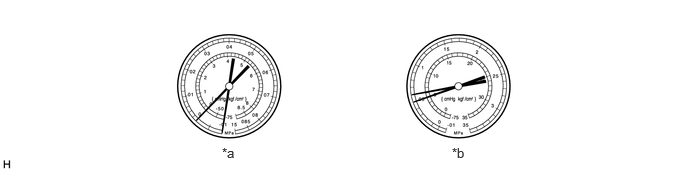
| *a | LO | *b | HI |
| Symptom | Probable Cause | Diagnosis | Corrective Action |
|---|---|---|---|
·
Pressure low on both low and high pressure sides ·
Frost exists on piping from condenser to A/C unit |
Refrigerant flow obstructed by dirt in condenser | Condenser clogged | Replace condenser |
The A/C system does not function or functions intermittently because the refrigerant does not circulate.
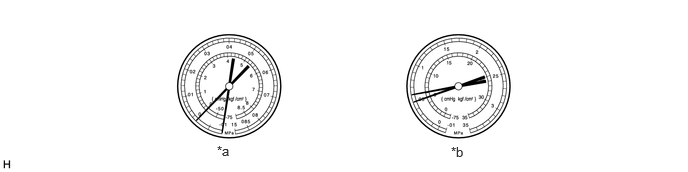
| *a | LO | *b | HI |
| Symptom | Probable Cause | Diagnosis | Corrective Action |
|---|---|---|---|
·
Vacuum indicated on low pressure side, and extremely low pressure indicated on high pressure side ·
Frost or condensation seen on piping on both sides of condenser or expansion valve |
·
Refrigerant flow obstructed by moisture or dirt in refrigeration system ·
Refrigerant flow obstructed by gas leakage from expansion valve |
Refrigerant does not circulate | 1.
Check expansion valve refrigerant 2.
Clean expansion valve using compressed air 3.
Replace condenser 4.
Evacuate air and charge system with appropriate volume of new refrigerant 5.
For gas leakage from expansion valve, replace expansion valve |
The A/C system does not function effectively due to the system being overcharged with refrigerant or insufficient cooling of the condenser.
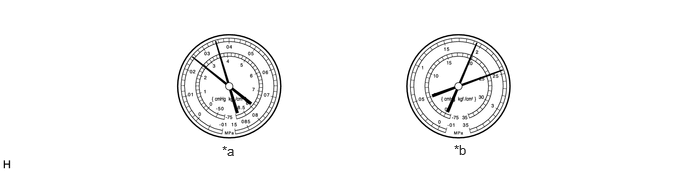
| *a | LO | *b | HI |
| Symptom | Probable Cause | Diagnosis | Corrective Action |
|---|---|---|---|
| Pressure extremely high on both low and high-pressure sides | ·
Excessive refrigerant ·
Cooling performance of condenser insufficient |
·
Condenser is dirty ·
Condenser fan motor is malfunctioning ·
Excessive refrigerant |
1.
Clean condenser 2.
Check condenser fan motor operation 3.
If actions taken in 1 and 2 do not solve problem, check amount of refrigerant and adjust amount of refrigerant to appropriate amount |
The A/C system does not function due to air in the refrigeration system.
- CAUTION:
-
The low-pressure piping may be very hot and cause serious burns.
- NOTICE:
-
These gauge indications occur when the refrigeration system opens and the system is charged with refrigerant without vacuum purging.
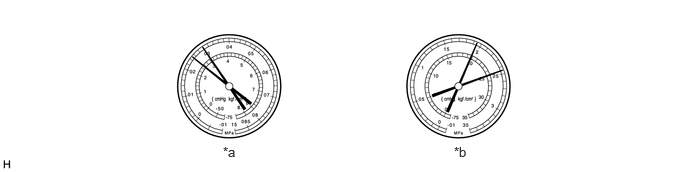
| *a | LO | *b | HI |
| Symptom | Probable Cause | Diagnosis | Corrective Action |
|---|---|---|---|
·
Pressure extremely high on both low and high-pressure sides ·
Low-pressure piping is too hot to touch |
Air in refrigeration system | ·
Air in refrigeration system ·
Vacuum purging insufficient |
1.
Check if compressor oil is dirty or insufficient 2.
Evacuate air and charge system with new refrigerant |
The A/C system does not function effectively due to an expansion valve malfunction.
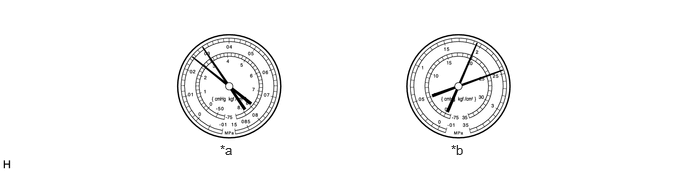
| *a | LO | *b | HI |
| Symptom | Probable Cause | Diagnosis | Corrective Action |
|---|---|---|---|
·
Pressure extremely high on both low and high-pressure sides ·
Frost or condensation on piping on low-pressure side |
Problem with expansion valve | ·
Excessive refrigerant in low pressure piping ·
Expansion valve open too widely |
Replace expansion valve |
The A/C system does not function due to a defective compressor.
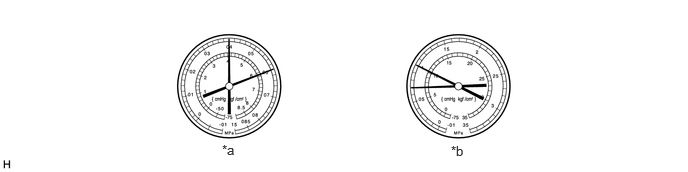
| *a | LO | *b | HI |
| Symptom | Probable Cause | Diagnosis | Corrective Action |
|---|---|---|---|
·
Pressure extremely high on both low and high-pressure sides ·
Pressure extremely low on high pressure side |
Internal leakage in compressor | ·
Compression failure ·
Leakage from damaged valve or broken sliding parts |
Repair or replace compressor |