Rear Door LH Entry Lock and Unlock Functions do not Operate
Circuit diagnosis · Vehicles built from Jan 2012
Versions by build date: Sep 2011 – Dec 2011 from Jan 2012
DESCRIPTION
When the rear door LH entry lock and unlock functions do not operate, one of the following may be malfunctioning: 1) power door lock system, 2) rear door electrical key oscillator LH, or 3) certification ECU (smart key ECU assembly).- HINT:
- For vehicles with entry function for rear doors.
WIRING DIAGRAM
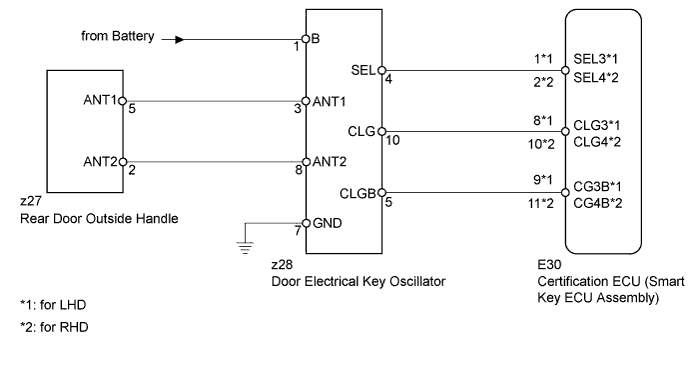

INSPECTION PROCEDURE
| 1. CHECK POWER DOOR LOCK OPERATION |

When the master switch assembly door control switch is operated, check that the locked doors unlock.
- OK:
- Door locks operate normally.
|
|
||||

| OK | |
 |
| 2. READ VALUE USING INTELLIGENT TESTER (DOOR LOCK POSITION SWITCH) |
Connect the intelligent tester to the DLC3.
Turn the engine switch on (IG).
Turn the intelligent tester on.
Enter the following menus: Body / Main Body / Data List.
Read the Data List according to the display on the intelligent tester.
for LHD
Main Body Tester Display
Measurement Item/Range
Normal Condition
Diagnostic Note
DR Door Lock Position SW
Driver side rear door lock position switch signal / ON or OFF
ON: Driver side rear door unlocked
OFF: Driver side rear door locked
-
- OK:
- On the intelligent tester screen, the display changes between ON and OFF as shown in the chart above.
for RHD
Main Body Tester Display
Measurement Item/Range
Normal Condition
Diagnostic Note
PR Door Lock Position SW
Passenger side rear door lock position switch signal / ON or OFF
ON: Passenger side rear door unlocked
OFF: Passenger side rear door locked
-
- OK:
- On the intelligent tester screen, the display changes between ON and OFF as shown in the chart above.
|
|
||||
| OK | |
|
| 3. READ VALUE USING INTELLIGENT TESTER (TOUCH SENSOR) |
Using the intelligent tester, read the Data List.
for LHD
Entry & Start Tester Display
Measurement Item/Range
Normal Condition
Diagnostic Note
Dr-Door Touch Sensor
Driver side rear door touch sensor / ON or OFF
ON: Touch sensor touched
OFF: Touch sensor not touched
-
Dr-Door Trigger Switch
Driver side rear door outside handle lock switch / ON or OFF
ON: Entry lock switch pushed
OFF: Entry lock switch not pushed
-
for RHD
Entry & Start Tester Display
Measurement Item/Range
Normal Condition
Diagnostic Note
Pr-Door Touch Sensor
Passenger side rear door touch sensor / ON or OFF
ON: Touch sensor touched
OFF: Touch sensor not touched
-
Pr-Door Trigger Switch
Passenger side rear door outside handle lock switch / ON or OFF
ON: Entry lock switch pushed
OFF: Entry lock switch not pushed
-
| Result |
Proceed to |
| Display changes according to manual operation |
A |
| Display does not change according to manual operation |
B |
|
|
||||

| A | |
|
| 4. CHECK WAVE ENVIRONMENT |
Bring the electrical key transmitter near the rear door outside handle LH, and perform a rear door LH entry lock and unlock operation check.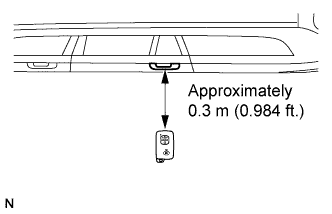
- NOTICE:
- If the key is brought within 0.2 m (0.656 ft.) of the door handle, communication is not possible.
- HINT:
- When the electrical key transmitter is brought near the rear door outside handle LH, the possibility of wave interference decreases, and it can be determined if wave interference is causing the problem symptom.
- If the operation check is normal, the possibility of wave interference is high. Also, added vehicle components may cause wave interference. If installed, remove them and perform the operation check.
- When the electrical key transmitter is brought near the rear door outside handle LH, the possibility of wave interference decreases, and it can be determined if wave interference is causing the problem symptom.
Result Result
Proceed to
Operation check fails
A
Operation check is normal
B
|
|
||||
| A | |
|
| 5. PERFORM KEY DIAGNOSTIC MODE INSPECTION |
Diagnostic mode inspection (rear door electrical key oscillator LH).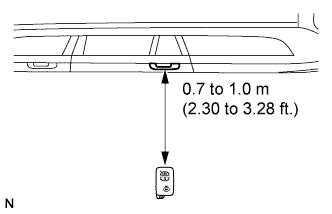
Connect the intelligent tester to the DLC3.
Turn the engine switch on (IG).
Turn the intelligent tester on.
Enter the following menus:for LHDSelect: Body / Entry & Start / Key Communication Check / Overhead + Driver Side Rear.for RHDSelect: Body / Entry & Start / Key Communication Check / Overhead + Passenger Side Rear.
When the electrical key transmitter is in the position shown in the illustration, check that the wireless door lock buzzer sounds.
- HINT:
- If the buzzer sounds, it can be determined that the rear LH seat outside transmitter is operating normally.
- OK:
- Wireless door lock buzzer sounds.
|
|
||||
| OK | ||
 |
||
| ||
| 6. CHECK HARNESS AND CONNECTOR (CERTIFICATION ECU [SMART KEY ECU ASSEMBLY] - DOOR ELECTRICAL KEY OSCILLATOR) |
Disconnect the E30 ECU connector.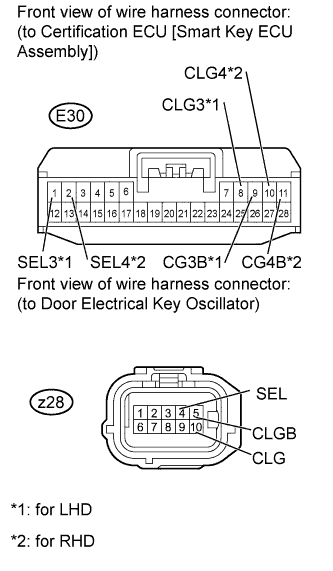
Disconnect the z28 oscillator connector.
Measure the resistance according to the value(s) in the table below.
- Standard Resistance:
- for LHD:
Tester Connection
Condition
Specified Condition
E30-1 (SEL3) - z28-4 (SEL)
Always
Below 1 Ω
E30-8 (CLG3) - z28-10 (CLG)
Always
Below 1 Ω
E30-9 (CG3B) - z28-5 (CLGB)
Always
Below 1 Ω
E30-1 (SEL3) - Body ground
Always
10 kΩ or higher
E30-8 (CLG3) - Body ground
Always
10 kΩ or higher
E30-9 (CG3B) - Body ground
Always
10 kΩ or higher
- for RHD:
Tester Connection
Condition
Specified Condition
E30-2 (SEL4) - z28-4 (SEL)
Always
Below 1 Ω
E30-10 (CLG4) - z28-10 (CLG)
Always
Below 1 Ω
E30-11 (CG4B) - z28-5 (CLGB)
Always
Below 1 Ω
E30-2 (SEL4) - Body ground
Always
10 kΩ or higher
E30-10 (CLG4) - Body ground
Always
10 kΩ or higher
E30-11 (CG4B) - Body ground
Always
10 kΩ or higher
|
|
||||
| OK | |
|
| 7. CHECK HARNESS AND CONNECTOR (DOOR ELECTRICAL KEY OSCILLATOR - REAR DOOR OUTSIDE HANDLE) |
Disconnect the z27 handle connector.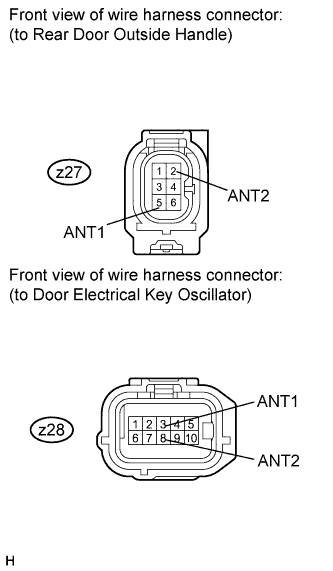
Disconnect the z28 oscillator connector.
Measure the resistance according to the value(s) in the table below.
- Standard Resistance:
Tester Connection
Condition
Specified Condition
z27-2 (ANT2) - z28-8 (ANT2)
Always
Below 1 Ω
z27-5 (ANT1) - z28-3 (ANT1)
Always
Below 1 Ω
z27-2 (ANT2) - Body ground
Always
10 kΩ or higher
z27-5 (ANT1) - Body ground
Always
10 kΩ or higher
|
|
||||
| OK | |
|
| 8. CHECK HARNESS AND CONNECTOR (DOOR ELECTRICAL KEY OSCILLATOR - BATTERY AND BODY GROUND) |
Disconnect the z28 oscillator connector.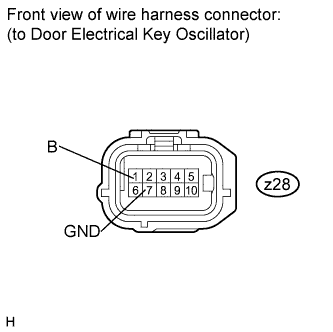
Measure the voltage according to the value(s) in the table below.
- Standard Voltage:
Tester Connection
Condition
Specified Condition
z28-1 (B) - z28-7 (GND)
Always
11 to 14 V
|
|
||||
| OK | |
|
| 9. REPLACE DOOR ELECTRICAL KEY OSCILLATOR |
Replace the door electrical key oscillator (Click here).
| NEXT | |
|
| 10. CHECK DOOR ELECTRICAL KEY OSCILLATOR (OPERATION) |
Check that the entry function operates normally.
- OK:
- Operates normally.
|
|
||||
| OK | ||
|
||
| ||
| 11. REPAIR REAR DOOR OUTSIDE HANDLE |
Replace the rear door outside handle (Click here).
| NEXT | |
|
| 12. CHECK REAR DOOR OUTSIDE HANDLE OPERATION |
Check that the entry function operates normally.
- OK:
- Operates normally.
|
|
||||
| OK | ||
|
||
| ||