NAVIGATION / MULTI INFO DISPLAY NAVIGATION SYSTEM CONTROL BLUETOOTH COMMUNICATION
FUNCTION
"Bluetooth" is a worldwide wireless communication standard widely used as a short range communication tool.
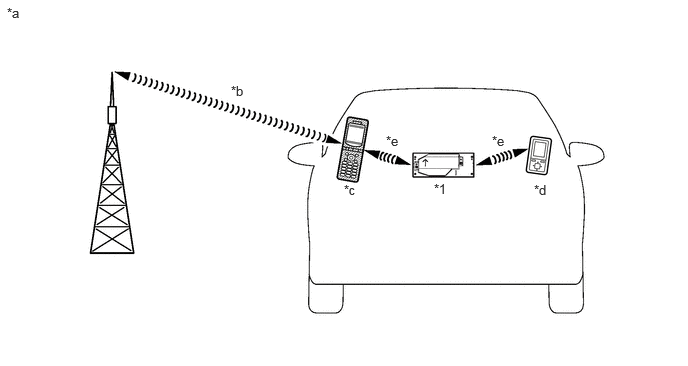
| *1 | Audio Head Unit (Radio Receiver Assembly)
·
Built-in "Bluetooth" Antenna |
- | - |
| *a | Example | *b | Cellular Network |
| *c | Cellular Phone ("Bluetooth" Compatible Type) |
*d | Portable Audio Player ("Bluetooth" Compatible Type) |
| *e | "Bluetooth" Wireless Connection | - | - |
"Bluetooth" is a trademark owned by Bluetooth SIG, Inc.
"Bluetooth" is a wireless connection technology that uses the 2.4 GHz frequency band.
- HINT:
-
The communication performance of "Bluetooth" may vary depending on obstructions or radio wave conditions between communication devices, electromagnetic radiation, communication device sensitivity or antenna capacity.
-

The Bluetooth word mark and logos are registered trademarks owned by the Bluetooth SIG, Inc.
Hands-free Function
The "Bluetooth" built-in audio head unit and a "Bluetooth" compatible cellular phone* can be connected using a "Bluetooth" wireless connection. This enables the use of the hands-free function on the cellular phone even if the phone is in a pocket or bag. For this reason, it is not necessary to use a connector or cable to connect the cellular phone.
*: Some versions of "Bluetooth" compatible cellular phones may not function properly.
The hands-free function uses a "Bluetooth" wireless connection. A "Bluetooth" wireless connection can be affected by uncertain elements, such as vehicle location, time of day, etc. Therefore, problems related to establishing a connection may be caused temporarily by "Bluetooth" connection conditions. It is necessary to check the frequency of occurrence and connection conditions using another cellular phone, etc. when performing diagnosis.
Compatible Hands-free Devices
|
*1: This profile is necessary when using the hands-free function. *2: This profile is necessary when transferring the phonebook data. *3: This profile is necessary when using the application link function (Models with Application Link Function) or smartphone linked function (Models with Smartphone Linked Function). *4: This profile is necessary when using the message function (Models with SMS/MMS/e-mail Function). *5: This profile is necessary when using the connected services function (Models with Toyota Online Function). |
|
| Required "Bluetooth" Specifications | Ver. 2.0 or higher (Ver. 4.2 or higher recommended) |
| Compatible Profiles |
·
HFP (Hands Free Profile) Ver. 1.0 or higher (Ver. 1.7 or higher recommended)*1
·
OPP (Object Push Profile) Ver. 1.1 or higher (Ver. 1.2 or higher recommended)*2
·
PBAP (Phone Book Access Profile) Ver. 1.0 or higher (Ver. 1.2 or higher recommended)*2
·
SPP (Serial Port Profile) Ver. 1.1 or higher (Ver. 1.2 or higher recommended)*3
·
MAP (Message Access Profile) Ver. 1.0 or higher (Ver. 1.2 or higher recommended)*4
·
PAN (Personal Area Networking) Ver. 1.0 or higher*5 |
| Maximum number of hands-free devices that can be registered (including audio devices) | 5 |
- HINT:
-
·
The amount of remaining battery charge displayed on the audio head unit may be different from that of the "Bluetooth" device.
·Some profiles described above may not be supported by the system depending on the audio head unit equipped.
·If the specification of the connected Bluetooth phone is lower than the recommended or does not support the functions required, the available functions may be limited.
·If a Bluetooth-compatible cellular phone does not support the Hands Free Profile (HFP), the cellular phone cannot be registered or data transmission such as Object Push Profile (OPP), Serial Port Profile (SPP), message access profile (MAP), personal area networking (PAN) or Phone Book Access Profile (PBAP) may not be available.
·When multiple Bluetooth-compatible devices are registered, the user can select different devices for the Bluetooth audio system and Bluetooth hands-free system.
·The connection history of Bluetooth devices is stored in the internal memory of the audio head unit. The stored data can be exported to a USB memory device as a connection history file, which can be checked using the Global TechStream (GTS).
·The Bluetooth hands-free system is included in the audio head unit.
"Bluetooth" Audio Function
The "Bluetooth" built-in audio head unit and a "Bluetooth" compatible portable audio player* can be connected using a "Bluetooth" wireless connection. This enables files stored in the portable audio player to be heard from the vehicle speakers. In addition, operations such as play/stop can be performed directly from the audio head unit.
*: Some versions of "Bluetooth" compatible audio players may not be able to be connected via the "Bluetooth" function, or music may play, but functions available using the audio head unit may be limited.
Compatible "Bluetooth" Audio Devices
| Required "Bluetooth" Specifications | Ver. 2.0 or higher (Ver. 4.2 or higher recommended) |
| Compatible Profiles |
·
A2DP (Advanced Audio Distribution Profile) Ver. 1.0 or higher (Ver. 1.3 or higher recommended)
·
AVRCP (Audio/Video Remote Control Profile) Ver. 1.0 or higher (Ver. 1.6 or higher recommended) |
| Maximum number of audio devices that can be registered (including hands-free devices) | 5 |
- HINT:
-
·
When multiple Bluetooth-compatible devices are registered, the user can select different devices for the Bluetooth audio system and Bluetooth hands-free system.
·The connection history of Bluetooth devices is stored in the internal memory of the audio head unit. The stored data can be exported to a USB memory device as a connection history file, which can be checked using the Global TechStream (GTS).
·The functions of the Bluetooth audio system that can be used vary with the version of the Audio/Video Remote Control Profile (AVRCP) supported by the Bluetooth audio player that is being used.
·The Bluetooth audio control system is built into the audio head unit.
·Up to 5 Bluetooth compatible devices can be registered.
·When Bluetooth audio and "Miracast" are connected simultaneously, audio output priority varies depending on the specifications of the device.
·Bluetooth and "Miracast" and other "Wi-Fi" use the same 2.4 GHz band radio waves. As a result, if Bluetooth audio and "Miracast" are connected at the same time some sound skipping etc., may occur.