INTRODUCTION FEATURES GENERAL PERFORMANCE
OUTLINE
V35A-FTS Engine
A V6 twin-turbo V35A-FTS (3.5 L) engine is used to achieve a higher dimension of balance between fuel efficiency, high performance, clean exhaust gas performance and quietness.
A Direct injection 4-stroke gasoline engine Superior version (D-4S) system (which uses both a direct cylinder injection method and port injection method) is used to perform efficient combustion. In addition, a turbocharger, Electronic Throttle Control System-intelligent (ETCS-i) and Dual Variable Valve Timing-intelligent (Dual VVT-i) system (a continuously variable valve timing mechanism for intake and exhaust) are used to achieve low fuel efficiency, low emissions, high performance and high output.
The Dual Variable Valve Timing-intelligent (Dual VVT-i) system (a continuously variable valve timing mechanism for intake and exhaust) uses a Variable Valve Timing-intelligent (VVT-i) (a continuously variable valve timing mechanism that operates oil pressure) on the intake side and exhaust side to further expand the degree of freedom of control and achieve optimal valve timings.
A Direct injection 4 stroke gasoline engine Superior version with Turbo (D-4ST) that comprehensively performs supercharging control for the turbocharger and Direct injection 4-stroke gasoline engine Superior version (D-4S) system. By optimizing the shape of the cylinder head port and piston top surface, it is possible to achieve high tumble flow in addition to high-level supercharged pressure control, improving fuel efficiency and low speed torque.
The shape of the high-efficient intake port and combustion chamber is optimized to improve combustion efficiency, and the valve mechanism system is improved to reduce friction loss in each part of the engine. As a result, a high level of engine fuel efficiency is achieved.
| Engine Type | V35A-FTS | |
|---|---|---|
| Item | No. of Cyls. and Arrangement | 6-cylinder, V-type |
| Valve Mechanism | 24-valve DOHC, Chain Drive (with Dual VVT-i) | |
| Fuel System | Sequential Multiport Fuel Injection (SFI) D-4ST | |
| Displacement | 3445 cm3 (210.2 cu. in.) | |
| Max. Output [NET] | 305 kW @ 5200 rpm | |
| Max. Torque [NET] | 650 N*m @ 2000 to 3600 rpm | |
1GR-FE Engine
The 1GR-FE engine is a V-type, 6-cylinder, 4.0-liter, 24-valve DOHC engine.
On this engine, the Dual Variable Valve Timing-intelligent (Dual VVT-i) system, Electronic Throttle Control System-intelligent (ETCS-i), and air injection system* are used. These control functions have been optimized to further improve engine performance and fuel economy, and to reduce exhaust emissions.
*: Models with air injection control
| Engine Type | 1GR-FE | |
|---|---|---|
| Item | No. of Cyls. and Arrangement | 6-cylinder, V-type |
| Valve Mechanism | 24-valve DOHC, Chain Drive (with Dual VVT-i) | |
| Fuel System | Sequential Multiport Fuel Injection (SFI) | |
| Displacement | 3956 cm3 (241.4 cu. in.) | |
| Max. Output [NET] | 202 kW @ 5600 rpm | |
| Max. Torque [NET] | 385 N*m @ 4400 rpm | |
Automatic Transmission
AC60F or AJA0F automatic transmission is used.
Suspension
A double-wishbone type suspension is used for the front.
A 4-link type suspension is used for the rear.
An Adaptive Variable Suspension system (AVS) is used.*
*: Models with AVS
An Electronic-Kinetic Dynamic Suspension System (E-KDSS) is used.*
*: Models with E-KDSS
Brake Control System
The following brake control functions are provided:
Multi-terrain Anti-lock Brake System (Multi-terrain ABS)
Electronic Brake force Distribution (EBD)
Brake assist
Active Traction Control (A-TRC)
Vehicle Stability Control (VSC)
Steering cooperative control
Trailer sway control
Hill-start assist control
Downhill assist control
CRAWL with turn assist function
Brake hold
Multi-terrain select
Front Brake
A ventilated disc brake is used.
Rear Brake
A ventilated disc brake is used.
Parking Brake
A duo servo inner drum type parking brake is used.
An electric parking brake system is used.
Steering
A power steering with a steer actuator is used.*
*: Models with steer actuator
A rack and pinion type steering gear assembly is used.
A hydraulic power steering is used.
A Variable Flow Control (VFC) power steering is used.*
*: Models with VFC power steering
A manual tilt and manual telescopic mechanism and a power tilt and power telescopic system is used.
Drive Mode Select
The drive mode select is a function where control characteristics switches of the powertrain (engine control system), chassis [Adaptive Variable Suspension system (AVS)*, power steering system] and air conditioning (air conditioning system) are integrated. This function optimally controls each system according to the driving mode selected by the driver.
*: Models with AVS
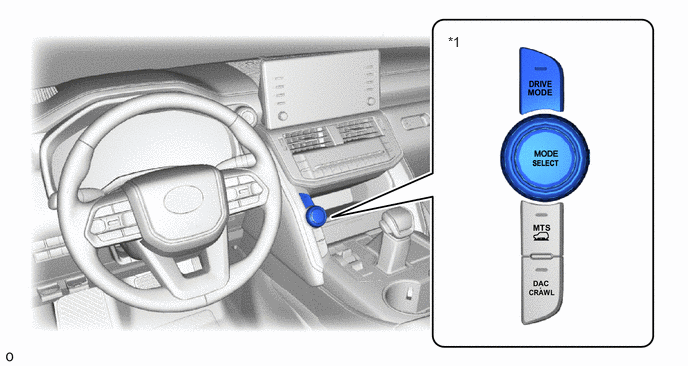
| *1 | Drive Mode Select | - | - |
Each drive mode of the drive mode select is provided with the following control characteristics:
| Drive Mode | Powertrain | Chassis | Air Conditioning | |
|---|---|---|---|---|
| Power Steering System | AVS | Air Conditioning System | ||
| NORMAL | NORMAL | NORMAL | NORMAL | NORMAL |
| ECO | ECO | NORMAL | NORMAL | ECO |
| COMFORT | NORMAL | NORMAL | COMFORT | NORMAL |
| SPORT S | POWER | NORMAL | NORMAL | NORMAL |
| SPORT S+ | POWER | SPORT | SPORT | NORMAL |
| Drive Mode | Powertrain | Chassis | Air Conditioning |
|---|---|---|---|
| Power Steering System | Air Conditioning System | ||
| NORMAL | NORMAL | NORMAL | NORMAL |
| ECO | ECO | NORMAL | ECO |
| SPORT | POWER | SPORT | NORMAL |
- HINT:
-
·
When L4 is selected while in transfer drive mode, drive mode select cannot be used.
·When 2nd start mode is selected, powertrain control performs control for 2nd start mode.
The control characteristics in each drive mode are as follows:
| Drive Mode | Control Characteristics |
|---|---|
| NORMAL | Performs control for normal driving. |
| ECO | Performs control for driving with improved fuel efficiency by generating torque more gently than NORMAL mode according to accelerator pedal depression while suppressing air conditioning cooling and heating operations. |
| COMFORT | Mainly uses the lower damping force range with the Adaptive Variable Suspension System (AVS) compared to NORMAL mode, performing control to achieve a comfortable ride. |
| SPORT S | Improves accelerator response by controlling the transmission and engine to perform control for driving that requires powerful acceleration. |
| SPORT S+ | Comprehensively controls the AVS and power steering system in addition to the transmission and engine control system of SPORT S mode to ensure maneuverability and stability to perform control for sporty driving. |
| Drive Mode | Control Characteristics |
|---|---|
| NORMAL | Performs control for normal driving. |
| ECO | Performs control for driving with improved fuel efficiency by generating torque more gently than NORMAL mode according to accelerator pedal depression while suppressing air conditioning cooling and heating operations. |
| SPORT | Performs control suitable for sporty driving by improving the acceleration response by controlling the transmission and engine and also improving the steering feeling. |
CUSTOM mode is provided. CUSTOM mode is a function where the control characteristics of each system can be freely selected and combined by the driver. Powertrain (NORMAL/ECO/POWER), chassis (NORMAL/SPORT/COMFORT) and air conditioning (NORMAL/ECO) combinations can be freely selected to support the specific needs of the driver. Refer to the Repair Manual for the details of the CUSTOM mode setting method.*
Control characteristics of each system when in CUSTOM mode are provided as follows:*
*: Models with AVS and navigation system
| Mode | Control Characteristics |
|---|---|
| Powertrain | |
| NORMAL | NORMAL |
| ECO | ECO |
| POWER | POWER |
| Mode | Control Characteristics | |
|---|---|---|
| AVS | Power Steering System | |
| NORMAL | NORMAL | NORMAL |
| COMFORT | COMFORT | NORMAL |
| SPORT | SPORT | SPORT |
| Mode | Control Characteristics |
|---|---|
| Air Conditioning System | |
| NORMAL | NORMAL |
| ECO | ECO |