SUSPENSION CONTROL ELECTRONIC-KINETIC DYNAMIC SUSPENSION SYSTEM DETAILS STABILIZER BAR
CONSTRUCTION
A lightweight hollow type stabilizer bar is used.
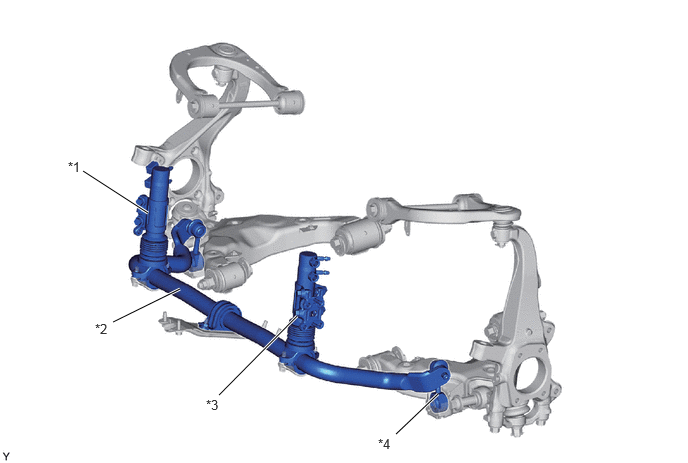
| *1 | Front Stabilizer Control Cylinder | *2 | Front Stabilizer Bar |
| *3 | Front Stabilizer Control Cylinder LH | *4 | Front Stabilizer Link Assembly |
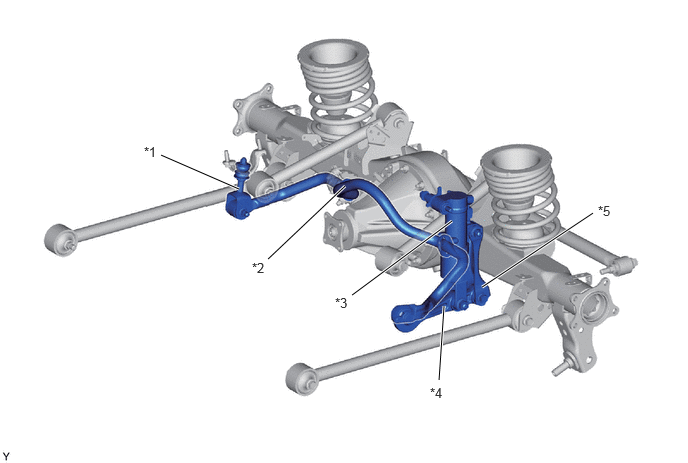
| *1 | Rear Stabilizer Link Assembly | *2 | Rear Stabilizer Bar |
| *3 | Rear Stabilizer Control Cylinder | *4 | Rear Stabilizer Control Arm Assembly |
| *5 | Rear No. 2 Stabilizer Control Arm | - | - |
OPERATION
Front
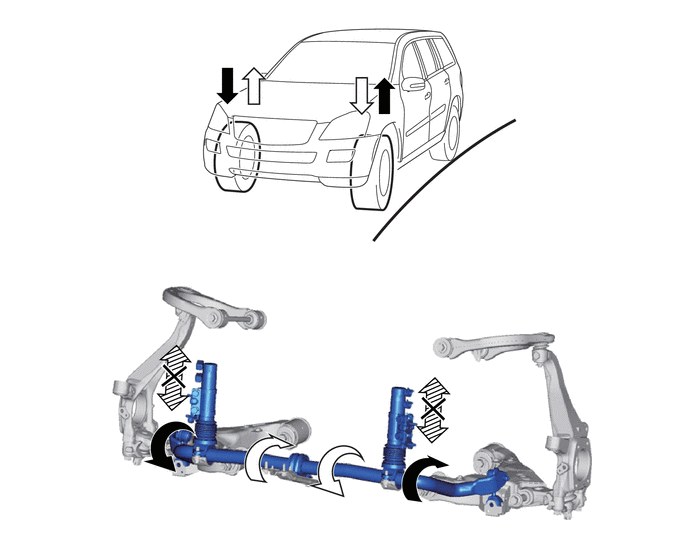
When the stabilizer is locked, the stabilizer bar is twisted by the locking of the expansion and contraction of the front cylinder connected to both sides. At this time, when twisting force due to rolling in operations such as turning is applied, the stabilizer bar generates force in the untwisting direction (stabilizer effect) to suppress vehicle body rolling.

|
Force Due to Rolling While Turning |

|
Untwisting Force Due to Stabilizer (Stabilizer Effect) |

|
Cylinder Movement | - | - |
When the stabilizer is free, the stabilizer bar moves with the center bush as a fulcrum due to the vertical expansion and contraction of the front cylinder connected to both sides. At this time, when one wheel is lifted up during off-road or other similar driving, a smooth suspension stroke is performed because twisting force is not applied to the stabilizer bar. This ensures the road contact performance of the tires.
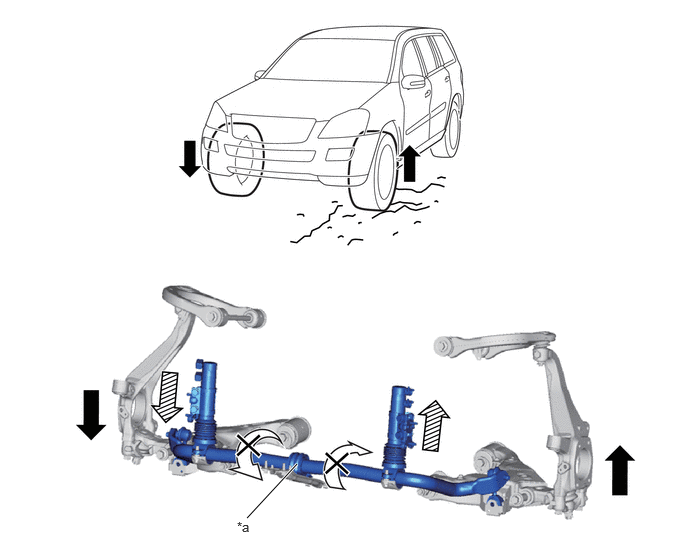
| *a | Center Bush Fulcrum | - | - |
|
|
Force Due to Lifting Up of One Wheel |
|
Untwisting Force Due to Stabilizer (Stabilizer Effect) |
|
|
Cylinder Movement | - | - |
Rear
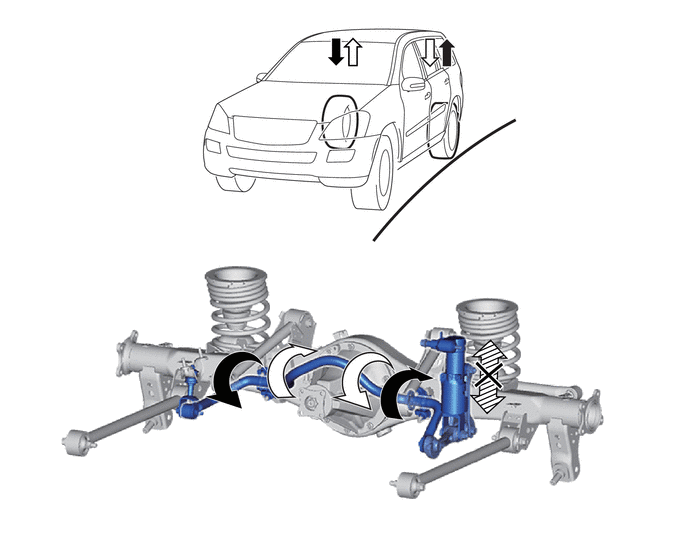
When the stabilizer is locked, the stabilizer bar is twisted by the locking of the expansion and contraction of the rear cylinder connected to the left side. At this time, when twisting force due to operations such as turning is applied, the stabilizer bar generates force in the untwisting direction (stabilizer effect) to suppress vehicle body rolling.
|
|
Force Due to Rolling While Turning |
|
Untwisting Force Due to Stabilizer (Stabilizer Effect) |
|
|
Cylinder Movement | - | - |
When the stabilizer is free, the stabilizer bar moves with the stabilizer control arm as a fulcrum due to the vertical expansion and contraction of the rear cylinder connected to the left side. At this time, when one wheel is lifted up during off-road or other similar driving, a smooth suspension stroke is performed because twisting force is not applied to the stabilizer bar. This ensures the road contact performance of the tires.
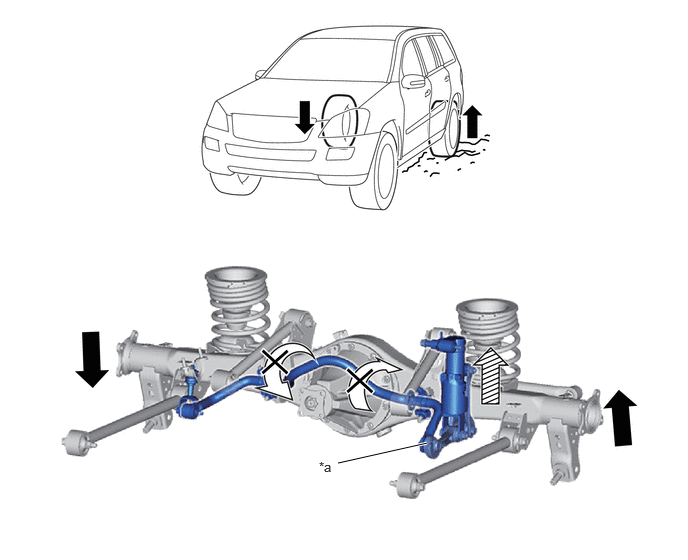
| *a | Stabilizer Control Arm Fulcrum | - | - |
|
|
Force Due to Lifting Up of One Wheel |
|
Untwisting Force Due to Stabilizer (Stabilizer Effect) |
|
|
Cylinder Movement | - | - |