BRAKE CONTROL / DYNAMIC CONTROL SYSTEMS BRAKE CONTROL SYSTEM GENERAL GENERAL
OUTLINE
The following brake control functions are provided: Multi-terrain Anti-lock Brake System (Multi-terrain ABS), Electronic Brake force Distribution (EBD), brake assist, Active Traction Control (A-TRC), Vehicle Stability Control (VSC), steering cooperative control*1, trailer sway control, hill-start assist control, downhill assist control*2, CRAWL with turn assist function*2 and brake hold.
*1: Models with steering actuator
*2: Models with DAC/CRAWL switch
Vehicle Dynamics Integrated Management (VDIM) is used.*
*: Models with steering actuator
An emergency brake signal system is used. This system reduces the danger of rear-end collisions by automatically flashing the hazard warning lights during emergency braking to warn vehicles to the rear.
A secondary collision brake system is used. This system lessens damage from a secondary collision by controlling the automatic brakes and stop light illumination after a collision occurs.*
*: Models with pre-collision system
Multi-terrain select is used. When the driver performs a switch operation to select an appropriate mode for the road conditions, vehicle control switches to the optimal control for the road conditions. As a result, optimal driving performance is maintained, achieving superior off-road driveability.*
*: Models with MTS Switch
MAIN FEATURES
Electronically Controlled Brake System
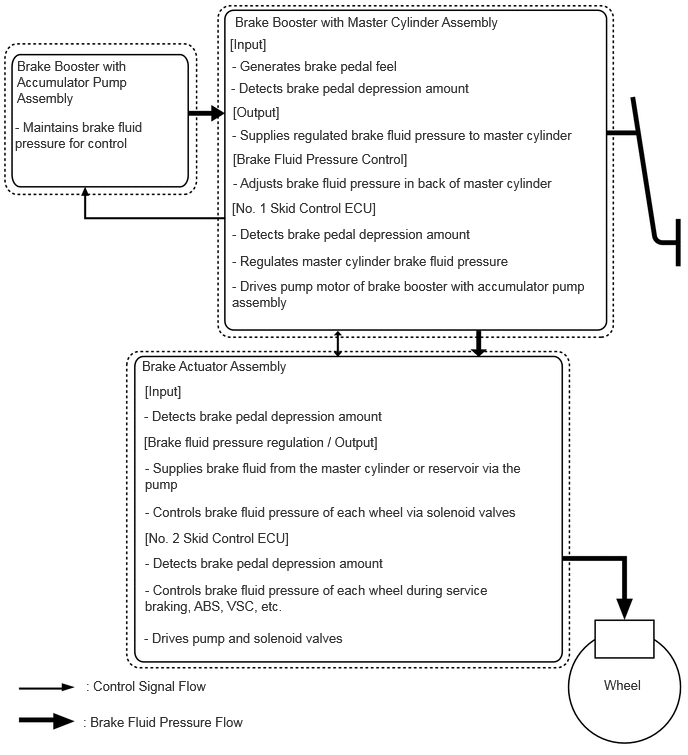
The electronically controlled brake system uses sensors to detect the amount of brake pedal depression. Based on this, the No. 1 skid control ECU (brake booster with master cylinder assembly) and No. 2 skid control ECU (brake actuator assembly) calculate the braking force and the brake booster with master cylinder assembly, brake booster with accumulator pump assembly and brake actuator assembly control the brake fluid pressure of the 4 wheels.
When the system is malfunctioning, brake control continues via the use of non-malfunctioning parts. Also, when the system is not operating, the brake fluid pressure generated in the brake master cylinder by the depression of the brake pedal works as a back-up mechanism to ensure braking force.
Vehicle Dynamics Integrated Management (VDIM)
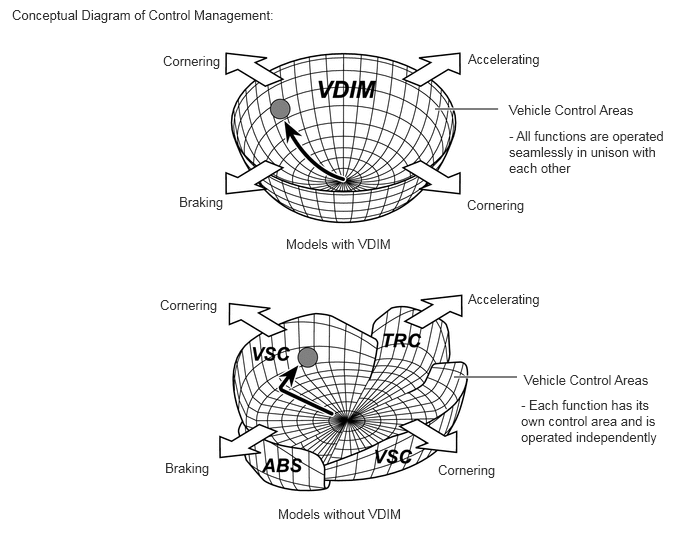
In contrast to the ABS, TRC and VSC functions that were controlled individually in the conventional brake control system, the VDIM manages these functions in the form of an integrated system.
Furthermore, the VDIM effects cooperative control together with the power steering system in order to improve the dynamic performance of the vehicle to "run, turn, and stop".
PRECAUTION
Multi-terrain ABS
The ABS system cannot increase the performance limit of the tires. Always drive safely and be aware of the vehicle speed and distance to other vehicles.
Any non-standard components such as non-standard tires that are installed may have a negative effect on the ABS function.
When braking using ABS, the braking distance may be longer than models without ABS in the following conditions:
When driving on a dirt road or a road covered with fresh snow
When using tire chains
When driving over a joint in the road surface
When driving on a rough road such as an unpaved or stone-paved road
Brake Assist
Brake assist cannot increase the performance limit of the fundamental brake system. Always drive safely and be aware of the vehicle speed and distance to other vehicles.
A-TRC, VSC
The A-TRC and VSC systems ensure traction and vehicle stability. Do not disable the A-TRC and VSC functions unless necessary.
The A-TRC and VSC systems cannot increase the performance limit of the tires. Always drive the vehicle carefully in conditions in which drive wheel traction or vehicle stability may be lost.
Trailer Sway Control
Trailer sway control is a part of the VSC function. Accordingly, if the VSC OFF mode or VSC is not functioning normally, trailer sway control will not operate.
Trailer sway control will be unable to stabilize the vehicle if a trailer is being towed which cannot be physically controlled due to the influence of the vehicle, road surface, driving conditions, etc.
Hill-start Assist Control
Hill-start assist control is not intended to keep the vehicle stationary on a hill for a prolonged period. As hill-start assist control only prevents the vehicle from rolling backwards for 2 seconds after the brake pedal is released, perform start-off within this period.
When hill-start assist control is operating and the power switch is turned off, hill-start assist control will be canceled without warning.
Hill-start assist control prevents the vehicle from rolling backwards by controlling the brake force to the 4 wheels. However, the vehicle may not remain stationary when on an extremely steep slope or a low friction surface such as ice.
Brake Hold
The brake hold is not for parking the vehicle for a long period of time in the same way as the parking brake.
If brake hold control does not operate even when the vehicle stops, depress the brake pedal again firmly to stop the vehicle. If the vehicle still does not stop, confirm the conditions for brake hold control to operate.
When the power switch is turned off during brake hold operation, control stops.
This function may not stop the vehicle on steep slopes and slippery roads.
Multi-terrain Select
Check that the multi-terrain select indicator light is illuminated before driving.
Multi-terrain select is not intended to expand the performance limits of the vehicle. Thoroughly check the road conditions and driving route in advance, and drive with caution.
The information about each mode that can be selected in multi-terrain select is for reference only. The mode may not be effective enough depending on the road conditions (pitch, road surface friction coefficient and undulations). Thoroughly check the road conditions before driving.
Multi-terrain select controls the vehicle so that the motive force is maximized to improve off-road driveability. Therefore, the fuel economy performance may not be as good as when driving without multi-terrain select.
Only use multi-terrain select during off-road driving.
Using multi-terrain select continuously for a long time and applying a high load to its related parts may prevent sufficiently effective operation. Also, when the brake temperature rises too much, the brake control of multi-terrain select stops temporarily, and the buzzer sounds continuously and TRC OFF is displayed on the multi-information display to inform the driver. In such cases, stop the vehicle immediately in a safe location and allow the brake related parts to cool sufficiently. When the temperature drops after waiting a while, the brake control of multi-terrain select becomes available for operation again.
When multi-terrain select operates, vibration may be felt from the vehicle body or steering wheel, or an operating sound may be heard from inside the engine room. This is not a malfunction.
Downhill Assist Control
Check that the downhill assist control indicator light is illuminated before driving.
While downhill assist control is operating, the slip indicator light blinks and the brake lights illuminate.
When driving down a steep hill that is likely to make downhill assist control operate, use the engine brake as well while driving downhill. This enables stable driving of the vehicle and reduces the load on the brake.
Using downhill assist control continuously for a long time and applying a high load to its related parts may prevent sufficiently effective operation. Also, when the brake temperature rises too much, downhill assist control stops temporarily, and the buzzer sounds continuously and the downhill assist control indicator light blinks to inform the driver. In such cases, stop the vehicle immediately in a safe location and allow the brake related parts to cool sufficiently. When the temperature drops after waiting a while, downhill assist control becomes available for operation again.
On extremely steep slopes and extremely slippery surfaces such as snow-covered roads, it may not be possible to maintain a set vehicle speed.
CRAWL with Turn Assist Function
CRAWL
Check that the CRAWL indicator light is illuminated before driving.
CRAWL is not intended to expand the performance limits of the vehicle. Thoroughly check the road conditions and driving route in advance, and drive with caution.
When CRAWL control ends for a reason other than a CRAWL switch operation, the CRAWL indicator changes from illuminated to blinking and the buzzer sounds intermittently. In such cases, take appropriate measures, such as stopping the vehicle.
Using CRAWL continuously for a long time and applying a high load to its related parts may prevent sufficiently effective operation. Also, when the brake temperature rises too much, CRAWL stops temporarily, and the buzzer sounds continuously and the CRAWL indicator light blinks and then turns off to inform the driver. In such cases, stop the vehicle immediately in a safe location and allow the brake related parts to cool sufficiently. When the temperature drops after waiting a while, CRAWL becomes available for operation again.
Using CRAWL continuously for long time may cause the oil temperature of the automatic transmission to rise too much. Continuing to drive under such conditions will cause an oil leak from the automatic transmission or a malfunction. In such cases, stop the vehicle immediately in a safe location and allow the automatic transmission to cool sufficiently.
On extremely steep slopes, very rough surfaces such as rocky roads, and extremely slippery surfaces such as snow-covered roads, it may not be possible to maintain a set vehicle speed.
Turn Assist Function
Check that the turn assist indicator light is illuminated before driving.
When the front differential and rear differential are locked, the turn assist function is canceled automatically, and the buzzer sounds intermittently and the turn assist indicator light turns off to inform the driver. In such cases, take appropriate measures, such as stopping the vehicle.
The turn assist function is for improving turning performance when driving off-road, such as on dirt roads. On road surfaces with a high surface friction coefficient, such as asphalt, control may not be sufficiently effective.
Variation in the effectiveness of the turn assist function may occur depending on the differential specifications.
The turn assist function is not intended to expand the performance limits of the vehicle. Thoroughly check the road conditions and driving route in advance, and drive with caution.
When the turn assist switch is operated immediately after disconnecting and reconnecting the battery, the turn assist indicator may blink and the turn assist function may stop. In this case, zero point calibration of the steering angle sensor (driving straight for a while at a vehicle speed of approximately 35 km/h or higher) is necessary. Refer to the Repair Manual for details.
Also, when the brake temperature rises too much, the turn assist function and CRAWL stop temporarily, and the buzzer sounds continuously and the CRAWL indicator light blinks and then turns off to inform the driver. In such cases, stop the vehicle immediately in a safe location and allow the brake related parts to cool sufficiently. In such cases, stop the vehicle immediately in a safe location and allow the brake related parts to cool sufficiently. When the temperature drops after waiting a while, CRAWL becomes available for operation again.
When the turn assist function operates, strong braking force is applied. Therefore, vibration may be felt from the vehicle body or steering wheel, or an operating sound may be heard from inside the engine room. This is not a malfunction. T urn Assist Switch