BRAKE CONTROL / DYNAMIC CONTROL SYSTEMS BRAKE CONTROL SYSTEM CONTROL CRAWL
SYSTEM CONTROL
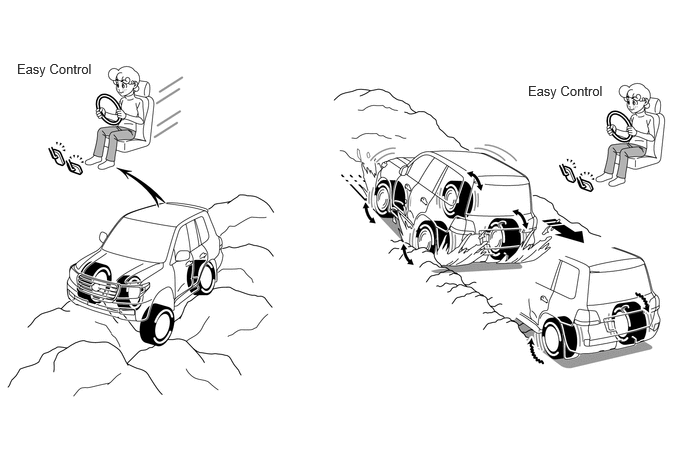
CRAWL is a drive assist system that controls the engine output and brake fluid pressure automatically when driving off-road or on slippery roads to maintain a set low vehicle speed without the driver needing to operate the accelerator or brake.
5 levels are provided for the target vehicle speeds of CRAWL, and the recommended speeds are as follows.
| Recommended Speeds | Road Conditions |
|---|---|
| Lo | Rock, Mogul (Downhill), Loose rock (Downhill) |
| Lo - Mid | Rock, Mogul (Downhill), Loose rock (Downhill), Mogul (Uphill) |
| Mid | Mogul (Uphill) |
| Mid - Hi | Mogul (Uphill), Snow, Mud, Loose rock (Uphill), Sand, Gravel/Dirt, Mogul (Uphill), Grass |
| Hi | Snow, Mud, Loose rock (Uphill), Sand, Gravel/Dirt, Mogul (Uphill), Grass |
- HINT:
-
The recommended speeds are for reference. They may not be optimal depending on the road conditions (pitch, road surface friction and undulations).
CRAWL Effects
The driver can concentrate on steering operations when driving on road surfaces that require advanced acceleration and brake operations, such as off-road driving on very rough surfaces.
Since control is performed to maximize the suppression of wheel spin and wheel lock, superior vehicle stability is ensured when driving on slippery roads, steep gradients and similar surfaces.
CRAWL Control Description
The No. 2 skid control ECU calculates the target vehicle speed for controlling the vehicle speed, and the target wheel speed for controlling wheel slip, based on the information from the various sensors and switches.
When the vehicle body speed is higher than the target vehicle speed, the engine output is reduced. When the wheel speed is higher than the target wheel speed, control is performed by raising the brake fluid pressure of the corresponding wheel.
When the vehicle body speed is lower than the target vehicle speed, the engine output is increased. When the wheel speed is lower than the target wheel speed, control is performed by reducing the brake fluid pressure of the corresponding wheel.
CRAWL Operation Conditions
When the CRAWL ON/OFF switch is turned on while all of the following conditions have been met, the CRAWL indicator light illuminates, the slip indicator light blinks and CRAWL starts.
|
·
Shift position is not in P or N
·
Transfer is in L4 position
·
Parking brake is released
·
Driver door is closed
·
ATF temperature is not abnormal
·
Brake actuator temperature is not abnormal
·
VSC system is not malfunctioning |
CRAWL Temporary Stop Conditions
When the vehicle speed exceeds approximately 25 km/h* while CRAWL is operating, CRAWL stops temporarily and the CRAWL indicator light blinks. In this case, CRAWL restarts when the vehicle speed drops below approximately 25 km/h*.
*: When the front differential is locked (models with front differential lock) or the rear differential is locked (models with rear differential lock), the vehicle speed will be approximately 10 km/h.
CRAWL Ending Conditions (Brake/Engine Control)
When any of the following conditions is met, the buzzer sounds, the CRAWL indicator light blinks and CRAWL ends. When control ends due to a DAC/CRAWL switch operation, the buzzer does not sound and the CRAWL indicator light turns off.
|
·
Turned off with DAC/CRAWL switch
·
Shift position is in P or N
·
Transfer is in H4 position
·
Parking brake is locked
·
Driver door is open
·
ATF temperature rises
·
Brake actuator temperature rises
·
VSC system is malfunctioning (take appropriate measures, such as stopping the vehicle)
·
No. 1 and No. 2 Skid control ECU determines that driving is difficult |
- HINT:
-
When turning CRAWL off with the DAC/CRAWL switch, perform the operation while the indicator of the DAC/CRAWL switch is illuminated.
FUNCTION
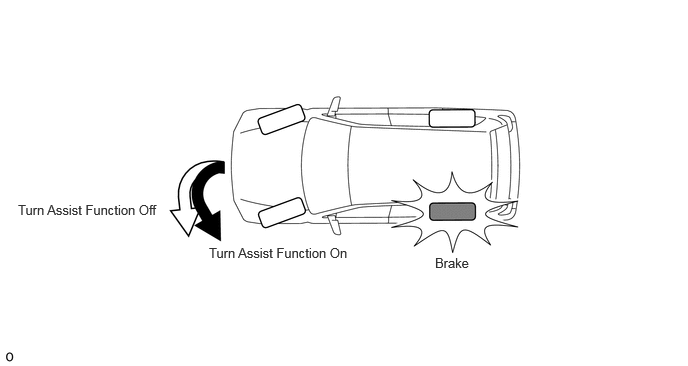
When driving through tight corners where travel is difficult without repeated turning operations, the turn assist function can be used for control that improves turning performance according to the driver's steering while maintaining a set low vehicle speed with CRAWL control. This reduces the number of repeated turning operations that the driver needs to perform.
Turn Assist Function Operation Conditions
The turn assist function operates when all of the following conditions have been met. When the turn assist function is available for operation, the turn assist indicator light illuminates.
|
·
CRAWL control is operating
·
Turn assist switch is on
·
Front differential is free*1
·
Rear differential is free*2
·
Driving at a low vehicle speed (10 km/h or less)
·
Brake pedal is off
·
Shift position is not in P, R or N (temporary stop condition when shift position is in P, R or N)
·
Large steering wheel operation angle |
Turn Assist Function Control Description
The turning intention of the driver is determined from the steering angle sensor signals and control is performed to raise the brake fluid pressure of the rear wheel on the inner side of the turn.
Control is performed so that when the rear wheel on the inner side of the turn locks (wheel speed is 0 km/h), the brake fluid pressure is maintained; when the wheel locked condition continues for a predetermined time, the brake fluid pressure is reduced; and when the wheel starts moving, the brake fluid pressure is increased until the wheel locks again.