EXTERIOR PANELS / TRIM BODY STRUCTURE DETAILS SOUND ABSORBING AND VIBRATION DAMPING MATERIAL
CONSTRUCTION
Sound Absorption and Insulation Structure
Various types of silencers are positioned around the floor panel and engine compartment to greatly suppress vibration and noise that are transmitted into the interior from parts such as the engine and tires, achieving superior quietness. Also, materials such as foamed materials, sound insulation sealant and damping materials are optimally positioned to achieve superior NVH* performance.
- HINT:
-
*: An abbreviation created by taking the first letter of Noise (unpleasant sounds and loud sounds), Vibration (vibrations from the engine and tires) and Harshness (vibrations felt through the steering wheel, seats and floor according to height changes in the road surface, etc.). NVH is used to describe the level of riding comfort and sound quality actually experienced by passengers.
Floor Silencer
The floor silencer (applied damping materials) optimal thickness varies by the area, is lightweight and provides excellent quietness. These characteristics allow the floor silencer to reduce road and engine noise which enters the cabin.
In what put out for coating of the thickness of the damping materials, I planned improvement of the silent nature and coexistence of the mass reduction.
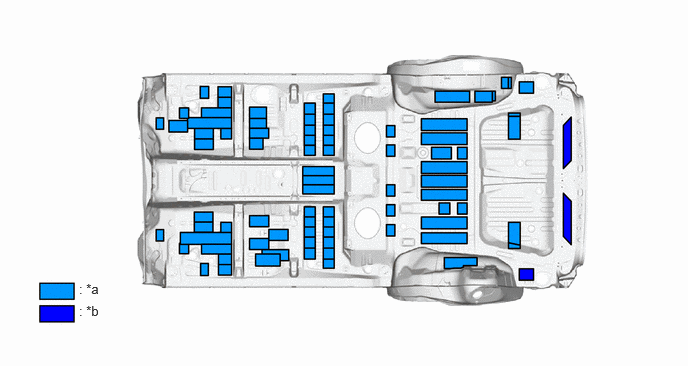
| *a | Dry Surface Density: 1.9 (kg/m2) | *b | Dry Surface Density: 3.8 (kg/m2) |
Sound Absorption Material
Sound absorption materials (foamed and solid foamed materials) are optimally positioned in the cabin frameworks, reducing the amount of wind and road noise that enter the vehicle.
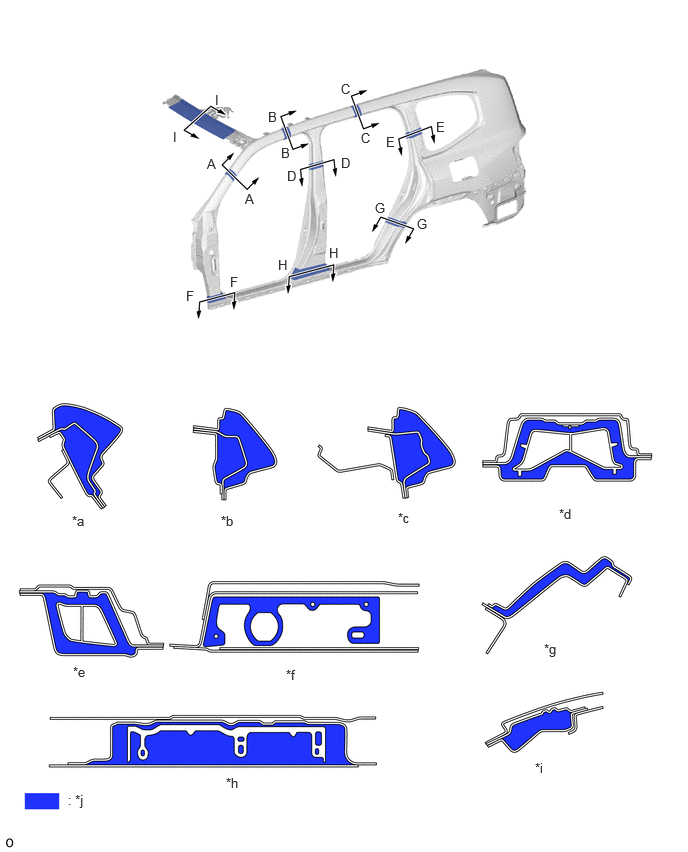
| *a | A - A Cross Section | *b | B - B Cross Section |
| *c | C - C Cross Section | *d | D - D Cross Section |
| *e | E - E Cross Section | *f | F - F Cross Section |
| *g | G - G Cross Section | *h | H - H Cross Section |
| *i | I - I Cross Section | *j | Sound Absorption Material |
Sound Absorption and Insulation Structure around Engine Compartment
A hood insulator is provided on the rear of the hood sub-assembly. This achieves excellent sound insulation performance.
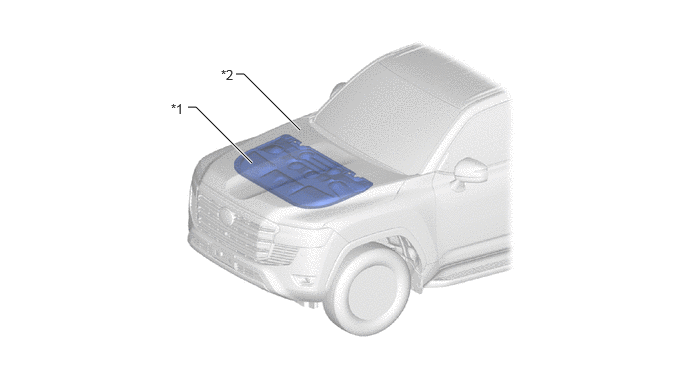
| *1 | Hood Insulator | *2 | Hood Sub-assembly |
A front side air guide is used in the front fender to reduce the noise which travels through the fender toward the cabin.
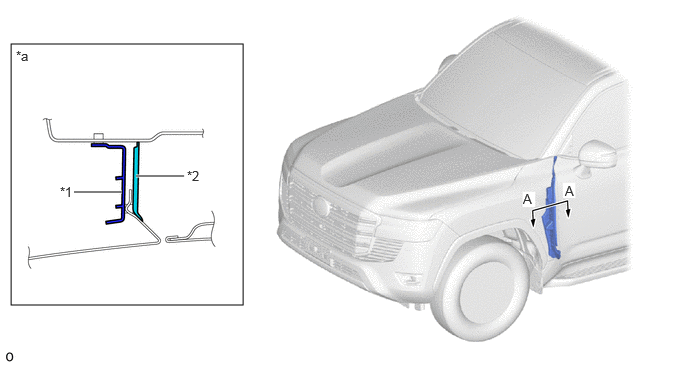
| *1 | Front Fender Side Panel Pritector | *2 | NO. 2 Front Side Panel Protector |
| *a | A - A Cross Section | - | - |
The dash panel insulator assembly uses a 3-layered construction that reduces the opening ratio* and ensures thickness to ensure superior sound absorption and insulation performance.
- HINT:
-
*: Opening area ratio for the entire area of the insulator
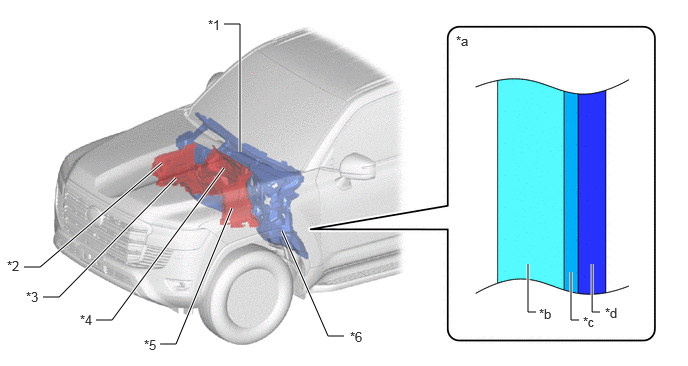
| *1 | Dash Panel Insulator Cover | *2 | Engine Side Under Cover Assembly LH |
| *3 | Engine Side Under Cover Assembly Rear RH | *4 | Dash Panel Insulator Outer |
| *5 | Engine Side Under Cover Assembly Rear LH | *6 | Dash Panel Silencer Assembly |
| *a | Material Structure | *b | Felt |
| *c | Olefin Sheet | *d | Felt |
An insulator with superior sound absorption effects (sound insulation material) is used around the fender splash shield sub-assembly front and rear wheel house liner to suppress the sound created by flying sand and water from the wheelhouse and road noise in order to provide excellent quietness.
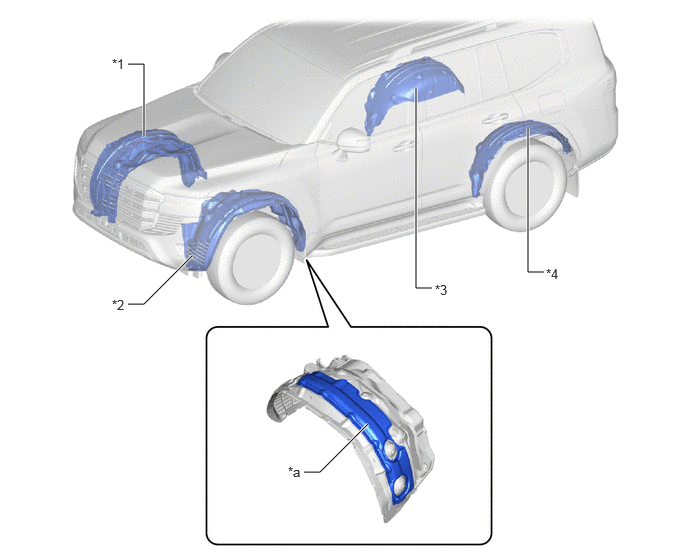
| *1 | Fender Splash Shield Sub-assembly Front RH | *2 | Fender Splash Shield Sub-assembly Front LH |
| *3 | Rear Wheel House Liner RH | *4 | Rear Wheel House Liner LH |
| *a | Insulator | - | - |
Windshield Glass and Front Door Glass
An acoustic layer laminated glass* is used for the windshield glass sub-assembly and Front Door Glass, reducing noise that enters from the outside to the cabin.
- HINT:
-
*: Glass including a high level of sound proofing interlayer with a laminated glass structure (Glass - Interlayer - Glass)
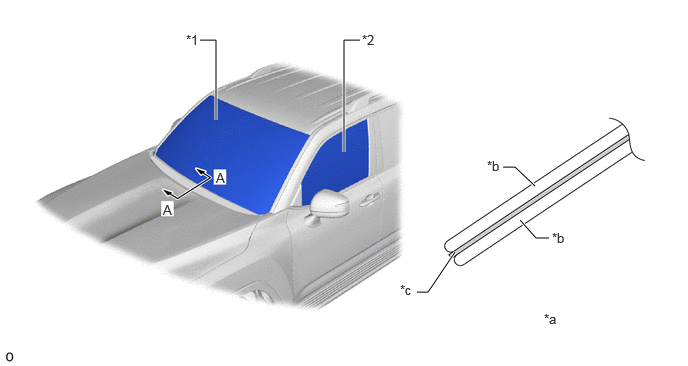
| *1 | Windshield Glass Sub-assembly | *2 | Front Door Glass |
| *a | A - A Cross Section | *b | Glass |
| *c | Interlayer Film (Acoustic Layer) | - | - |
A one-sided adhesive molding is used to reduce the level difference of the windshield glass and suppress the generation of wind noise.
The shape of the rain gutter molding step and front body pillar has been optimized to achieve both runback and wind noise suppression.
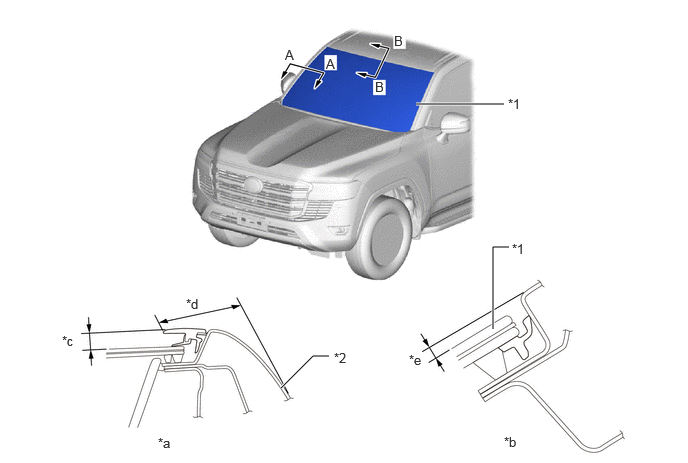
| *1 | Windshield Glass Sub-assembly | *2 | Front Body Pillar |
| *a | A - A Cross Section | *b | B - B Cross Section |
| *c | Rain Gutter Mall Steps | *d | Front Body Pillar Width |
| *e | Lower Steps | - | - |
Door
A polypropylene resin service hole cover is used, reducing noise that enters from the outside to the cabin through the doors.
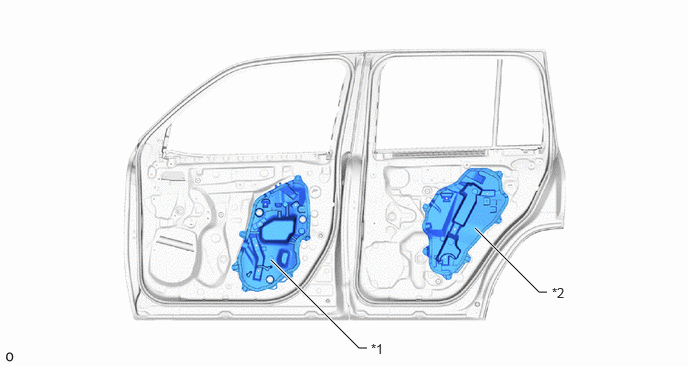
| *1 | Front Door Service Hole Cover | *2 | Rear Door Service Hole Cover |
A polypropylene resin service hole cover is used, reducing noise that enters from the outside to the cabin through the doors.
Weatherstrips (front door opening trim weatherstrip, rear door opening weatherstrip, front door weatherstrip No. 2 and rear door weatherstrip No. 5) are used around the entire circumferences of the doors, reducing noise that enters from the outside to the cabin through the doors.
Polyester is used as a flocked material for the inner weatherstrips (front door glass weatherstrip inner and rear door glass weatherstrip inner) to suppress noise, achieving a high level of sound insulation performance.
Resin corner pieces (front door belt seal front, front door belt seal rear, rear door belt seal front and rear door belt seal rear) are used at the front and rear of the belt line to fill the clearance, ensuring a high level of sound insulation performance.
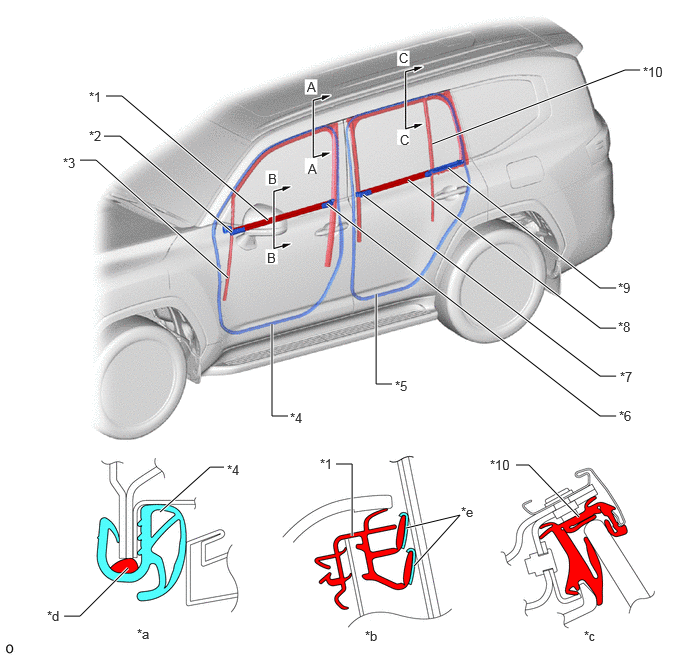
| *1 | Front Door Glass Weatherstrip Inner | *2 | Front Door Belt Seal Front |
| *3 | Front Door Glass Run | *4 | Front Door Opening Trim Weatherstrip |
| *5 | Rear Door Opening Trim Weatherstrip | *6 | Front Door Belt Seal Rear |
| *7 | Rear Door Belt Seal Front | *8 | Rear Door Glass Weatherstrip Inner |
| *9 | Rear Door Belt Seal Rear | *10 | Rear Door Glass Run |
| *a | A - A Cross Section | *b | B - B Cross Section |
| *c | C - C Cross Section | *d | Sponge |
| *e | Flocked Material | - | - |