F33A-FTV INTAKE / EXHAUST RADIATOR ON-VEHICLE INSPECTION
CAUTION / NOTICE / HINT
- CAUTION:
-
To avoid the danger of being burned, do not remove the reserve tank cap (for Intercooler) while the coolant (for Intercooler) is still hot. Thermal expansion will cause hot coolant and steam to blow out from the intercooler reserve tank.
PROCEDURE

 16475A 1.INSPECT RESERVE TANK CAP (for Intercooler)
Measure the valve opening pressure.
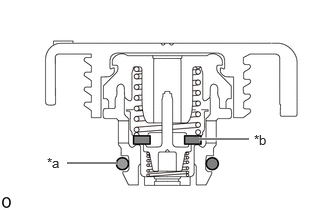
| *a | O-ring |
| *b | Rubber Packing |
If there are water stains or foreign matter on the O-ring, clean it with water and finger scouring.
- NOTICE:
-
Always perform procedure by hand so as not to damage the O-ring.
Check that the O-ring is not deformed, cracked or swollen.
Apply engine coolant to the O-ring and rubber packing before using a radiator cap tester.
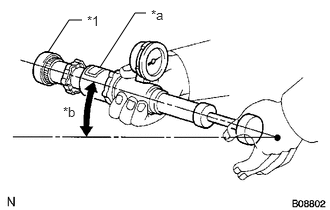
| *1 | Reserve Tank Cap (for Intercooler) |
| *a | Radiator Cap Tester |
| *b | 30° or more |
When using the radiator cap tester, tilt it more than 30° degrees.
Pump the radiator cap tester several times and check the maximum pressure*.
- Pump speed:
-
1 pump per second
*: Even if the cap cannot maintain the maximum pressure, it is not a defect.
- Standard Judgment Criterion:
-
Item Specified Condition Standard value
(for brand-new cap)93 to 123 kPa (1.0 to 1.3 kgf/cm2, 13.5 to 18 psi) Minimum standard value
(for used cap)79 kPa (0.8 kgf/cm2, 11.4 psi)
If the maximum pressure is less than the minimum standard value, replace the reserve tank cap (for Intercooler).