1HZ FUEL FUEL INJECTION NOZZLE INSPECTION
PROCEDURE

 1. INJECTION PRESSURE TEST
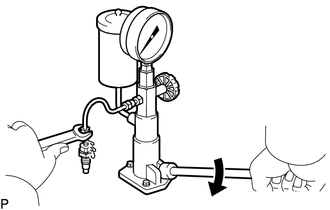
Install the injection nozzle to the injection nozzle hand tester and bleed air from the union nut.
- CAUTION:
-
Do not place your finger over the nozzle injection hole.
Pump the tester handle a few times as fast as possible to discharge the carbon from the injection hole.
Pump the tester handle slowly and observe the pressure gauge.
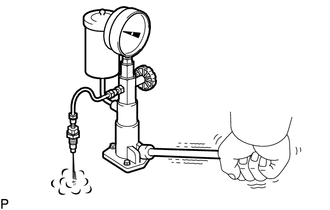
Read the pressure gauge just as the injection pressure begins to drop.
- Opening pressure:
-
14220 to 15200 kPa (145.0 to 155.0 kgf/cm2, 2062 to 2204 psi)
- HINT:
-
Proper nozzle operation can be determined by a swishing sound.
-
If the opening pressure is not as specified, disassemble the nozzle holder and change the adjusting shim on the top of the pressure spring.
- Adjusting Shim Thickness:
-
Specified Condition 0.900 mm (0.0354 in.) 1.275 mm (0.0502 in.) 1.650 mm (0.0650 in.) 0.925 mm (0.0364 in.) 1.300 mm (0.0512 in.) 1.675 mm (0.0659 in.) 0.950 mm (0.0374 in.) 1.325 mm (0.0522 in.) 1.700 mm (0.0669 in.) 0.975 mm (0.0384 in.) 1.350 mm (0.0531 in.) 1.725 mm (0.0679 in.) 1.000 mm (0.0394 in.) 1.375 mm (0.0541 in.) 1.750 mm (0.0689 in.) 1.025 mm (0.0404 in.) 1.400 mm (0.0551 in.) 1.775 mm (0.0699 in.) 1.050 mm (0.0413 in.) 1.425 mm (0.0561 in.) 1.800 mm (0.0709 in.) 1.075 mm (0.0423 in.) 1.450 mm (0.0571 in.) 1.825 mm (0.0719 in.) 1.100 mm (0.0433 in.) 1.475 mm (0.0581 in.) 1.850 mm (0.0728 in.) 1.125 mm (0.0443 in.) 1.500 mm (0.0591 in.) 1.875 mm (0.0738 in.) 1.150 mm (0.0453 in.) 1.525 mm (0.0600 in.) 1.900 mm (0.0748 in.) 1.175 mm (0.0463 in.) 1.550 mm (0.0610 in.) 1.925 mm (0.0758 in.) 1.200 mm (0.0472 in.) 1.575 mm (0.0620 in.) 1.950 mm (0.0768 in.) 1.225 mm (0.0482 in.) 1.600 mm (0.0630 in.) - 1.250 mm (0.0492 in.) 1.625 mm (0.0640 in.) -
- HINT:
-
·
Varying the adjusting shim thickness by 0.025 mm (0.0010 in.) changes the injection pressure by about 476 kPa (4.9 kgf/cm2, 69 psi).
·Only 1 adjusting shim should be used.
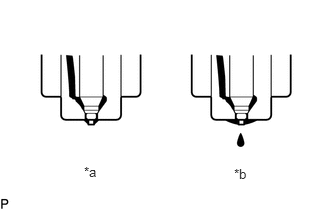
| *a | Good |
| *b | Faulty |
These should be no dripping after injection.
2. LEAKAGE TEST
While maintaining pressure at about 981 to 1961 kPa (10 to 20 kgf/cm2, 142 to 284 psi) below opening pressure (adjust by tester handle), check that there is no dripping for 10 seconds from the injection hole or around the retaining nut.
If the nozzle drips within 10 seconds, replace or clean and overhaul the nozzle assembly.
3. SPRAY PATTERN TEST
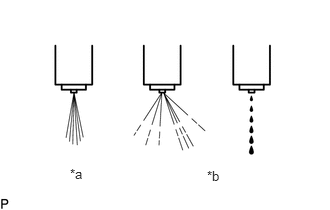
| *a | Good |
| *b | Faulty |
The injection nozzle should shudder at a certain pumping speed between 15 to 60 times (old nozzle) or 30 to 60 times (new nozzle) per minute.
Check the spray pattern during shuddering.
If the spray pattern is not correct during shuddering, the nozzle must be replaced or cleaned.
4.CLEAN NOZZLE ASSEMBLY
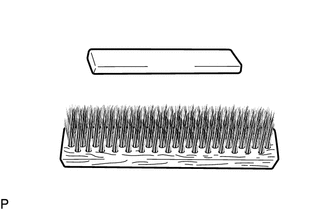
To wash the nozzles, use a wooden stick and brass brush. Wash them in clean diesel fuel.
- NOTICE:
-
Do not touch the nozzle mating surfaces with your fingers.
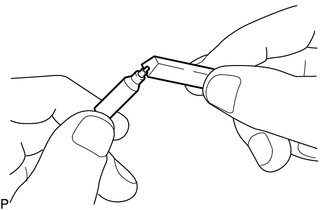
Using a wooden stick, remove the carbon adhering to the nozzle needle tip.
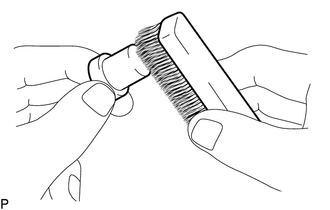
Using a brass brush, remove the carbon from the exterior of the nozzle body (except lapped surface).
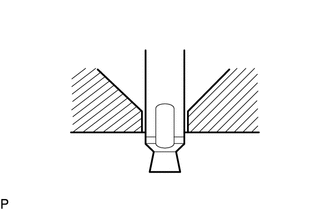
Check the seat of the nozzle body for burns or corrosion.
Check the nozzle needle tip for damage or corrosion.
If any of these conditions are present, replace the nozzle assembly.
23620 5.INSPECT NOZZLE ASSEMBLY
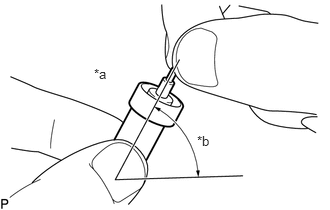
| *a | One third of its length |
| *b | About 60° |
Wash the nozzle in clean diesel fuel.
- NOTICE:
-
Do not touch the nozzle mating surfaces with your fingers.
Tilt the nozzle body about 60° and pull the needle out about one third of its length.
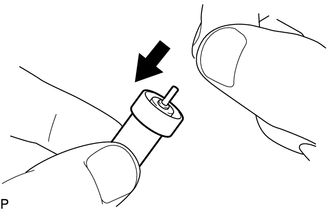
When released, the needle should sink down into the body vent smoothly by its 1 weight.
Repeat this test, rotating the needle slightly each time.
If the needle does not sink freely, replace the nozzle assembly.