BRAKE SYSTEM (OTHER) BRAKE FLUID(w/ VSC) BLEEDING
CAUTION / NOTICE / HINT
- HINT:
-
If any work is performed on the brake system or if air in the brake lines is suspected, bleed air from the brake system.
- NOTICE:
-
·
for Manual Transmission:
Move the shift lever to neutral and apply the parking brake before bleeding the brakes.
·for Automatic Transmission:
Move the shift lever to P and apply the parking brake before bleeding the brakes.
·Add brake fluid to keep the level between the MIN and MAX lines of the reservoir while bleeding the brakes.
·If brake fluid leaks onto any painted surface, immediately wash it off.
·When bleeding air, select the suitable procedure listed below.
Replaced/Installed Item Work procedure Flexible hose (front/rear) Bleed brake line Front disc brake cylinder assembly Rear disc brake cylinder assembly Brake actuator assembly Bleed brake system Brake master cylinder sub-assembly Brake master cylinder reservoir assembly Brake booster assembly
PROCEDURE

 1.BLEED BRAKE LINE
Remove the brake master cylinder reservoir filler cap assembly.
Add brake fluid to keep the level between the MIN and MAX lines of the reservoir while bleeding the brakes.
- Brake Fluid:
-
SAE J1703 or FMVSS No. 116 DOT 3
- NOTICE:
-
Do not remove the filter from the brake master cylinder reservoir and sure to fill with new brake fluid to avoid any potential contamination of the brake system. Contamination, for example by dirt particles or mineral oil, could lead to functional brake problems.
Loosen the bleeder plug of the front disc brake cylinder RH.
Repeatedly depress the brake pedal and bleed the air from the bleeder plug of the front disc brake cylinder RH.
- NOTICE:
-
Add fluid as necessary so that the fluid in the reservoir does not decrease below the MIN level.
After air is completely bled out, tighten the bleeder plug while depressing the brake pedal.
- Torque:
- 11 N*m (112 kgf*cm, 8 ft.*lbf)
Bleed the air from the bleeder plug of the front disc brake cylinder LH using the same procedure as for the RH side.
Loosen the bleeder plug of the rear disc brake cylinder RH.
Repeatedly depress the brake pedal and bleed the air from the bleeder plug of the rear disc brake cylinder RH.
- NOTICE:
-
Add fluid as necessary so that the fluid in the reservoir does not decrease below the MIN level.
After air is completely bled out, tighten the bleeder plug while depressing the brake pedal.
- Torque:
- 11 N*m (112 kgf*cm, 8 ft.*lbf)
Bleed the air from the bleeder plug of the rear disc brake cylinder LH using the same procedure as for the RH side.
Inspect for brake fluid leaks.
Inspect brake fluid level in reservoir.
Click hereBrake>BRAKE SYSTEM (OTHER)>BRAKE FLUID (w/ VSC)>ON-VEHICLE INSPECTION
Check and clear the DTCs.
2.BLEED BRAKE SYSTEM
- CAUTION:
-
If air is bled without using the GTS, damage or accidents may result. Therefore, always use the GTS when bleeding air.
- NOTICE:
-
Be sure to clean your hands before bleeding from the master cylinder to avoid any potential contamination of the brake system. Contamination, for example by dirt particles or mineral oil, could lead to functional brake problems.
Remove the brake master cylinder reservoir filler cap assembly.
Add brake fluid to keep the level between the MIN and MAX lines of the reservoir while bleeding the brakes.
- Brake Fluid:
-
SAE J1703 or FMVSS No. 116 DOT3
- NOTICE:
-
Do not remove the filter from the brake master cylinder reservoir and be sure to fill with new brake fluid to avoid any potential contamination of the brake system. Contamination, for example by dirt particles or mineral oil, could lead to functional brake problems.
Using a union nut wrench, disconnect the 2 brake lines from the brake master cylinder.
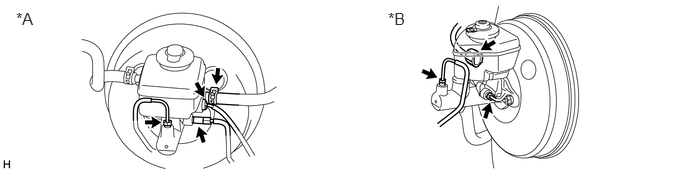
| *A | for LHD | *B | for RHD |
- NOTICE:
-
·
Do not kink or damage the brake lines.
·Do not allow any foreign matter such as dirt or dust to enter the brake lines from the connecting parts.
Slowly depress and hold the brake pedal.*1
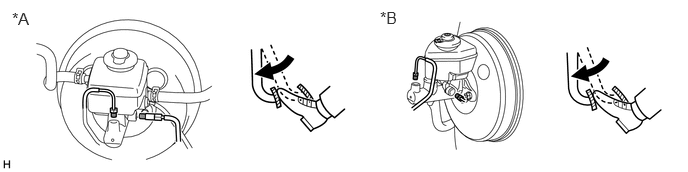
| *A | for LHD | *B | for RHD |
Block the outer holes with your fingers, and release the pedal.*2
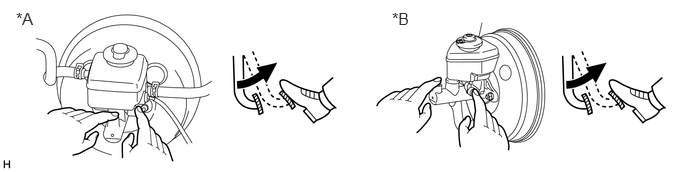
| *A | for LHD | *B | for RHD |
Repeat steps *1 and *2, 3 or 4 times.
Using a union nut wrench, connect the 2 brake lines to the brake master cylinder.
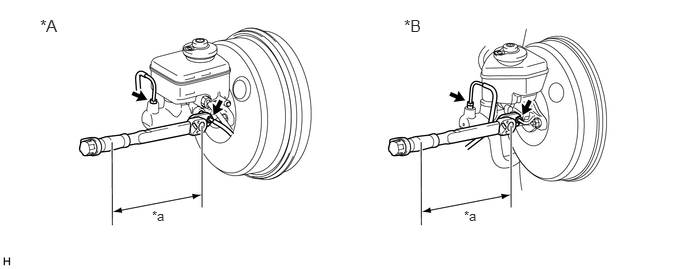
| *A | for LHD | *B | for RHD |
| *a | Torque Wrench Fulcrum Length | - | - |
- Torque:
- Specified tightening torque : 19.5 N*m (199 kgf*cm, 14 ft.*lbf)
- HINT:
-
·
Calculate the torque wrench reading when changing the fulcrum length of the torque wrench.
Click hereGeneral>INTRODUCTION>REPAIR INSTRUCTION>PRECAUTION
·When using a union nut wrench (fulcrum length of 20 mm (0.787 in.)) + torque wrench (fulcrum length of 162 mm (6.378 in.)): 17.4 N*m (177 kgf*cm, 13 ft.*lbf)
Loosen the bleeder plug of the front disc brake cylinder assembly RH.
Repeatedly depress the brake pedal and bleed the air from the bleeder plug of the front disc brake cylinder assembly RH.
- NOTICE:
-
Add fluid as necessary so that the fluid in the reservoir does not decrease below the MIN level.
After air is completely bled out, tighten the bleeder plug while depressing the brake pedal.
- Torque:
- 11 N*m (112 kgf*cm, 8 ft.*lbf)
Bleed the air from the bleeder plug of the front disc brake cylinder LH using the same procedure as for the RH side.
Loosen the bleeder plug of the rear disc brake cylinder RH.
Repeatedly depress the brake pedal and bleed the air from the bleeder plug of the rear disc brake cylinder RH.
- NOTICE:
-
Add fluid as necessary so that the fluid in the reservoir does not decrease below the MIN level.
After air is completely bled out, tighten the bleeder plug while depressing the brake pedal.
- Torque:
- 11 N*m (112 kgf*cm, 8 ft.*lbf)
Bleed the air from the bleeder plug of the rear disc brake cylinder LH using the same procedure as for the RH side.
Depress the brake pedal more than 20 times with the engine off.
Connect the GTS to the DLC3, and turn the ignition switch to ON.
- NOTICE:
-
Do not start the engine.
w/ Pre-collision System:
Enter the following menus: Chassis / Brake / Utility / Air Bleeding.
- Chassis > Brake > Utility
-
Tester Display Air Bleeding - 50005 435 6114
w/o Pre-collision System:
Enter the following menus: Chassis / ABS/VSC/TRC / Utility / Air Bleeding.
- Chassis > ABS/VSC/TRC > Utility
-
Tester Display Air Bleeding - 50005 105 125
Bleed the brake system following the instructions on the GTS.
After air bleeding, tighten each bleeder plug.
- Torque:
- 11 N*m (112 kgf*cm, 8 ft.*lbf)
Turn the GTS off and turn the ignition switch off.
Disconnect the GTS from the DLC3.
Check for brake fluid leaks.
Check the fluid level in the reservoir.
Click hereBrake>BRAKE SYSTEM (OTHER)>BRAKE FLUID (w/ VSC)>ON-VEHICLE INSPECTION
Check and clear DTCs.