NETWORKING CAN COMMUNICATION SYSTEM(w/ Pre-collision System) SYSTEM DESCRIPTION
BRIEF DESCRIPTION
The Controller Area Network (CAN) is a serial data communication system for real time application. It is a vehicle multiplex communication system which has a high communication speed and the ability to detect malfunctions.
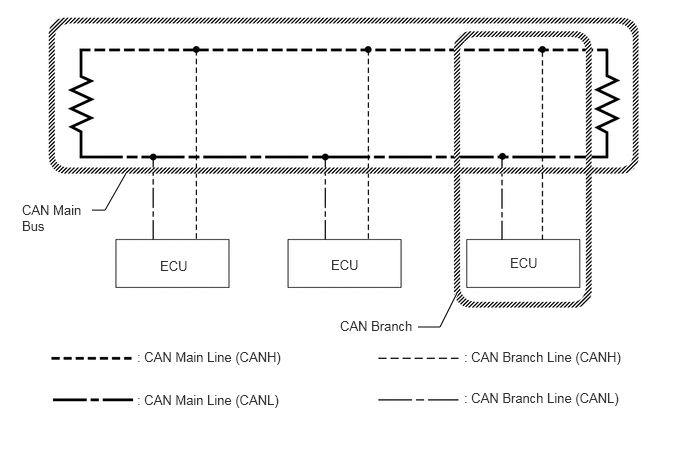
Using the CANH and CANL bus wires as a pair, CAN communication is performed using a voltage differential. (A base voltage is applied to the pair of wires and a voltage differential is created when communicating.)
Many ECUs or sensors installed on the vehicle operate by sharing information and communicating with each other.
The CAN has two resistors of 120 Ω which are necessary to enable communication.
DEFINITION OF TERMS
CAN main wire
The CAN main wire is a wire harness between the 2 termination circuits on the bus (communication wire). This is the main bus in the CAN communication system.
CAN branch wire
The CAN branch wire is a wire harness which diverges from the main wire to an ECU or sensor.
Termination circuits
Two resistors of 120 Ω are installed in parallel across the ends of the CAN main bus wires. They are called terminating resistors. These resistors allow the changes of the voltage differential between the CAN bus wires to be accurately judged. To allow proper function of CAN communication, it is necessary to have both terminating resistors installed. Since the two resistors are installed in parallel, this results in a measurement of approximately 60 Ω.