ADVANCED DRIVER ASSISTANCE SYSTEM ADAPTIVE HIGH BEAM SYSTEM GENERAL GENERAL
OUTLINE
Adaptive High Beam System (AHS)
By using the forward recognition camera to detect the lights of preceding and oncoming vehicles and subsequently optimizing the illumination area of the headlights accordingly, visibility is enhanced and the demands on the driver is reduced as they do not need to constantly switch between high beam and low beam.
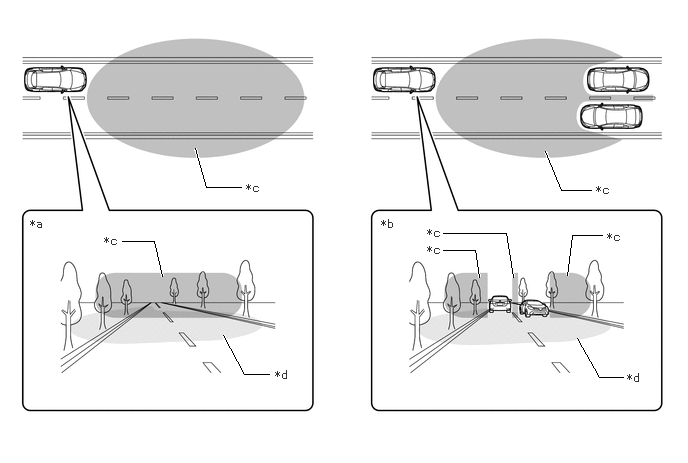
| *a | Adaptive High Beam System OFF | *b | Adaptive High Beam System ON |
| *c | Area Illuminated by High Beams | *d | Area Illuminated by Low Beams |
PRECAUTION
High beam/low beam switching operation
Turn the adaptive high beam switch off. The vehicle switches to low beams based on the dimmer switch position (low). To switch to high beams, move the dimmer switch to the high position.
To switch from low beams or variable shade beams to high beams when the adaptive high beam system is operating, move the dimmer switch to the high position.
Surrounding light conditions for adaptive high beam system operation
The adaptive high beam system uses the forward recognition camera located in the cabin to monitor the area to the front of the vehicle. The system functions when the surrounding area is dark and headlights (for an oncoming vehicle) or taillights (from a preceding vehicle) are detected. The system may therefore operate unexpectedly in the following situations.
If the surrounding area is not dark, the vehicle will continue to use low beams and not switch to high beams or a half shade beam, even if the adaptive high beam indicator is on in the combination meter assembly and the vehicle is in motion at a speed of approximately 60 km/h (37 mph) or higher.
If an oncoming vehicle approaches from a sharp curve or a vehicle crosses in front of the vehicle, the vehicle may continue to use high beams or a half shade beam without switching to low beams.
The vehicle may switch from high beams to a half shade beam when fog lights from an oncoming vehicle are detected.
The shaded area tracking speed and the timing at which the vehicle switches to low beams may differ depending on the brightness of headlights and fog lights (oncoming vehicles) or taillights and rear fog lights (preceding vehicles).
If the road surface is wet, frozen or snowy, the shaded area tracking speed and the timing at which the vehicle switches to low beams may differ from normal (in fine weather).
The shaded area tracking speed and the timing at which the vehicle switches to low beams may differ depending on the number of passengers and amount of luggage.
The light distribution may rarely be switched to a state not expected by the driver.
Light emitted by sources other than vehicles (such as signs, reflective objects or traffic signals) to the front of the vehicle may be recognized, causing the system to switch to a half shade beam or low beams, or change the shaded area.
If driving a right-hand drive vehicle in the right lane, the shaded area tracking speed and the timing at which the vehicle switches to low beams may differ. In this case, it is recommended to operate the adaptive high beam switch or dimmer switch to stop the adaptive high beam system from operating.
Timing at which the adaptive high beam system turns the high beams on
Surrounding light will continue to be detected even when the surrounding area is dark and taillights (preceding vehicles) or headlights (oncoming vehicles) are not detected. The system will therefore not switch instantaneously to high beams even if there is no surrounding light.
Windshield glass replacement
The timing at which the adaptive high beam system operates may vary if the permeability of the windshield glass changes. When replacing the windshield glass, be sure to use a genuine windshield glass from the dealer. After replacing the windshield glass, adjust the optical axis of the camera to match the beam axis of the headlights.
Handling the forward recognition camera
Keep the following precautions in mind to prevent malfunctions.
Do not directly touch the lens of the forward recognition camera.
Do not stick anything to the lens of the forward recognition camera.
Do not subject the forward recognition camera to a strong impact.
Do not allow liquid to drip on the lens of the forward recognition camera.
Other situations where the adaptive high beam system will not operate
The adaptive high beam system may not operate if the temperature inside the vehicle cabin is high.
The system may not operate if a tag or other object preventing images from being captured is attached in front of the forward recognition camera.
The system will not operate if the wipers are on Hi for 10 seconds or more.
General precautions
The adaptive high beam system helps to maintain visibility for the driver by automatically switching the headlights to high beams, low beams and variable shade beams (half shade beam). There are limitations to the automatic control provided by the adaptive high beam system.
When driving, remain constantly aware of your surroundings, switch manually between low beams and high beams as needed and drive safely while directly confirming safety in the surrounding area.
The adaptive high beam system will not operate if the steering angle sensor has been initialized through such means as removing and installing the auxiliary battery. Use the system only after the steering angle sensor has learned the neutral position. Refer to the Repair Manual for details on how learning is performed.
Conditions unsuitable for using the adaptive high beam system
Vehicles and light cannot be detected in the surrounding area under the following conditions. Do not use the adaptive high beam system. Instead, switch manually between low beams and high beams.
Caused by weather/climate
During bad weather (such as rain, snow, fog or dust storm)
High temperature inside cabin
Vehicle is driven on a snow-covered road and taillights of preceding vehicle are not visible due to kicked-up snow
Caused by windshield glass
Windshield glass is not clear (frozen, snowy or foggy)
Windshield glass is dirty (sticking sand, mud, water scales, insects, etc.)
Windshield glass is cracked
Windshield glass is fogged up
Windshield glass has film applied
An object placed on the instrument panel is reflected in the windshield glass
There is something else out of the ordinary with the windshield glass
Caused by forward recognition camera
The forward recognition camera is deformed
The forward recognition camera is dirty
There is some other forward recognition camera malfunction (high temperature, etc.)
Caused by vehicle/light in surrounding area
There is light similar to headlights or taillights in the surrounding area
There is a vehicle to the front with its lights off, without lights, with lights of an atypical color or with a misaligned beam axis
There is a vehicle to the front with extremely dirty headlights or taillights
Caused by road conditions
The brightness of the surrounding area changes frequently between light and dark
The height of the road changes frequently between high and low
The curve of the road changes frequently or the curve of the road is sharp
The road is bumpy (rocky road, gravel road or unpaved rough road)
There is a highly reflective object (mirror, sign, etc.) to the front
Caused by own vehicle
The headlights are damaged, deformed or dirty
The vehicle is driven while tilted forward/backward or to the left/right (due to a puncture, excessive load, being towed, etc.)
There is some other malfunction or the vehicle has been modified
Caused by adaptive high beam system malfunction
The adaptive high beam indicator in the combination meter assembly is off
Caused by adaptive high beam system
The timing at which adaptive high beam system control switches to low beams, high beams or variable shade beams (half shade beam), or the change in the shaded area feels abnormal or changes occur frequently
High beams are likely to cause glare or otherwise be a nuisance to surrounding vehicles and people for some other reason