BATTERY / CHARGING CHARGING SYSTEM PRECAUTION
INITIALIZATION
- NOTICE:
- ·
Make sure to perform the necessary procedures (adjustment, calibration, initialization, or registration) after parts related to the charging system have been removed/installed or replaced, or the cable has been disconnected from the negative (-) auxiliary battery terminal.
(a)When parts related to the charging system have been removed/installed or replaced:
Click hereGeneral>SETUP>WHEN REPLACING OR REMOVING/INSTALLING PARTS>WORK PROCEDURE
(b)When the negative (-) auxiliary battery terminal has been disconnected:
Click hereGeneral>SETUP>WHEN DISCONNECTING OR RECONNECTING BATTERY TERMINAL>WORK PROCEDURE
- HINT:
-
When disconnecting and reconnecting the auxiliary battery, there is an automatic learning function that completes learning when the respective system is used.
-
Click hereGeneral>SETUP>WHEN DISCONNECTING OR RECONNECTING BATTERY TERMINAL>AUTOMATIC LEARNING CHART
·After the power switch is turned off, there may be a waiting time before disconnecting the negative (-) auxiliary battery terminal.
Click hereGeneral>SETUP>WHEN DISCONNECTING OR RECONNECTING BATTERY TERMINAL>BEFORE DISCONNECTING BATTERY
CHARGING SYSTEM PRECAUTION
- CAUTION:
- ·
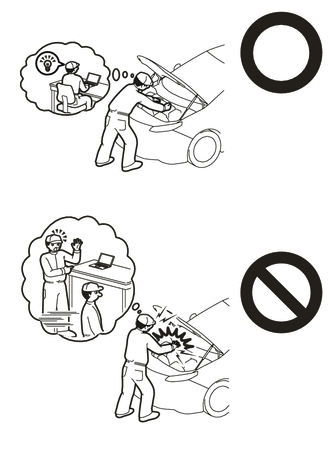
Orange wire harnesses and connectors indicate high-voltage circuits. To prevent electric shock, always follow the procedure described in the repair manual.
Click here
·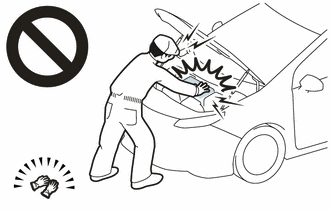
To prevent electric shock, wear insulated gloves when working on wire harnesses and components of the high voltage system.
- NOTICE:
- ·
If the auxiliary battery is fully depleted or the READY indicator does not illuminate, recharge the auxiliary battery.
·Never disconnect the auxiliary battery while the power switch is on (READY).
·Before giving the auxiliary battery a quick charge, disconnect the auxiliary battery cables.
·Check the auxiliary battery again before the vehicle is returned to the customer.
·When replacing the auxiliary battery, use a new auxiliary battery of the same dimensions and same capacity or more from the same class at a 20-hour rate.