  |
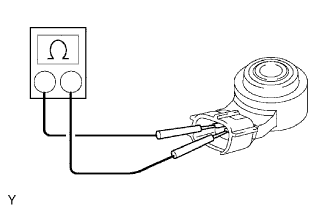
Measure the resistance of the sensor.
- Standard resistance:
- 120 to 280 kΩ at 20°C (68°F)
- A flat type knock sensor (non-resonant type) has a structure that can detect vibrations between approximately 6 kHz and 15 kHz.
- Knock sensors are fitted onto the engine block to detect engine knocking.
- The knock sensor contains a piezoelectric element which generates a voltage when it becomes deformed. The voltage is generated when the engine block vibrates due to knocking. Any occurrence of engine knocking can be suppressed by delaying the ignition timing.
| DTC No. | DTC Detection Condition | Trouble Area |
| P0327 | Output voltage of knock sensor is 0.5 V or less (1 trip detection logic) |
|
| P0328 | Output voltage of knock sensor is 4.5 V or more (1 trip detection logic) |
|
- HINT:
- When either of the DTCs P0327 and P0328 are set, the ECM enters fail-safe mode. During fail-safe mode, the power timing is delayed to its maximum retardation. Fail-safe mode continues until the power switch OFF.
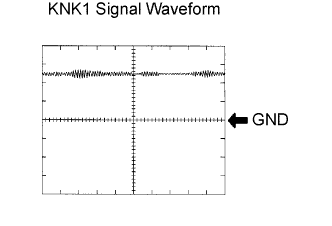
The correct waveform is shown.
| Items | Contents |
| Terminals | KNK1 - EKNK |
| Equipment Settings | 0.01 to 10 V/Division, 0.01 to 10 msec./Division |
| Conditions | Keep engine speed at 4,000 rpm with warm engine |