HYBRID BATTERY SYSTEM > SYSTEM DESCRIPTION |
| OUTLINE |
| CONTROL DESCRIPTION |
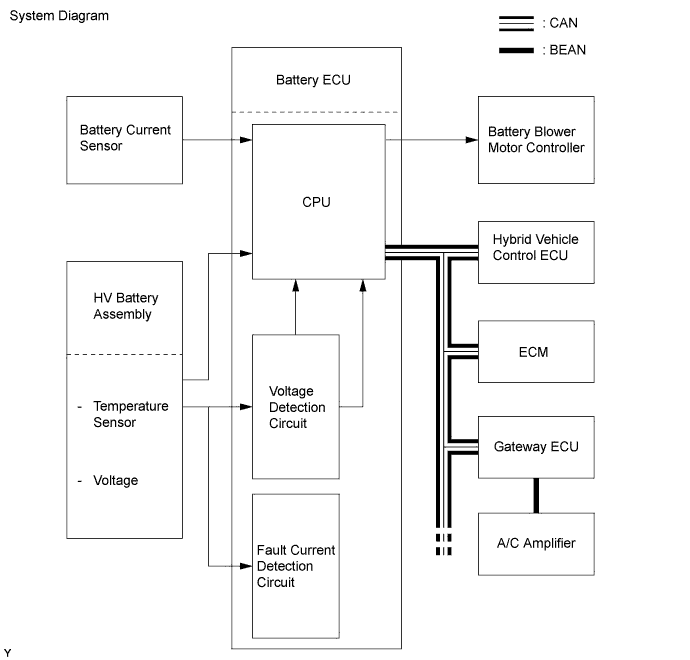
HV battery assembly management and fail-safe function.
When the vehicle is accelerated, the battery assembly is discharged. When the vehicle is decelerated, the battery assembly is charged by converting brake energy. The battery ECU calculates SOC (state of charge) of the HV battery based on voltage, current, and temperature, and then sends the results to the hybrid vehicle control ECU. As a result, charge and discharge control is performed in the hybrid vehicle control ECU depending on the SOC.
If a malfunction occurs, the battery ECU performs a fail-safe function and protects the HV battery assembly in accordance with the extent of the malfunction.
Battery blower motor control.
To control an increase in the temperature of the HV battery assembly while the vehicle is being driven, the battery ECU determines and controls the operating mode of the battery blower in accordance with the temperature of the HV battery assembly.
MIL illumination control.
If the battery ECU detects a malfunction that affects the exhaust gas emissions, it will transmit an MIL illumination request to the hybrid vehicle control ECU. (The battery ECU does not directly illuminate the MIL.)