EXHAUST PIPE GAS CONTROL ACTUATOR > INSTALLATION |
| 1. INSTALL EXHAUST PIPE GAS CONTROL ACTUATOR SUB-ASSEMBLY |
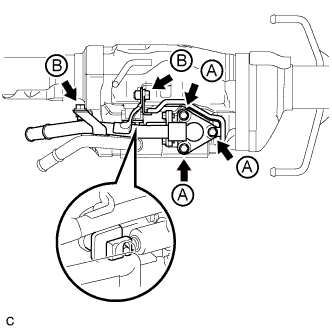
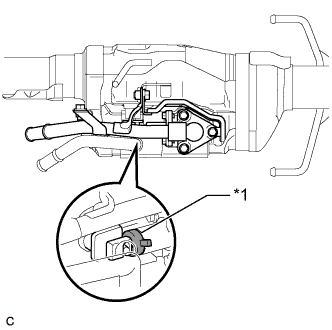
Install the exhaust by-pass pipe to the exhaust pipe gas control actuator sub-assembly.
![]() |
Install the No. 1 exhaust pipe heat insulator, exhaust pipe gas control actuator sub-assembly and exhaust by-pass pipe with the 5 bolts.
When replacing the exhaust pipe gas control actuator sub-assembly with a new one:
![]() |
Remove the spacer from the new exhaust pipe gas control actuator sub-assembly.
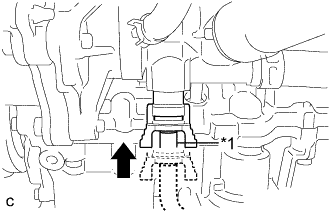
| *1 | Spacer |
| 2. INSTALL FRONT EXHAUST PIPE ASSEMBLY |
| 3. ADD COOLANT (for Engine) |
![]() |
Insert the engine drain cock plug.
| *1 | Hose |
Disconnect the hose from the engine drain cock plug.
Install the stop ring.
Tighten the radiator drain cock plug by hand.
![]() |
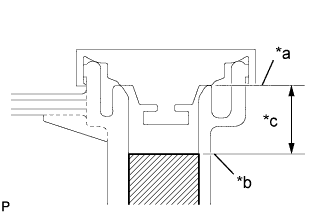
Slowly fill the radiator with TOYOTA Super Long Life Coolant (SLLC) from the water filler. (Coolant level should be within 20 mm (0.787 in.) from the filler tube end.)
| *a | Filler Tube End |
| *b | Coolant Level |
| *c | 20 mm |
Remove the reserve tank cap.
![]() |
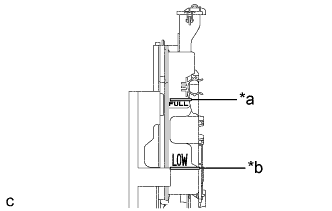
Slowly pour coolant into the radiator reserve tank assembly until it reaches the full line.
| *a | Full Line |
| *b | Low Line |
Squeeze the No. 1 and No. 2 radiator hoses several times by hand, and then check the level of the coolant.
If the coolant level is low, add coolant.
Install the water filler cap sub-assembly and reserve tank cap.
Put the engine in inspection mode (Click here).
Bleed air from the cooling system.
Warm up the engine until the thermostat opens. While the thermostat is open, circulate the coolant for several minutes.
Squeeze the No. 1 and No. 2 radiator hoses several times by hand to bleed air.
Stop the engine and wait until the engine coolant cools down.
Add engine coolant to the full line on the radiator reserve tank assembly.
| 4. INSPECT FOR COOLANT LEAK (for Engine) |
![]() |
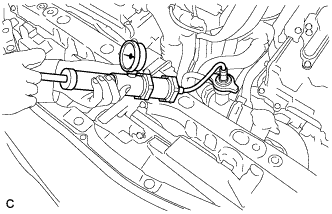
Fill the radiator with coolant and attach a radiator cap tester.
Put the engine in inspection mode (Click here).
Warm up the engine.
Using a radiator cap tester, increase the pressure inside the radiator to 108 kPa (1.1 kgf/cm2, 16 psi), and check that the pressure does not drop.
If the pressure drops, check the hoses, radiator, engine water pump, front exhaust pipe assembly and engine coolant temperature sensor for leaks. If no external leaks are found, check the heater core, cylinder block and cylinder head.