P0488 Exhaust Gas Recirculation Throttle Position Control Range / Performance
Diagnostic trouble codes · Vehicles built from Jan 2007
Versions by build date: Nov 2005 – Dec 2006 from Jan 2007
DESCRIPTION
The ECM opens and closes the throttle valve using a rotary solenoid type actuator. Due to the opening and closing of the valve, the exhaust gas recirculation volume can be properly controlled. Also, engine vibration and noise will be reduced by closing the valve when the engine is stopped.| DTC Detection Condition |
DTC Detection Drive Pattern |
Trouble Area |
The throttle motor activation duty is less than 10% or greater than 90% for 30 seconds (1 trip detection logic).
|
Over a period of 10 seconds or more, slowly raise engine speed to 3000 rpm and lower it to idle |
|
| DTC No. |
Data List |
| P0488 |
|
| Condition |
Throttle Valve Position |
| Moment when accelerator pedal is depressed further or released at 3000 rpm |
Throttle valve opening angle varies smoothly |
MONITOR DESCRIPTION
The ECM opens and closes the throttle valve by adjusting the current flowing to the rotary solenoid with a duty ratio controlled voltage signal. If the throttle valve does not move smoothly or is stuck, the duty ratio used during valve movement control increases or decreases greatly. The ECM will determine that the throttle valve is malfunctioning and illuminate the MIL.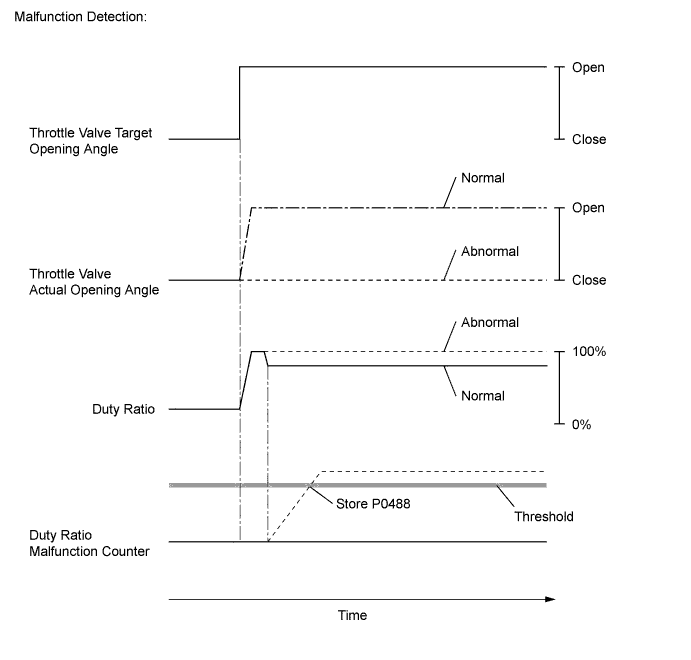

WIRING DIAGRAM
Refer to DTC P0120 (Click here).INSPECTION PROCEDURE
- NOTICE:
- When cleaning the EGR valve or the diesel throttle body, use a piece of cloth soaked with cleaning solvent. Spraying the solvent directly onto these parts or soaking the parts in the solvent may damage the parts.
- HINT:
- If carbon deposits exist in the diesel throttle body assembly, the following parts possibly also have deposits inside: The EGR valve assembly, intake manifold, exhaust fuel addition injector, DPF or DPNR catalyst, and other parts related to the exhaust gas.
By removing the EGR valve assembly from the intake manifold, the carbon deposit condition between the EGR valve and intake manifold can be checked visually. When checking for deposits in the EGR valve assembly, hold the EGR valve to a light and confirm that the valve contacts with the valve seat securely.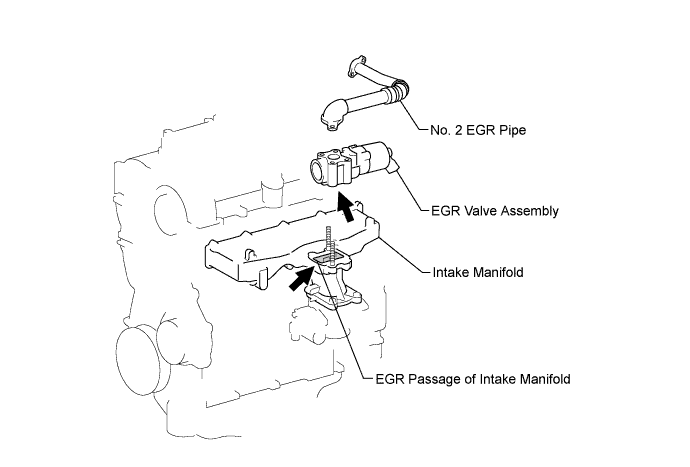
- For vehicles with DPF or DPNR catalyst:
If the catalyst (for DPF or DPNR) has become clogged with PM (Particulate Matter) and the difference in pressure in front of and behind the catalyst becomes more than the value of the "intake air amount (Mass Air Flow rate: g/sec) multiplied by about 0.4", DTC P2002 (Particulate Trap Efficiency Below Threshold) may be present.
If the differential pressure in front of and behind the catalyst becomes near the value of the "intake air amount multiplied by about 0.4", the catalyst is probably clogged with PM even if DTC P2002 is not present.
Check the DPF Differential Pressure by entering the following menus on an intelligent tester:
Powertrain / Engine and ECT / Data List / MAF and DPF Differential Pressure.
If DTC P2002 is present, refer to the inspection procedure for DTC P2002.
- For vehicle with exhaust fuel addition injector:
If the exhaust fuel addition injector becomes clogged, the additional fuel injection volume correction value (Exhaust Fuel Addition FB in Data List) becomes 1.99, and DTC P1386 (Injector for Exhaust Fuel Addition) will be present. Exhaust Fuel Addition FB in Data List is a correction value to increase the fuel volume injected from the exhaust fuel addition injector when the catalyst temperature does not rise to the desired level during catalyst regeneration. Under normal conditions, the value is between 0.9 and 1.4.
Check the correction value by entering the following menus on an intelligent tester: Powertrain / Engine and ECT / Data List / Exhaust Fuel Addition FB.
Under normal conditions, the exhaust gas temperature becomes 150 to 350°C (302 to 662°F) when the vehicle is driven at a constant vehicle speed of about 50 km/h (31 mph). While driving under these conditions, the exhaust gas temperature rises to 500 to 700°C (932 to 1292°F) when the catalyst regeneration function in the Active Test (Activate the DPF Rejuvenate) is performed. If the temperature does not rise sufficiently, the exhaust fuel addition injector or the catalyst (for DPF or DPNR) may be damaged.
- If carbon deposits exist in the diesel throttle body assembly, the following parts possibly also have deposits inside: The EGR valve assembly, intake manifold, exhaust fuel addition injector, DPF or DPNR catalyst, and other parts related to the exhaust gas.
| 1. READ VALUE USING INTELLIGENT TESTER (ACTUAL THROTTLE POSITION) |

Connect the intelligent tester to the DLC3.
Turn the ignition switch to ON and turn the tester on.
Enter the following menus: Powertrain / Engine and ECT / DTC.
Record the stored DTC and Freeze Frame Data.
Clear the DTC.
Turn the ignition switch to off and wait for 5 seconds or more.
- HINT:
- Be sure to turn off the ignition switch before performing this inspection. The fully closed position of the diesel throttle valve is learned when the ignition switch is turned off.
Turn the ignition switch to ON and turn the tester on.
Enter the following menus: Powertrain / Engine and ECT / Data List / Actual Throttle Position.
Read the value.
- Standard:
Engine Condition
Specified Condition
Ignition switch ON
-5 to 5%
Idling
(after engine warmed up, at an altitude near sea level)
81 to 95%
Accelerator pedal fully depressed
-5 to 5%
and value changes smoothly in transition
- HINT:
- Check the Throttle Motor DUTY in the Data List items at the same time. If the value in Throttle Motor DUTY is outside the range of 50 +/-40% for 30 seconds or more, the throttle valve may not be sliding properly.
- The Actual Throttle Position in the Data List items is indicated as follows:
- Check the Throttle Motor DUTY in the Data List items at the same time. If the value in Throttle Motor DUTY is outside the range of 50 +/-40% for 30 seconds or more, the throttle valve may not be sliding properly.
Throttle Valve Condition
Actual Throttle Position
Fully closed
100%
Fully open
0%
Enter the following menus: Powertrain / Engine and ECT / Data List / Throttle Close Learning Val. and Diesel Throttle Learn Status.
Read the values when the ignition switch is ON.
- Standard:
- Throttle Close Learning Val. is between 14.25 to 21.25 deg. and Diesel Throttle Learn Status is OK
- NOTICE:
- Extremely cold conditions might cause the throttle valve movement to be delayed.
|
|
||||

| OK | |
 |
| 2. INSPECT VACUUM HOSE AND PIPE (BETWEEN INTERCOOLER AND INTAKE MANIFOLD) |
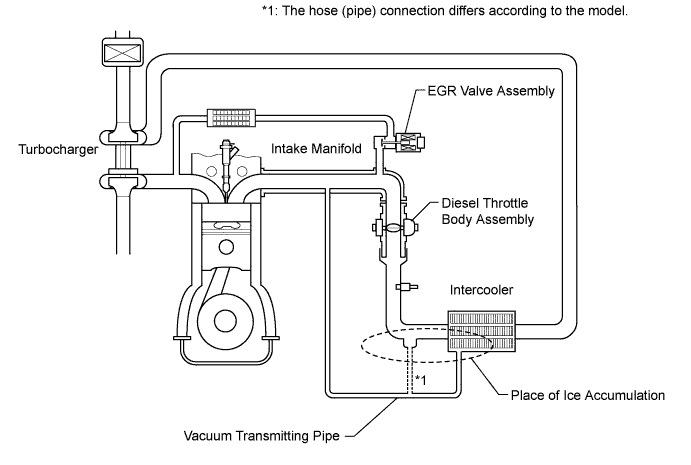
Check for water or water marks in the hoses and pipes between the intercooler and intake manifold.
- OK:
- No water or water marks in the hoses and pipes.
- HINT:
- If water or water marks exist, water may have frozen in the diesel throttle body. The DTC was possibly caused by the presence of ice.
Inspect the hoses and pipes between the intercooler and intake manifold.
- OK:
- Hoses and pipes are not damaged, squashed, or disconnected.
|
|
||||
|
|
||||

| 3. CHECK FOR DEPOSIT (DIESEL THROTTLE BODY ASSEMBLY) |
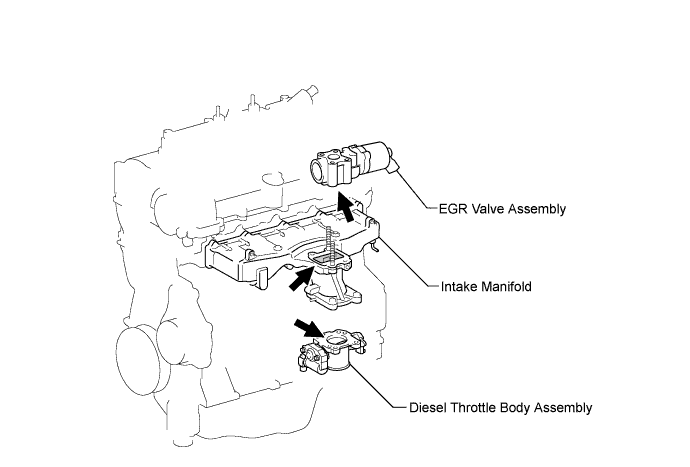
Check for any deposits in the diesel throttle body assembly.
- OK:
- No deposits in the diesel throttle body assembly.
- HINT:
- If carbon deposits exist in the diesel throttle body assembly, the following parts possibly also have deposits inside: The EGR valve assembly, intake manifold, exhaust fuel addition injector, DPF or DPNR catalyst, and other parts related to the exhaust gas.
- By removing the EGR valve assembly from the intake manifold, the carbon deposit condition between the EGR valve and intake manifold can be checked visually. When checking for deposits in the EGR valve assembly, hold the EGR valve to a light and confirm that the valve contacts with the valve seat securely.
|
|
||||
|
|
||||
| 4. CHECK FOR DEPOSIT (CLEAN THROTTLE BODY) |
Remove the deposits from the throttle body assembly and clean it.
- NOTICE:
- When cleaning the EGR valve or the diesel throttle body, use a piece of cloth soaked with cleaning solvent. Spraying the solvent directly onto these parts or soaking the parts in the solvent may damage the parts.
| NEXT | |
|
| 5. INSPECT DIESEL THROTTLE BODY ASSEMBLY (THROTTLE VALVE MOVEMENT) |
Using your finger, check that the throttle valve moves smoothly.
- OK:
- Throttle valve moves smoothly.
- NOTICE:
- Take care that you do not damage the throttle valve and the valve housing.
|
|
||||
| OK | |
|
| 6. READ VALUE USING INTELLIGENT TESTER (ACTUAL THROTTLE POSITION) |
Connect the intelligent tester to the DLC3.
Turn the ignition switch to ON.
Turn the ignition switch off and wait for 5 seconds or more.
- HINT:
- Be sure to turn off the ignition switch before performing this inspection. The fully closed position of the diesel throttle valve is learned when the ignition switch is turned off.
Turn the ignition switch to ON and turn the tester on.
Enter the following menus: Powertrain / Engine and ECT / Data List / Actual Throttle Position.
Read the values.
- Standard:
Engine Condition
Specified Condition
Ignition switch ON
-5 to 5%
Idling
(after engine warmed up, at an altitude near sea level)
81 to 95%
Accelerator pedal fully depressed
-5 to 5%
and value changes smoothly in transition
- HINT:
- Check the Throttle Motor DUTY in the Data List items at the same time. If the value in Throttle Motor DUTY is outside the range of 50 +/-40% for 30 seconds or more, the throttle valve may not be sliding properly.
Enter the following menus: Powertrain / Engine and ECT / Data List / Throttle Close Learning Val. and Diesel Throttle Learn Status.
Read the values when the ignition switch is ON.
- Standard:
- Throttle Close Learning Val. is between 14.25 to 21.25 deg. and Diesel Throttle Learn Status is OK
|
|
||||
|
|
||||
| 7. INSPECT DIESEL THROTTLE BODY ASSEMBLY (THROTTLE VALVE MOVEMENT) |
Using your finger, check that the throttle valve moves smoothly.
- OK:
- Throttle valve moves smoothly.
- NOTICE:
- Take care that you do not damage the throttle valve and the valve housing.
|
|
||||
| OK | |
|
| 8. CHECK HARNESS AND CONNECTOR (POWER SOURCE OF DIESEL THROTTLE BODY) |
Disconnect the B33 throttle control motor connector.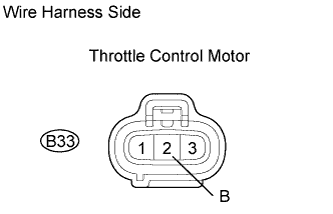
Turn the ignition switch to ON
Measure the voltage of the wire harness side connector.
- Standard voltage:
Tester Connection
Condition
Specified Condition
B33-2 (B) - Body ground
Ignition switch ON
11 to 14 V
Reconnect the throttle control motor connector.
|
|
||||
| OK | |
|
| 9. CHECK HARNESS AND CONNECTOR (GROUND CIRCUIT OF DIESEL THROTTLE BODY) |
Disconnect the B33 throttle control motor connector.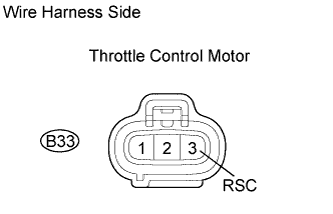
Measure the resistance of the wire harness side connector.
- Standard resistance:
Tester Connection
Condition
Specified Condition
B33-3 (RSC) - Body ground
Always
Below 1 Ω
Reconnect the throttle control motor connector.
|
|
||||
| OK | |
|
| 10. CHECK HARNESS AND CONNECTOR (ECM - DIESEL THROTTLE BODY) |
Disconnect the B33 throttle control motor connector.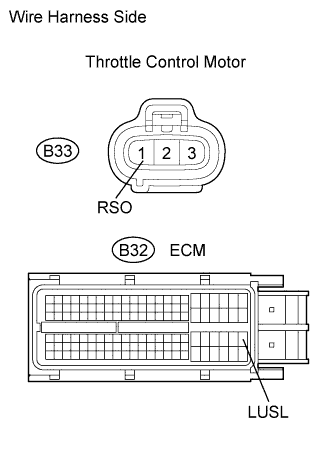
Disconnect the B32 ECM connector.
Measure the resistance of the wire harness side connectors.
- Standard resistance:
Tester Connection
Specified Condition
B33-1 (RSO) - B32-86 (LUSL)
Below 1 Ω
B33-1 (RSO) or B32-86 (LUSL) - Body ground
10 kΩ or higher
Reconnect the throttle control motor connector.
Reconnect the ECM connector.
|
|
||||
|
|
||||
| 11. REPAIR OR REPLACE HARNESS OR CONNECTOR |
|
|
||||
| 12. REPLACE DIESEL THROTTLE BODY ASSEMBLY |
Replace the diesel throttle body assembly (Click here).
|
|
||||
| 13. REPLACE DIESEL THROTTLE BODY ASSEMBLY |
Replace the diesel throttle body assembly (Click here).
| NEXT | |
|
| 14. CHECK WHETHER DTC OUTPUT RECURS (DTC P0488) |
Connect the intelligent tester to the DLC3.
Turn the ignition switch to ON and turn the tester on.
Clear DTCs.
Turn the ignition switch to off and wait for 5 seconds or more.
- HINT:
- The fully closed position of the diesel throttle valve is learned when the ignition switch is turned off.
Start the engine and warm it up.
Drive the vehicle with a stop-and-go city drive pattern for more than 5 minutes.
Enter the following menus: Powertrain / Engine and ECT / DTC.
Read DTCs.
Result Display (DTC Output)
Proceed to
P0488
A
No output
B
|
|
||||
| A | |
|
| 15. REPLACE ECM |
Replace the ECM.
- NOTICE:
- After replacing the ECM, perform initialization (Click here) and registration (Click here).
| NEXT | |
|
| 16. CHECK WHETHER DTC OUTPUT RECURS (DTCP0488) |
Connect the intelligent tester to the DLC3.
Turn the ignition switch to ON and turn the tester on.
Clear DTCs.
Turn the ignition switch to off and wait for 5 seconds or more.
- HINT:
- The fully closed position of the diesel throttle valve is learned when the ignition switch is turned off.
Start the engine and warm it up.
Drive the vehicle with a stop-and-go city drive pattern for more than 5 minutes.
Enter the following menus: Powertrain / Engine and ECT / DTC.
Read DTCs.
- OK:
- No DTCs are output.
| NEXT | ||
 |
||
| ||