Use a sound scope to check for injector operating sounds.
Check that the operating sounds stop momentarily and then resume when the throttle lever is released.
HINT:
Perform this step with the A/C off.
Fuel injection restart rpm:
1400 rpm
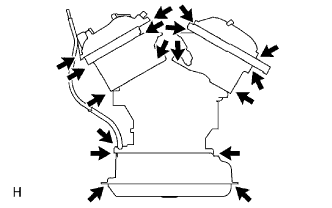
INSPECT FOR LEAK
Visually check that the hoses, connections and gaskets have no cracks, leaks or damage.
NOTICE:
Detachment or other problems with the engine oil dipstick, filler cap, ventilation hose and other components may cause the engine to run improperly.
Air suction caused by disconnections, looseness or cracks in any part of the air induction system between the throttle body and cylinder head will cause engine failure or engine malfunctions.
If any defects are found, replace parts as necessary.
CHECK CHARCOAL CANISTER
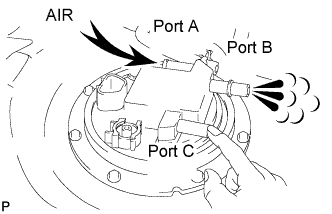
Inspect the ventilation of the canister.
Close port C and apply compressed air into port A and check that the air flows out from port B.
HINT:
Do not wash the charcoal canister.
No activated carbon should come out.
If a problem is found, replace the fuel pump sub-assembly.
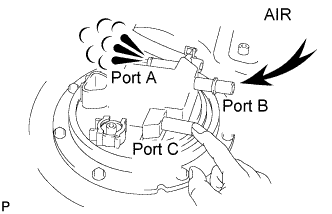
Close port C and apply compressed air into port B and check that the air flows out from port A.
HINT:
Do not wash the charcoal canister.
No activated carbon should come out.
If a problem is found, replace the fuel pump sub-assembly.
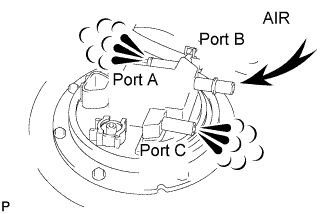
Apply compressed air into port B and check that the air flows out from port A and port C.
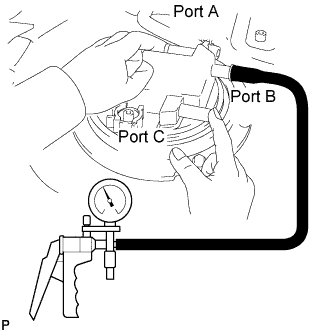
Inspect no leakage of the charcoal canister.
Close port A and port C. Using a hand-held vacuum pump, apply a vacuum to port B and check that the vacuum keeps.