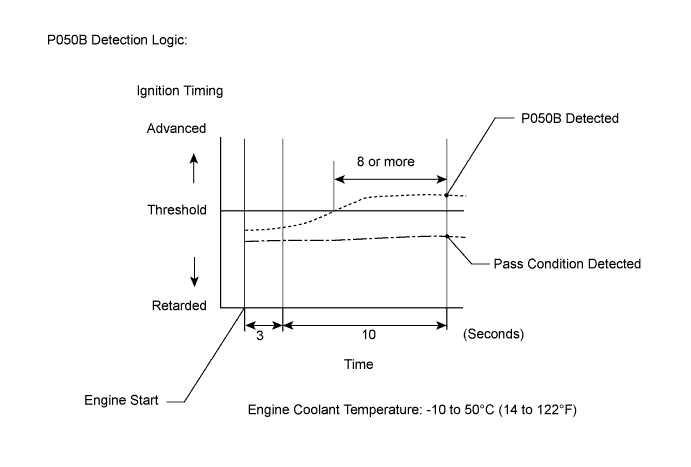
DTC P050B Cold Start Ignition Timing Performance |
| DTC No. | DTC Detection Condition | Trouble Area |
| P050B | Insufficient ignition timing retard at cold start (2-trip detection logic) |
|
| Related DTCs | P050B: Cold start ignition timing performance |
| Required Sensors / Components (Main) | Throttle body assembly |
| Required Sensors / Components (Related) | Mass air flow meter Engine Coolant Temperature (ECT) sensor |
| Frequency of Operation | Once per driving cycle |
| Duration | 10 seconds |
| MIL Operation | 2 driving cycles |
| Sequence of Operation | None |
| Monitor runs whenever following DTCs not present | P0010, P0020 (VVT Oil control valve) P0011, P0021 (VVT System - Advance) P0012, P0022 (VVT System - Retard) P0013, P0023 (Exhaust VVT Oil control valve) P0014, P0024 (Exhaust VVT System - Advance) P0015, P0025 (Exhaust VVT System - Retard) P0016, P0018 (VVT System - Misalignment) P0017, P0019 (Exhaust VVT System - Misalignment) P0102, P0103 (Mass air flow meter) P0115, P0117, P0118 (Engine coolant temperature sensor) P0120, P0121, P0122, P0123, P0220, P0222, P0223, P2135 (Throttle position sensor) P0125 (Insufficient coolant temperature for closed loop fuel control) P0171, P0172, P0174, P0175 (Fuel system) P0301 - P0308 (Misfire) P0335 (Crankshaft position sensor) P0340, P0342, P0343, P0345, P0347, P0348, P1340 (VVT sensor) P0351 - P0358 (Igniter) P0365, P0367, P0368, P0390, P0392, P0393 (Exhaust VVT sensor) P0500 (Vehicle speed sensor) P2195, P2196, P2197, P2198, P2237, P2238, P2239, P2240, P2241, P2242, P2252, P2253, P2255, P2256, P2A00, P2A03 (Front oxygen/Air fuel ratio sensor) P0705 (Shift lever position switch) |
| Battery voltage | 8 V or more |
| Time after engine start | 3 seconds or more |
| Starter | OFF |
| ECT at engine start | -10°C (14°F) or more |
| ECT | -10 to 50°C (14 to 122°F) |
| Engine idling time | 3 seconds or more |
| Fuel-cut | OFF |
| Vehicle speed | Less than 3 km/h (1.875 mph) |
| Atmospheric pressure | 76 kPa (570 mmHg) or more |
| Accumulated time when ignition timing retard value is cut off | 5 seconds or more |
| Symptom | Factor | Trouble Area |
| Low idle speed when engine is cold (immediately after engine start) | Excessive engine friction |
|
| Rough idle when engine is cold (immediately after engine start) | Abnormal combustion | Fuel quality |
| 1.CHECK ANY OTHER DTCS OUTPUT (IN ADDITION TO DTC P050B) |
Connect the Techstream to the DLC3.
Turn the ignition switch to ON.
Turn the Techstream on.
Enter the following menus: Powertrain / Engine and ECT / Trouble Codes.
Read the DTCs.
| Result | Proceed to |
| P050B is output | A |
| P050B and other DTCs are output | B |
|
| ||||
| OK | |
 |
| 2.READ VALUE USING TECHSTREAM (FUEL TRIM) |
Connect the Techstream to the DLC3.
Turn the ignition switch to ON.
Turn the Techstream on.
Enter the following menus: Powertrain / Engine and ECT / Data List / A/F Control System / Short FT #1 and Long FT #1, or Short FT #2 and Long FT #2.
Read the values displayed on the Techstream.
Add together the Short FT #1 and Long FT #1, or Short FT #2 and Long FT #2 values to obtain the total fuel trim.
|
| ||||
| OK | |
|
| 3.INSPECT THROTTLE BODY |
Check that there are no deposits around the throttle valve.
|
| ||||
| OK | |
|
| 4.REPLACE ECM |
Replace the ECM (Click here).
|
| ||||
| 5.PERFORM ACTIVE TEST USING TECHSTREAM (OCV OPERATION) |
Connect the Techstream to the DLC3.
Start the engine.
Turn the Techstream on.
Warm up the engine.
Enter the following menus: Powertrain / Engine and ECT / Active Test / Control the VVT System (Bank 1) or Control the VVT System (Bank 2).
Check the engine speed while operating the Oil Control Valve (OCV) using the Techstream.
| Tester Operation | Specified Condition |
| OCV OFF | Normal engine speed |
| OCV ON | Soon after OCV switched from OFF to ON, engine idles roughly or stalls |
|
| ||||
| OK | |
|
| 6.CHECK PCV SYSTEM |
Start the engine.
Pinch the positive crankcase PCV hose.
Check the engine rpm.
|
| ||||
| OK | |
|
| 7.INSPECT AIR CLEANER FILTER ELEMENT SUB-ASSEMBLY |
Visually check that the air cleaner filter element is not excessively contaminated with dirt or oil.
|
| ||||
| OK | |
|
| 8.CHECK AIR INDUCTION SYSTEM |
Check the air induction system for vacuum leaks .
|
| ||||
| OK | |
|
| 9.REPLACE MASS AIR FLOW METER |
Replace the mass air flow meter .
|
| ||||
| 10.REPAIR OR REPLACE THROTTLE BODY |
Repair or replace the throttle body (Click here).
|
| ||||
| 11.CHECK AND REPAIR VVT SYSTEM |
|
| ||||
| 12.REPAIR OR REPLACE PCV SYSTEM |
|
| ||||
| 13.REPLACE AIR CLEANER FILTER ELEMENT SUB-ASSEMBLY |
|
| ||||
| 14.REPAIR OR REPLACE AIR INDUCTION SYSTEM |
| NEXT | |
|
| 15.CHECK WHETHER DTC OUTPUT RECURS (DTC P050B) |
Connect the Techstream to the DLC3.
Turn the ignition switch to ON.
Turn the Techstream on.
Clear the DTCs (Click here).
Switch the ECM from normal mode to check mode using the Techstream (Click here).
Start the engine and idle it for one minute.
Check that the idling is stable and fast.
Read the DTCs.
| NEXT | ||
 | ||
| ||

