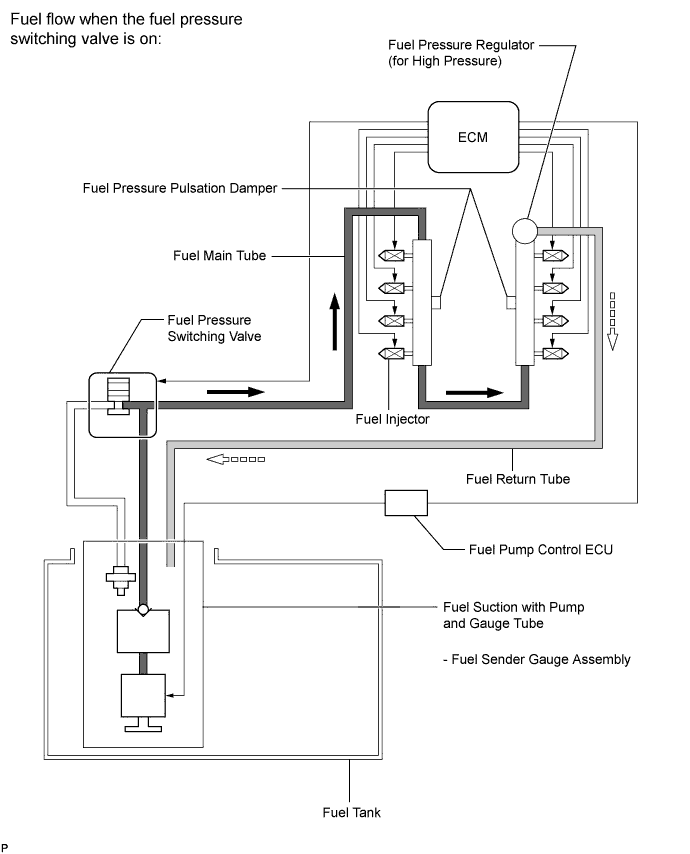
SFI SYSTEM > Fuel Pressure Switching System |
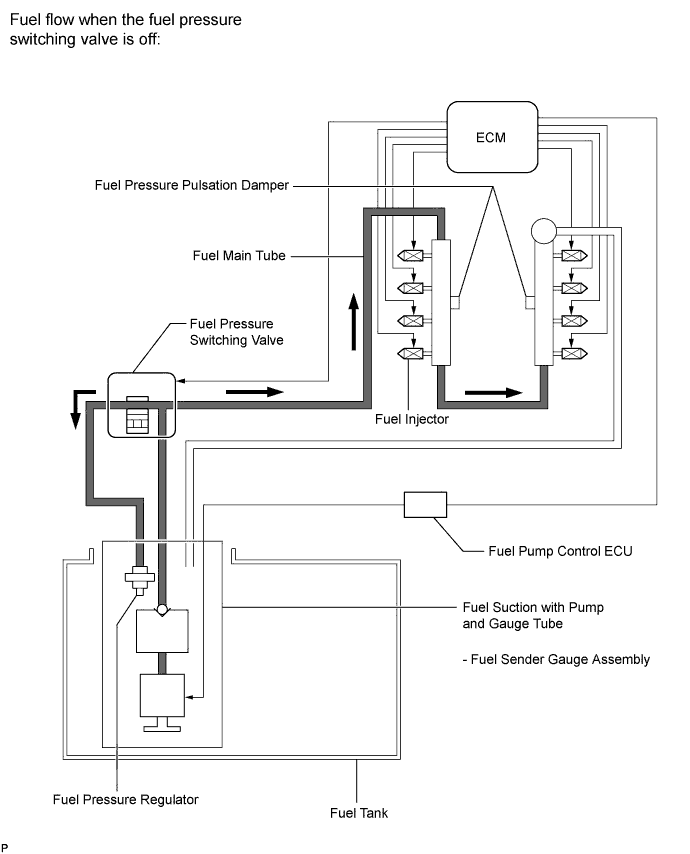
| 1.CHECK FUEL LEAK |
Visually check for fuel leaks.
|
| ||||
| OK | |
 |
| 2.INSPECT FUEL PRESSURE REGULATOR (for HIGH PRESSURE) |
Install the pressure gauge .
Start the engine.
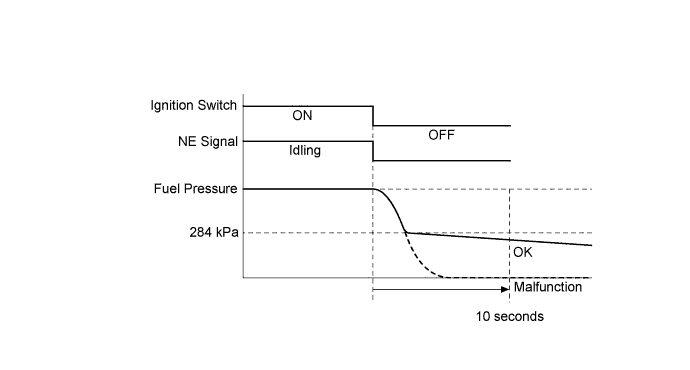
Check that the fuel pressure discharge when the ignition switch is turned off.
| Result | Proceed to |
| Fuel pressure remains almost constant or discharges gradually after a sudden drop | A |
| Fuel pressure drops suddenly, and when return hose of the fuel pressure regulator for high pressure is pinched shut, the sudden fuel pressure drop (fuel pressure drops to 270 kPa or less) stops | B |
|
| ||||
| A | |
|
| 3.CHECK FUEL PUMP CONTROL SYSTEM |
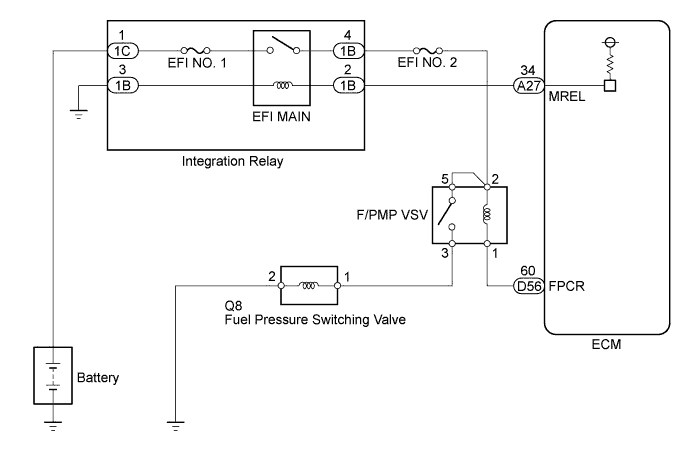
Check the fuel pump control circuit (Click here).
| NEXT | |
|
| 4.PERFORM ACTIVE TEST USING TECHSTREAM (FUEL PRESSURE SWITCHING VALVE) |
Install the pressure gauge .
Chock the wheels.
Securely apply the parking brake.
Warm up the engine until the engine coolant temperature is 75°C (167°F) or more.
Connect the Techstream to the DLC3.
Allow the engine to idle and turn the A/C on (MAX COOL, blower motor on maximum setting).
Depress the brake pedal and move the shift lever to D.
Enter the following menus: Powertrain / Engine and ECT / Active Test / Activate the Fuel Pressure Switching Valve / All Data / Short FT #1 and Short FT #2.
Using the Active Test, switch the fuel pressure switching valve to "High" and "Low".
Check the change in Short FT and the fuel pressure.
| Result | Condition | Proceed to |
| Short FT change is below 7% and fuel pressure does not change 30 kPa or more | Performing switching between "High" and "Low" | A |
| Anything except above | Performing switching between "High" and "Low" | B |
| Change in Short FT while performing Active Test | 10 to 20% | |
| Active Test State | Low | High |
| Normal Fuel Pressure | 270 to 330 kPa | 370 to 430 kPa |
| Data List | Low | High |
| AFS Voltage B1 S1 | 3.23 V | 3.10 V |
| AFS Voltage B2 S1 | 3.26 V | 3.05 V |
| O2S B1 S2 | 0.11 V | 0.33 V |
| O2S B2 S2 | 0.13 V | 0.21 V |
| Short FT #1 | 11.7% | -16.5 % |
| Long FT #1 | -2.4% | -2.4% |
| Short FT #2 | 11.7% | -16.5% |
| Long FT #2 | -2.4% | -2.4% |
| AF Lambda B1 S1 | 0.99 | 0.96 |
| AF Lambda B2 S1 | 1.00 | 0.96 |
| Alcohol Density Estimate | 73% | 73% |
| Alcohol Density Learning | Compl | Compl |
| Change in Short FT while performing Active Test | Less than 7% | 7% or more | ||
| Active Test State | Low | High | Low | High |
| Fuel pressure when there is fuel leak from fuel pipes | Below 270 kPa | Below 370 kPa | Below 270 kPa | Below 370 kPa |
| Fuel pressure when fuel pressure in high pressure side pressure regulator cannot remain stable | Below 270 kPa | Below 370 kPa | Below 270 kPa | Below 370 kPa |
| Fuel pressure when fuel pump ECU is malfunctioning and drive voltage stuck at low | 270 to 330 kPa | Below 370 kPa | - | - |
| Fuel pressure when fuel pump ECU is malfunctioning and drive voltage stuck at high | 370 kPa or higher | 370 to 430 kPa | - | - |
| Fuel pressure when fuel pressure switching valve stuck | No change in pressure | - | - | |
| Fuel pressure when fuel pressure in low pressure side pressure regulator cannot remain stable | - | - | Below 270 kPa | 370 to 430 kPa |
| Fuel pressure when fuel pump discharge ability decreases | - | Below 370 kPa | - | Below 370 kPa |
|
| ||||
| A | |
|
| 5.CHECK FUEL PRESSURE SWITCHING VALVE (POWER SOURCE) |
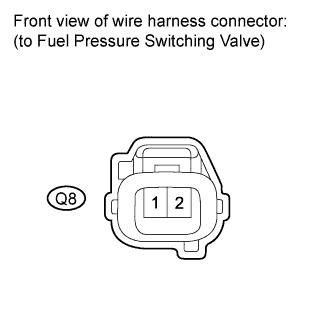 |
Disconnect the fuel pressure switching valve connector.
Connect the Techstream to the DLC3.
Enter the following menus: Powertrain / Engine and ECT / Active Test / Activate the Fuel Pressure Switching Valve.
Operate the fuel pressure switching valve.
Measure the voltage according to the value(s) in the table below.
| Tester Connection | Condition | Specified Condition |
| 1 - 2 | High selected in Active Test | 11 to 14 V |
|
| ||||
| OK | |
|
| 6.INSPECT FUEL PRESSURE SWITCHING VALVE |
Inspect the fuel pressure switching valve .
|
| ||||
| OK | ||
 | ||
| ||
| 7.INSPECT RELAY (F/PMP VSV) |
Inspect the F/PMP VSV relay .
|
| ||||
| OK | |
|
| 8.CHECK RELAY (F/PMP VSV POWER SOURCE) |
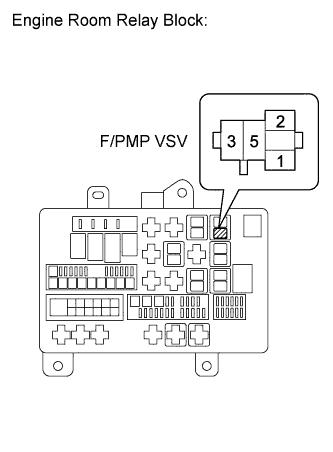 |
Remove the fuel pressure control valve relay (F/PMP VSV) from the engine room relay block.
Measure the voltage according to the value(s) in the table below.
| Tester Connection | Condition | Specified Condition |
| F/PMP VSV relay (5) - Body ground | Always | 11 to 14 V |
|
| ||||
| OK | |
|
| 9.CHECK HARNESS AND CONNECTOR (FUEL PRESSURE SWITCHING VALVE - F/PMP RELAY, BODY GROUND) |
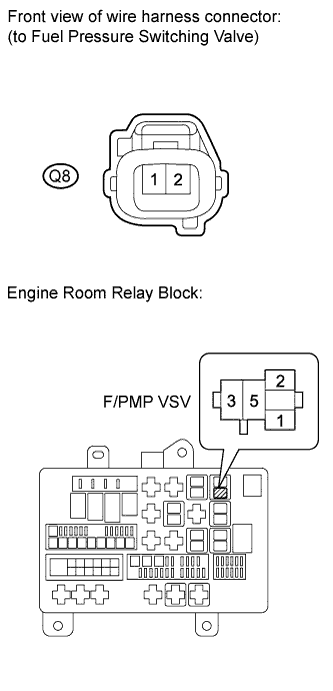 |
Disconnect the fuel pressure switching valve connector.
Remove the fuel pressure control valve relay (F/PMP VSV) from the engine room relay block.
Measure the resistance according to the value(s) in the table below.
| Tester Connection | Condition | Specified Condition |
| Q8-1 - F/PMP VSV relay (3) | Always | Below 1 Ω |
| Q8-2 - Body ground | Always | Below 1 Ω |
| Q8-1 or F/PMP VSV relay (3) - Body ground | Always | 10 kΩ or higher |
|
| ||||
| OK | ||
| ||
| ||

