 |
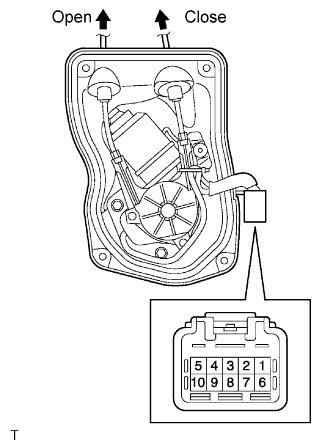
Remove the motor and clutch.
POWER SLIDE DOOR MOTOR ASSEMBLY > INSPECTION |
| 1. INSPECT SLIDE DOOR CONTROL MOTOR ASSEMBLY LH |
|
Remove the motor and clutch.
Connect the battery positive (+) lead to terminal 3 and the battery negative (-) lead to terminal 2.
Apply battery voltage to the terminals and check the motor operation.
| Measurement Condition | Specified Condition |
| Battery positive (+) → Terminal 8 Battery negative (-) → Terminal 7 | Open |
| Battery positive (+) → Terminal 7 Battery negative (-) → Terminal 8 | Closed |
Check the resistance of the terminals.
| Terminal No. | Specified Condition |
| 2 - 3 | 4.0 Ω |
 |
Reinstall the motor and clutch with the connector connected.
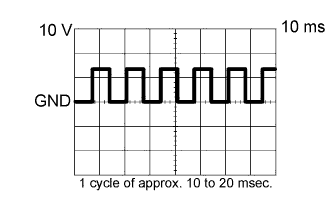
Check the pulse of the pulse sensor.
Using an oscilloscope, check the pulse generated when the door is manually opened and closed.
| Terminal | Tool setting | Vehicle condition |
| 5 - 9, 9 - 10 | 10 V/DIV., 10 ms/DIV. | Door moving |
| 2. INSPECT SLIDE DOOR CONTROL MOTOR ASSEMBLY RH |
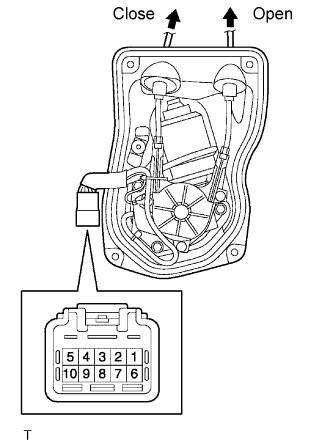 |
Remove the motor and clutch.
Connect the battery positive (+) lead to terminal 3 and the battery negative (-) lead to terminal 2.
Apply battery voltage to the terminals and check the motor operation.
| Measurement Condition | Specified Condition |
| Battery positive (+) → Terminal 8 Battery negative (-) → Terminal 7 | Open |
| Battery positive (+) → Terminal 7 Battery negative (-) → Terminal 8 | Closed |
Check the resistance of the terminals.
| Terminal No. | Specified Condition |
| 2 - 3 | 4.0 Ω |
| 6 - Body ground | 10 kΩ or higher |
|
Reinstall the motor and clutch with the connector connected.
Check the pulse of the pulse sensor.
Using an oscilloscope, check the pulse generated when the door is manually opened and closed.
| Terminal | Tool setting | Vehicle condition |
| 5 - 9, 9 - 10 | 10 V/DIV., 10 ms/DIV. | Door moving |