CRUISE CONTROL DYNAMIC RADAR CRUISE CONTROL SYSTEM GENERAL GENERAL
OUTLINE
The major benefit of the adaptive cruise control with stop&go function in terms of driver comfort is that the strain is taken out of stop/go driving situations. This is in addition to the advantage already familiar from other similar systems where the driver no longer has to constantly make monotonous small adjustments to speed and the distance from the vehicle in front. The inclusion of these classic stressful situations in the automatic control yields a significant added relief for the driver, which significantly increases the perceived benefit of the system.
As this vehicle responds to the stopping procedures of the vehicle in front or to parked vehicles in a prompt manner designed to deliver maximum comfort, the vehicle dynamics give the driver a tangible indication that the system is dealing with the situation at hand. The increases the driver's level of trust in the system.
With the adaptive cruise control with stop&go function, the driver can now move along with the flow of traffic confidently and can stay relaxed even in situations such as this, which are perceived as being particularly unpleasant, and can delegate the constant control required in stop/go driving conditions to the vehicle.
The adaptive cruise control with stop&go function controls up to a speed of 160 km/h (99 mph).
The distance information function alerts the driver if the vehicle-to-vehicle following distance between this vehicle and the preceding vehicle falls to less than a specified minimum distance. This can help prevent rear-end collisions. (Models with headup display)
PRECAUTION
Detection range
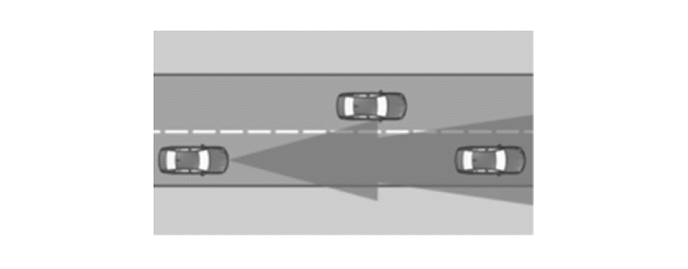
The system's detection capability and automatic braking capacity are limited. For example, two-wheeled vehicles may not be detected.
Deceleration
The system does not decelerate in the following situations:
For pedestrians or similar slow road users.
For red traffic lights.
For crossing traffic.
For oncoming vehicles.
Vehicles pulling out
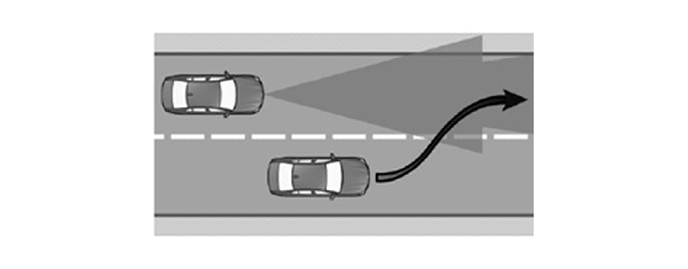
A vehicle driving ahead of you is only detected when it is fully in your driving lane. If another vehicle suddenly pulls out in front of you, the system might not be able to re-establish the selected distance of its own accord. In some circumstances, it may also not be possible to restore the selected distance if you are driving significantly faster than vehicles in front, for example when rapidly approaching a truck. If a vehicle is clearly detected in front of you, the system prompts you to intervene by braking, and if necessary by taking evasive action.
Cornering
If the desired speed is too high for cornering, it will be reduced slightly in the bend. However, the system does not detect bends in advance. For this reason, moderate your speed when cornering.
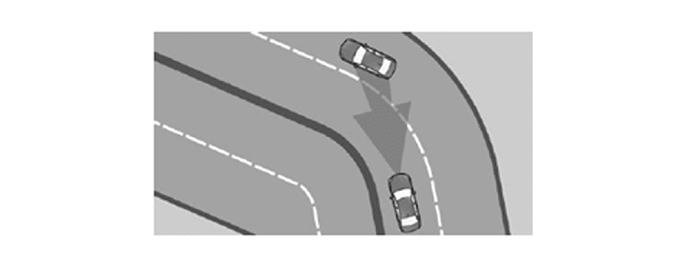
The system has a limited detection range. Situations can arise on tight bends where a vehicle driving in front will not be detected or will be detected very late.
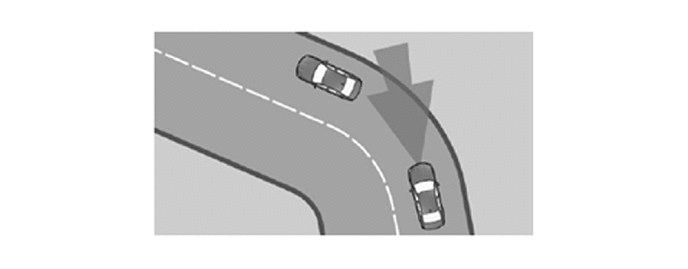
When your vehicle is approaching a bend, the angle of the bend may cause the system to respond temporarily to vehicles in the other lane. If the system responds by decelerating the vehicle, you may compensate for this by accelerating briefly. When the accelerator pedal is released again, the system will resume control of the vehicle's speed.