SUPPLEMENTAL RESTRAINT SYSTEMS AIRBAG SYSTEM DETAILS SEAT BELT PRETENSIONER
CONSTRUCTION
The effect of the belt retractor is that in the event of a collision the occupant's shoulder region is fixed more strongly on the seat.
As a rule, the seat belt does not fully tighten around the body.
The belt slack in the seat belt allows the occupants sufficient ease of movement.
In the event of a collision, the pyrotechnic retractor tensioner will coil up the seat belt and thereby tension it.
In the event of a crash, the airbag ECU assembly determines whether activation is required and which gas generators (belt tensioner, airbags, etc.) should be ignited.
For example, the retractor pretensioner has a lower triggering threshold than the front airbags. This means that, depending on the accident severity, only the front seat outer belt assemblies are activated by the airbag ECU assembly.
If the airbag ECU assembly sends a trigger signal, the front seat outer belt assemblies trigger as follows:
The ignition squib in the pyrotechnic component activates a propellant charge in a pipe (ignition squib and propellant charge are parts of the gas generator).
A piston is moved linearly in the pipe as a result of the pressure increase.
There are balls in the pipe which are moved by the piston. Using the balls, the piston stroke is transferred to a pinion.
The pinion is connected mechanically to the seat belt reel. The seat belt reel is thus turned and the belt slack is reduced.
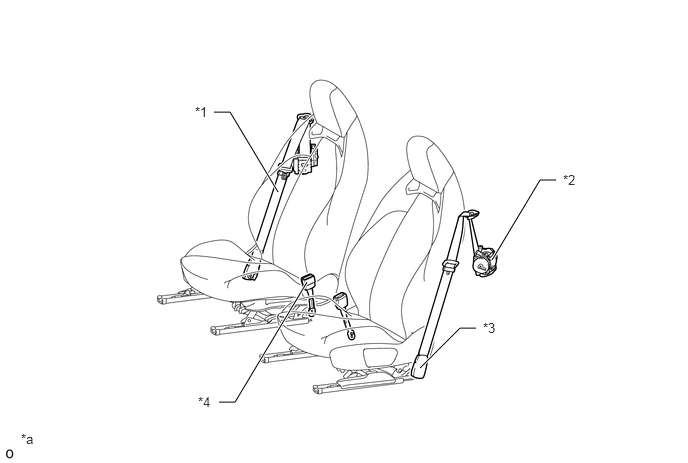
| *1 | Seat Belt | *2 | Front Seat Outer Belt Assembly
·
Pretensioner ·
Force Limiter ·
Hole Sensor |
| *3 | End Fitting | *4 | Front Seat Inner Belt Assembly |
| *a | The illustration shown is an example only. | - | - |
The front seat outer belt assemblies are monitored by the airbag ECU assembly.
The front seat outer belt assembly is connected through 2 signal lines with the airbag ECU assembly.
If the retractor tensioner for the driver and/or front passenger fails, the following is to be expected:
Fault entry in the airbag ECU assembly
Airbag warning light lights up