HEATING / AIR CONDITIONING AIR CONDITIONING SYSTEM DETAILS EVAPORATOR TEMPERATURE SENSOR (NO. 1 COOLER THERMISTOR)
CONSTRUCTION
The evaporator temperature sensor (No. 2 cooler thermistor) picks up the outlet temperature of the cooled air at the evaporator to prevent icing of the No. 1 cooler evaporator sub-assembly.
The evaporator fins are cooled by the refrigerant that has been evaporated inside the No. 1 cooler evaporator sub-assembly. The air mass flow generated by the blower is fed over the cooled evaporator fins. The air is cooled and dried and fed into the vehicle.
The No. 1 cooler evaporator sub-assembly temperature is regulated with the help of the evaporator temperature sensor (No. 2 cooler thermistor) and a controllable cooler expansion valve. The No. 1 cooler evaporator sub-assembly temperature is adjusted to the specified setpoint value of 2°C. Lower temperatures are not possible due to the risk of icing.
If the variable evaporator control function has been encoded, the setpoint value of the No. 1 cooler evaporator sub-assembly temperature is calculated between 2°C and 8°C. The specified value depends on the ambient temperature, the ventilation temperature and the refrigerant pressure. A variable evaporator temperature reduces interior air dehumidification. This reduces the risk of mucous membranes drying out.
The evaporator temperature sensor (No. 2 cooler thermistor) is directly connected with the air conditioning amplifier assembly. If the No. 1 cooler evaporator sub-assembly temperature drops below a given setpoint value (2°C), the air conditioning amplifier assembly switches off the compressor with magnet clutch.
The evaporator temperature sensor (No. 2 cooler thermistor) is a precision thermistor or NTC (Negative Temperature Coefficient) resistor.
NTC resistors convert temperature values into resistance values, which can then be evaluated electronically. The conductive materials in the NTC resistor conduct current better at high temperatures than at low temperatures. In other words, the hotter the NTC resistor gets, the lower its resistance becomes. To balance inner temperature effects, the NTC resistor is operated at low current. This means that the external ambient temperature is decisive for the resistance value. Every temperature change at the NTC resistor leads to a change in the voltage signal.
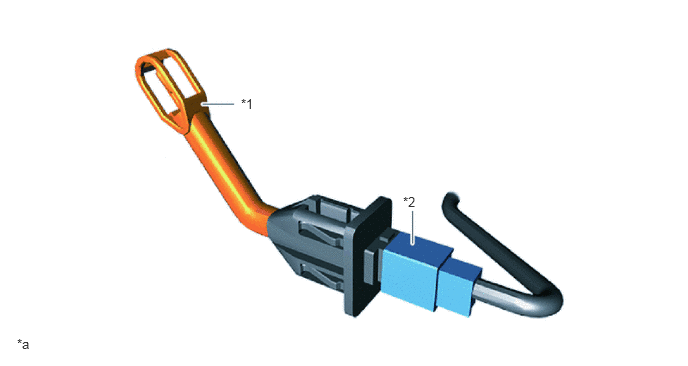
| *1 | Evaporator Temperature Sensor (No. 2 Cooler Thermistor) | *2 | 2-pin Plug Connection |
| *a | Illustration shows a representative example. | - | - |