8HP51 AUTOMATIC TRANSMISSION / TRANSAXLE AUTOMATIC TRANSMISSION SYSTEM DETAILS TORQUE CONVERTER
CONSTRUCTION
The torque converter is equipped with a lockup clutch. When the lockup clutch is closed there is a positive connection between the pump impeller and the turbine runner. A slip is avoided, however there is no longer any vibration-reducing effect. This is why a spring/damper system is used to reduce the torsional vibrations of the engine.
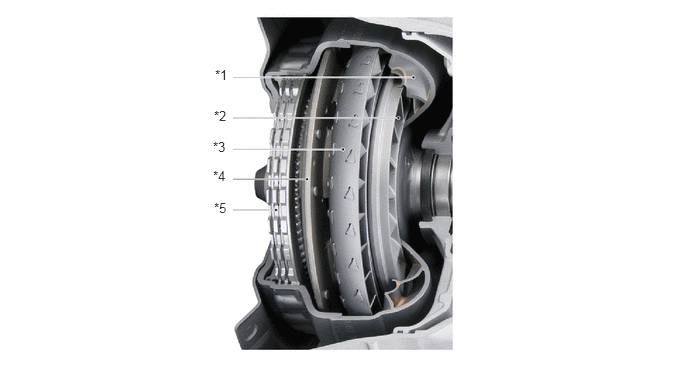
| *1 | Pump Impeller | *2 | Stator |
| *3 | Turbine Runner | *4 | Torsional Vibration Damper |
| *5 | Lockup Clutch | - | - |
Torsional Vibration Damper
The purpose of the torsional vibration damper is to isolate the automatic transmission from torsional vibrations of the engine.
2 different torsional vibration dampers are used in the torque converter, depending on the engine type. A turbine torsional vibration damper (TTD) is used in vehicles with 6-cylinder engines, whereas 2-damper converters with centrifugal weights (ZDW) are used in vehicles with 4-cylinder engines due to the higher torsional vibrations.
Turbine Torsional Vibration Damper (TTD)
The turbine torsional vibration damper (TTD) is a classical torsion damper in which the primary side (engine end) can be permanently connected with the turbine runner of the converter using the lockup clutch. This increases the centrifugal mass on the primary side, which markedly improves the damping properties.
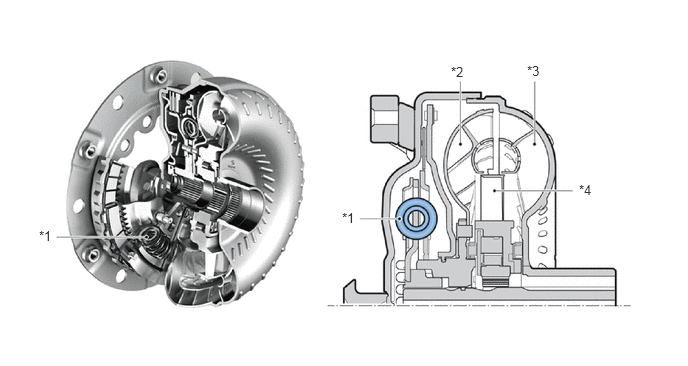
| *1 | Spring/Damper System, Torsional Vibration Damper | *2 | Turbine Runner |
| *3 | Pump Impeller | *4 | Stator |
2-damper Converter with Centrifugal Weights (ZDW)
The 2-damper converter with centrifugal weights (ZDW) is basically a turbine torsional vibration damper with a further upstream damper. This is also equipped with centrifugal weights. The centrifugal pendulum is also installed for the spring/damper system and can almost fully absorb the other torsional vibrations.
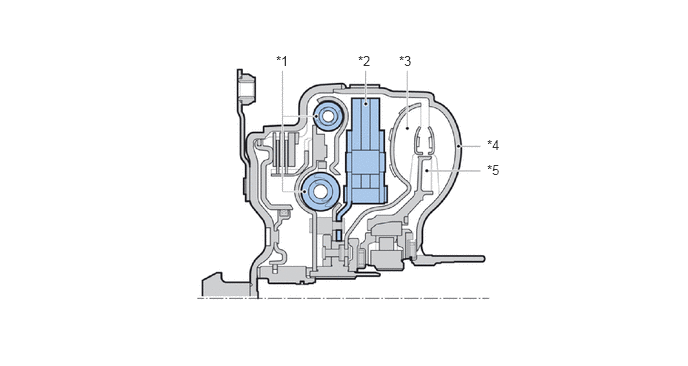
| *1 | Spring/Damper System | *2 | Centrifugal Pendulum |
| *3 | Turbine Runner | *4 | Pump Impeller |
| *5 | Stator | - | - |
The centrifugal pendulum is secured between the turbine runner and spring/damper system.
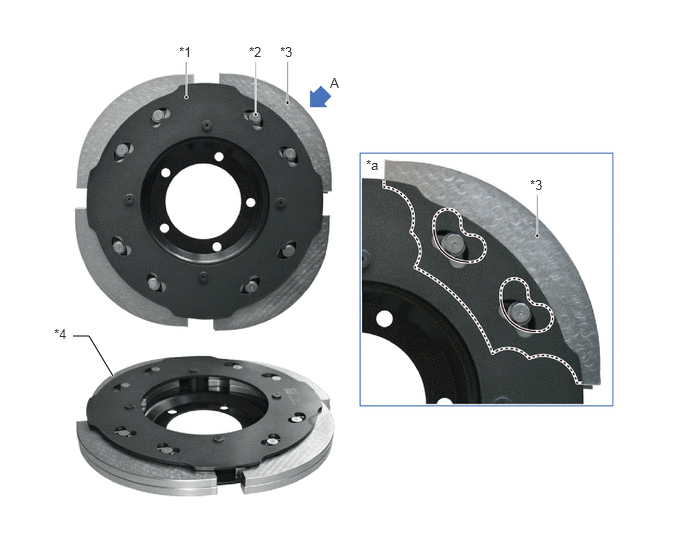
| *1 | Sheet Metal | *2 | Roller |
| *3 | Mass | *4 | Centrifugal Pendulum |
| *a | View from A | - | - |
The centrifugal pendulum consists of 2 guide plates which are attached to each other and which allow damping masses to move between them on defined paths. Arch-shaped curved tracks are integrated in the sheet metal and in the masses, which serve as running tracks. The damping masses are connected with the guide plates by 2 rollers in each case and can move to and fro along the curved paths.
The centrifugal pendulum consists of several oscillating masses (dynamic vibration absorbers). They vibrate contrary to the torsional vibrations and compensate for these. At low engine speeds, i.e. precisely when the annoying vibrations occur most, the deflection of the dynamic vibration absorbers is particularly big.
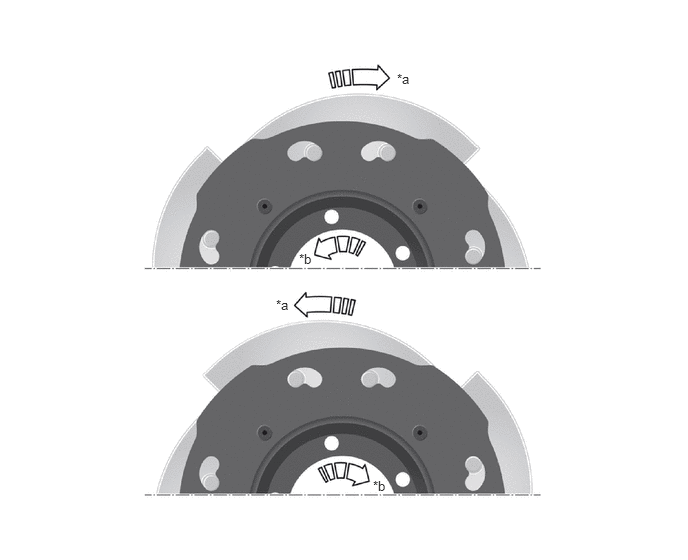
| *a | Oscillating Mass | *b | Torsional Vibration of The Engine |
The following advantages result from eliminating the torsional vibrations:
The lockup clutch can remain closed over a larger engine speed range.
The slip in the lockup clutch can be reduced and thus also the slip percentage in the torque converter. The efficiency is therefore improved.
Lower engine speeds can be used.
These measures lead to a reduction of the fuel consumption and improved acoustics in the passenger compartment.