8HP51 AUTOMATIC TRANSMISSION / TRANSAXLE AUTOMATIC TRANSMISSION SYSTEM DETAILS PLANETARY GEAR
CONSTRUCTION
Brakes and clutches are described as shift elements that enable shifting and changing gears. The automatic transmission needs only five shift elements to change eight gears. The following shift elements are used:
2 fixed multi-plate brakes (brakes B1 and B2)
3 rotating multidisc clutches (clutches K1, K2 and K3)
The multidisc clutches transmit the drive torque to the planetary gear. The multi-plate brakes support the torque against the transmission housing.
Clutches and brakes are closed hydraulically. Furthermore, the linked movement of a hydraulic piston compresses the plate packages against each other strongly. When oil pressure drops, the outer side multi-plate brake shift elements are pressed back into their initial position by a spring plate. The multi-plate brake is opened hydraulically. The shift elements enable changing gears without traction interruption. In addition, all gearshifts (from first to eighth gear and back) are performed as overlapping gear changes. During the shift process, the "transmitting" clutch remains actuated with a lower pressure value until the "receiving" clutch can transmit the torque.
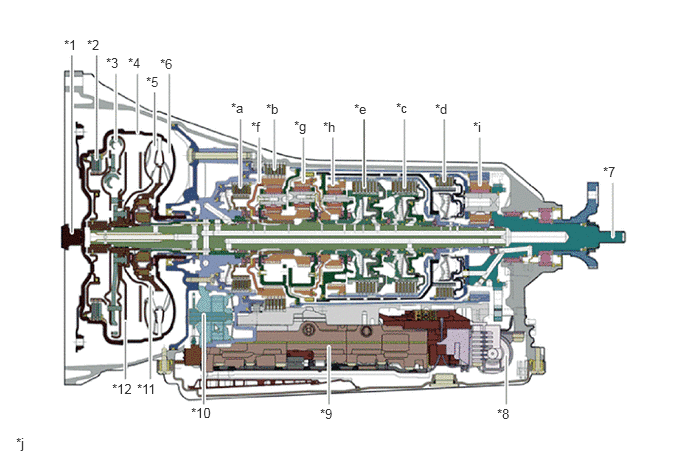
| *1 | Guide Pivot | *2 | Lockup Clutch |
| *3 | Torsional Vibration Damper | *4 | Torque Converter |
| *5 | Turbine Runner | *6 | Pump Impeller |
| *7 | Transmission Output Shaft | *8 | Hydraulic Impulse Storage |
| *9 | Mechatronics | *10 | Vane-type Compressor |
| *11 | Stator | *12 | Centrifugal Pendulum |
| *a | Brake B1 | *b | Brake B2 |
| *c | Clutch K1 | *d | Clutch K2 |
| *e | Clutch K3 | *f | Planetary Gear Set P1 |
| *g | Planetary Gear Set P2 | *h | Planetary Gear Set P3 |
| *i | Planetary Gear Set P4 | *j | The illustrations shown are examples only. |
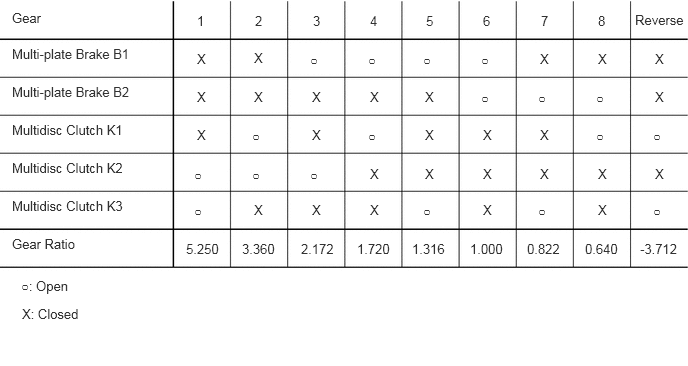
The following table shows the generation of individual gears. It shows which shift elements are closed and which are open as well as the resulting transmission gear ratio.