B48 INTAKE / EXHAUST TURBOCHARGER ON-VEHICLE INSPECTION
CAUTION / NOTICE / HINT
If there are signs of leakage, the cause should first be looked for in the vicinity of the turbocharger sub-assembly and eliminated if possible. The pressure in the turbine and compressor housing is greater than in the bearing housing, which means that an oil leak from the turbocharger sub-assembly in normal condition is physically impossible.
PROCEDURE

 1. EXTERNAL OIL LEAK
Leakage on oil supply or oil return line
When leaks are detected at the oil supply or oil return, check the bolt connections for tightening torques and correctly installed gaskets.
Escaping blow-by oil
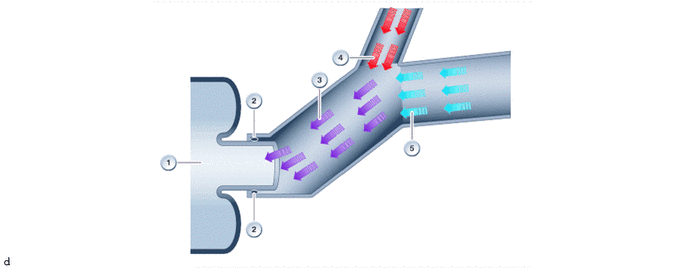
| *1 | Compressor housing | *2 | Sealing ring |
| *3 | Fresh air, enriched with blow-by oil | *4 | Blow-by gas from crankcase ventilation |
| *5 | Fresh air | - | - |
Oil can penetrate into the air intake duct via the crankcase ventilation.
If the gaskets of the air intake duct or charge air duct leak, blow-by oil can emerge there.
Check the following when blow-by oil emerges:
Crankcase ventilation (measure internal pressure of the engine!)
Gaskets of the air duct
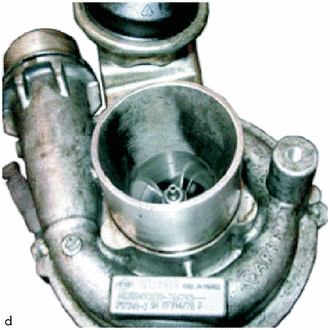
When an excessive amount of blow-by oil is present in the air duct, the cause for that must be eliminated.
Turbocharger sub-assembly with normal deposits.
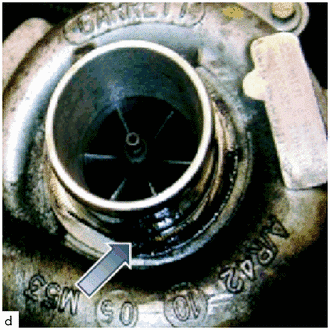
Oil deposits on the compressor housing.
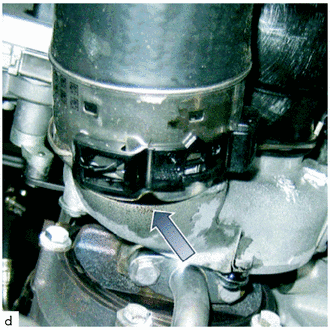
Unacceptable oil leakage at the hose connection.
2. INTERNAL OIL LEAK
- NOTICE:
-
The causes of the oil leaks described here are not caused by the turbocharger sub-assembly itself. If such oil leak occurs, the cause must be eliminated in the periphery!
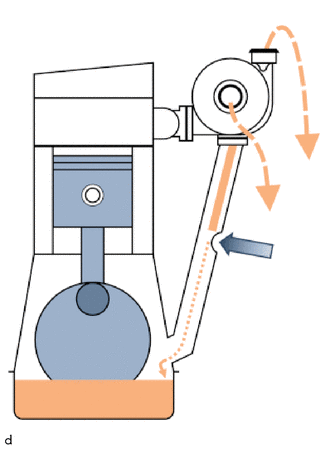
Oil return restricted
If the oil return is restricted due to oil coking, the oil can no longer flow freely from the turbocharger sub-assembly bearing housing into the oil return. Excess pressure builds up in the bearing housing, and the oil is pressed out past the radial shaft seals and into the charge air duct and the turbine.
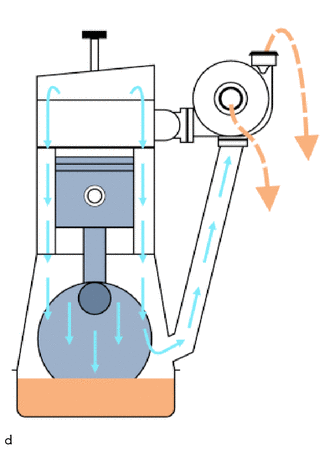
Crankcase ventilation faulty
If the pressure inside the crankcase is too high as a result of faulty crankcase ventilation, the oil can no longer flow freely from the turbocharger sub-assembly bearing housing into the oil return. Excess pressure builds up in the bearing housing, and the oil is pressed out past the radial shaft seals and into the charge air duct and the turbine.
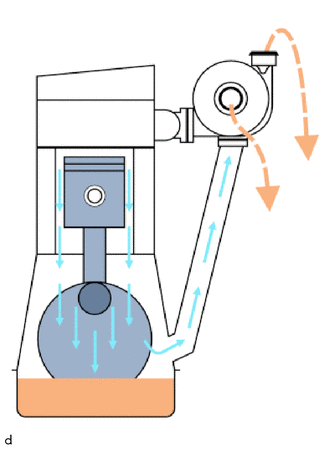
Worn piston rings/increase in blow-by gas
If the pressure inside the crankcase is too high as a result of faulty piston rings, the oil can no longer flow freely from the turbocharger sub-assembly bearing housing into the oil return. Excess pressure builds up in the bearing housing, and the oil is pressed out past the radial shaft seals and into the charge air duct and the turbine.
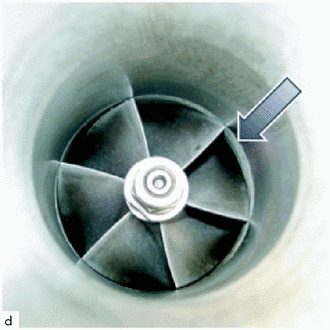
Bearing damage, turbocharger sub-assembly
Impeller scraping against housing.
The turbocharger sub-assembly has a dynamic plain bearing which stabilizes itself in operation. This means that in rest state, play in the shaft is normal.
As long as the impeller does not scrape against the housing, play in the shaft bearing is OK and there is no bearing damage.
If the impeller scrapes against the housing, the shaft bearing of the turbocharger sub-assembly is damaged.
If the shaft bearing of the turbocharger sub-assembly is damaged, the radial shaft seals will no longer seal properly and oil flows from the bearing housing into the compressor and turbine.
3. CRACKS IN THE TURBINE HOUSING
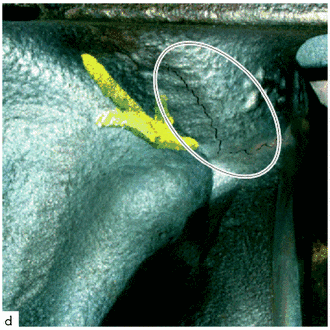
In the event of cracks in the turbine housing that have led to exhaust leaks (soot traces at surrounding components), the turbocharger sub-assembly must be replaced.
External crack in turbine housing.
4. EXHAUST GAS LEAKS AT SCREW CONNECTIONS
Incorrect AZDs or tension can lead to leakage at the connection of the turbine housing to the exhaust manifold. The exhaust manifold must also be checked for leaks.
5. EXHAUST LEAKS BETWEEN TURBINE AND BEARING HOUSINGS
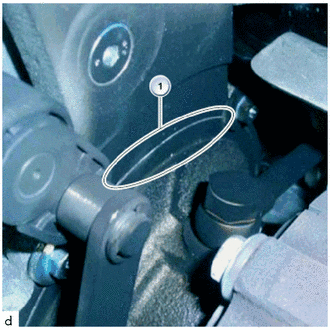
Leaks at the connection of turbine housing and bearing housing can lead to heavy soot accumulations on the surrounding components. In the event of such leaks the turbocharger sub-assembly must be replaced.
Exhaust leaks between turbine and bearing housings
6. EXHAUST GAS ESCAPING AT THE ADJUSTING MECHANISM
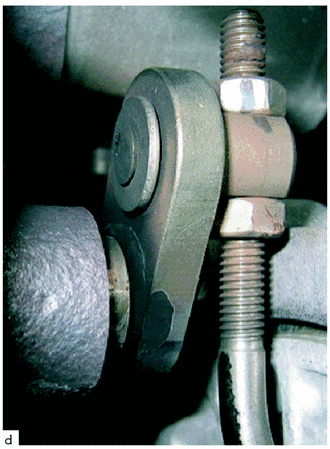
The adjusting mechanism is connected to the variable turbine geometry by the wall of the exhaust turbocharger housing. Limited leakage occurs at this point for design reasons. Such leaks may produce slight discoloration of the outer side of the turbocharger sub-assembly.
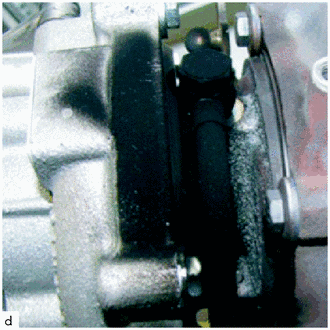
Normal discoloration as a result of a leak.
Excessive deposits.