B48 INTAKE / EXHAUST TURBOCHARGER INSPECTION
CAUTION / NOTICE / HINT
Complaints of a lack of power are usually connected with one or more fault entries in the engine control unit (charging pressure control deviation). These fault entries must be processed using the diagnosis system.
PROCEDURE

 1. BEARING DAMAGE
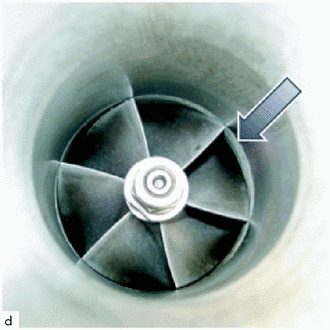
If the compressor or turbine wheel rub against the housing (see picture below), the turbocharger sub-assembly is faulty. This damage leads not only to a drop below the charging pressure but also noises.
Traces left by the impeller grinding against the housing.
2. FOREIGN BODY ON THE TURBINE SIDE
If a foreign body damages the turbine wheel, the efficiency of the turbocharger sub-assembly is severely limited and the required charging pressure is no longer reached. Where a foreign body causes damage on the turbine side, the adjustment vanes are usually also damaged in addition to the turbine wheel, which often causes the adjusting mechanism to jam.
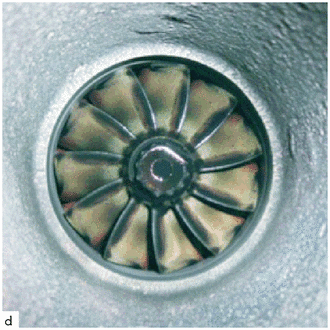
In the event of damage caused by a foreign body, it is imperative to establish how the foreign body penetrated the system and to remedy the cause, as otherwise the newly installed turbocharger sub-assembly may also be damaged.
Normal turbine wheel without damage.
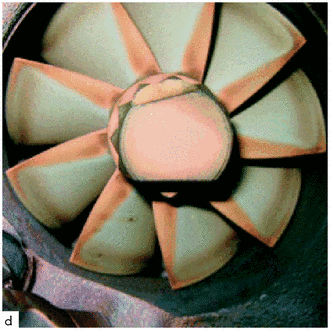
Normal turbine wheel without damage.
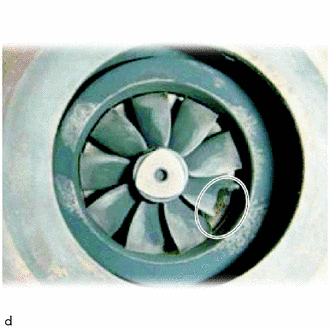
The picture below shows an example for a damaged turbine wheel.
Turbine vanes damaged by foreign bodies.
3. FOREIGN BODY ON THE COMPRESSOR SIDE
If a foreign body damages the impeller, the efficiency of the turbocharger sub-assembly is severely limited and the required charging pressure is no longer reached.
In the event of damage caused by a foreign body, it is imperative to establish how the foreign body penetrated the system and to remedy the cause, as otherwise the newly installed turbocharger sub-assembly may also be damaged.
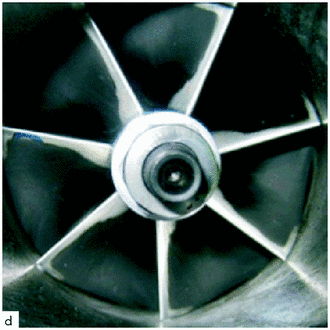
Slight discoloration and shiny patches on the impeller arise normally during production and in operation, see the following image.
Normal impeller without damage.
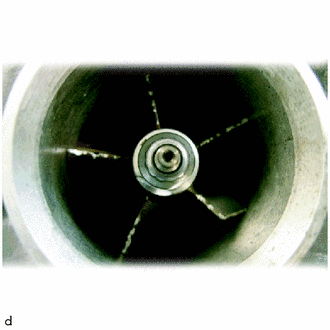
The following images show examples of damaged impellers.
Impeller damaged by foreign bodies.
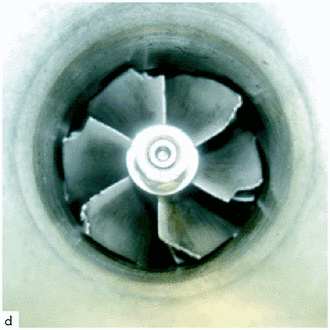
Impeller damaged by foreign bodies.
4. COMPRESSOR PUMPING
The phenomenon referred to as compressor pumping can occur if the charging pressure becomes too high where there is low air mass flow. The air current at the compressor is severed abruptly and a pulsating current develops. This current can damage the compressor and cause disruptive noises.
Charger pumping may occur due to defects that obstruct the air mass flow in the charge air guide or cause excessive charging pressure.
5. EXTERNAL CORROSION
External corrosion on the turbine housing is not a cause for concern. External corrosion on the adjusting mechanism is also not a cause for concern as long as the function of the adjusting mechanism is OK. The function of the adjusting mechanism must be checked through the diagnosis system.
6. OIL CRUSTING ON THE COMPRESSOR INTAKE
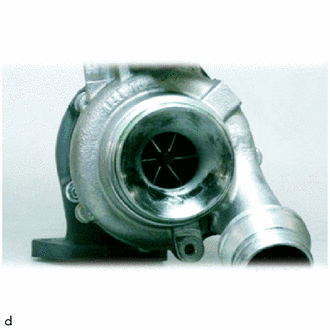
If the oil content in the blow-by gas is too high, heavy oil crusting may form on the compressor. In this case, the cause of the excessive oil content must be remedied.
Normal oil accumulations in the diffuser of the compressor.
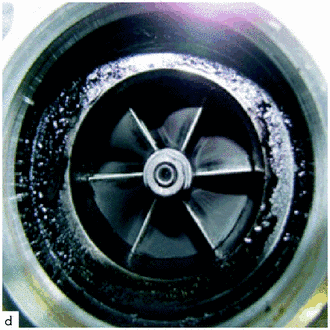
Heavy oil crusting in the diffuser of the compressor.
7. OIL GRADE
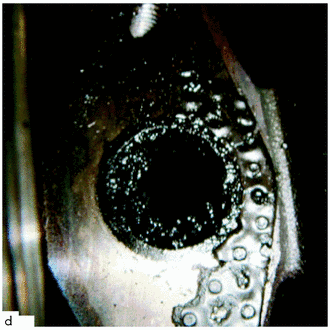
Oil of poor quality can break down and form deposits in the oil circuit. This can lead to insufficient lubrication of the turbocharger sub-assembly. Only Toyota Genuine Motor Oil SN 0W-20 C5 for GR Toyota Supra oil may be used.
Oil deposits in the oil return.
8. CHARGE AIR ROUTING HAS A LEAK
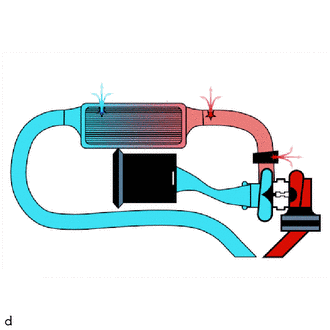
In the event of leakage in the charge air routing, the charging pressure and thus the power of the engine falls. Noises may also arise.
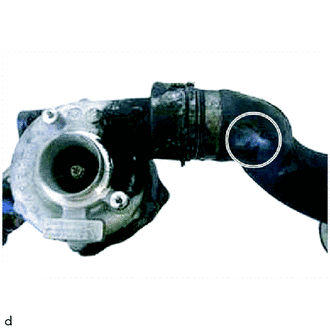
Leaky charge air routing caused by a damaged hose.
9. AIR CLEANER CLOGGED/FAULTY OR SUCTION DUCT NARROWED
If the air intake duct is blocked (for example the air cleaner is clogged/faulty or the air intake hose has collapsed ), this leads to a lack of air in the compressor. As a result, the compressor is not able to generate the charging pressure.
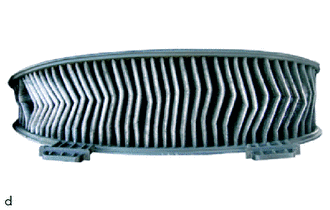
This fault almost always results in serious overspeeding of the turbocharger sub-assembly.
Example: Faulty air cleaner with damaged fins (air cleaner contracts under load and blocks the air intake duct).
10. WIRING OF THE CHARGING PRESSURE ACTUATOR IS FAULTY
If the wiring of the charging pressure actuator is faulty, the engine control cannot activate the charging pressure actuator properly. This can have various effects (excessively high charging pressure, excessively low charging pressure, poor response characteristics).