Radio frequency band
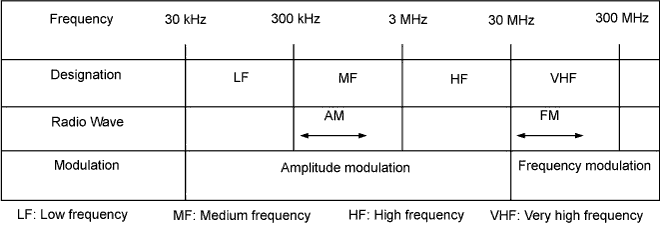
The radio wave bands used in radio broadcasting are as follows:
 |
Service area
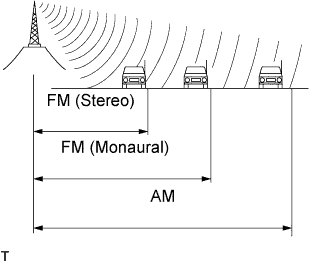
There is a great difference in the size of the service areas for AM and FM broadcasting. Sometimes an FM stereo broadcast cannot be received even though AM can be received very clearly.
FM stereo has a smaller service area, ant it also picks up static and other types of interference (noise) easily.
Radio reception problems
- HINT:
- Besides the problem of static, there are other problems, such as phasing, multipath and fade-out. These problems are caused not by electrical noise but by the nature of the radio waves themselves.
Phasing
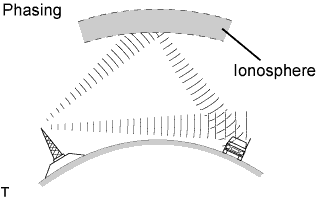
Besides electrical interference, AM broadcasts are also susceptible to other types of interference, especially at night. This is because AM radio waves bounce off the ionosphere at night. These radio waves then interfere with the signals that reach the vehicle's antenna directly from the same transmitter. This type of interference is called phasing.Multipath
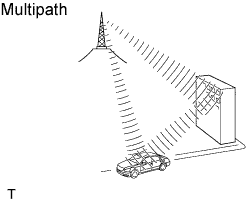
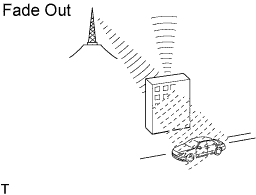
Interference caused by reflection of radio waves against obstructions is called multipath. Multipath occurs when radio signals emitted from the broadcast transmitter antenna are reflected against tall buildings or mountains and interfere with other signals which are received directly.Fade-out
FM radio waves tend to be reflected against obstructions such as tall buildings or mountains because FM frequency is higher than AM. For this reason, FM signals often seem to gradually disappear or fade away as the vehicle goes behind those obstructions. This phenomenon is called fade-out.
 |
 |
 |
Noise problem
It is very important for technicians to clearly understand a customer's complaint about noise. Use the following table to diagnose the phenomena.
| Radio Wave | Condition in Which Noise Occurs | Probable Cause |
| AM | Noise occurs in a specified area | Strong possibility of foreign noise |
| Noise occurs when listening to faint broadcasting | The same program may be broadcasted from some local stations. If the program is the same, one of those may be tuned in. | |
| Noise occurs only at night | Strong possibility of an interfering beat from a distant broadcast. | |
| FM | Noise occurs at a specific place while driving | Strong possibility of multipath noise and phasing noise caused by changes of FM frequency. |
- HINT:
- If the condition when the noise occurs is not described above, find out the cause based on the reception problems. Refer to the description about multipath and phasing mentioned previously.
Identify the conditions under which the noise occurs, and check the noise filter on the relevant part.
| Conditions under Which Noise Occurs | Noise Type |
| Noise increases when the accelerator pedal is depressed, but stops when the engine is stopped. | Generator noise |
| Noise occurs during A/C or heater operation. | Blower motor noise |
| Noise occurs when the vehicle accelerates rapidly on an unpaved road or after the ignition switch is turned on. | Fuel pump noise |
| Noise occurs when the horn switch is pressed and released or when pressed and held. | Horn noise |
| Quiet noise occurs while the engine is running, but stops when the engine is stopped. | Ignition noise |
| Noise occurs synchronously with the blink of the turn signal. | Flasher noise |
| Noise occurs during window washer operation. | Washer noise |
| Noise occurs while the engine is running, and continues even after the engine is stopped. | Engine coolant temperature sensor noise |
| Noise occurs during wiper operation. | Wiper noise |
| Noise occurs when the brake pedal is depressed. | Stop light switch noise |
| Others | Start electricity stored on the vehicle |
- First ensure that the noise is not coming from the outside. Failure to do so makes noise source detection difficult and may lead to a misdiagnosis.
- Noise should be removed in descending order of loudness.
- Tuning the radio so that no station is received makes the noise more noticeable, making recognition of the phenomenon easier.