Home › ENGINE · 2TR-FE › ENGINE CONTROL SYSTEM › SFI SYSTEM

DTC    P0335    Crankshaft Position Sensor "A" Circuit

DTC    P0339    Crankshaft Position Sensor "A" Circuit Intermittent

for Preparation Click here


DESCRIPTION

The Crankshaft Position (CKP) sensor system consists of a CKP sensor plate and a pickup coil. The sensor plate has 34 teeth and is installed on the crankshaft. The pickup coil is made of an iron core and a magnet.
The sensor plate rotates and, as each tooth passes through the pickup coil, a pulse signal is created. The pickup coil generates 34 signals per engine revolution. Based on these signals, the ECM calculates the crankshaft position and engine RPM. Using these calculations, the fuel injection time and ignition timing are controlled.

DTC No.
DTC Detection Conditions
Trouble Areas
P0335
  1. No Crankshaft Position (CKP) sensor signal to ECM while cranking (1 trip detection logic)
  2. No CKP sensor signal to ECM at engine speed of 600 rpm or more (1 trip detection logic)
  1. Open or short in CKP sensor circuit
  2. CKP sensor
  3. Sensor plate (CKP sensor plate)
  4. ECM
P0339
Under conditions (a), (b) and (c), no Crankshaft Position (CKP) sensor signal to ECM for 0.05 seconds or more
(1 trip detection logic):
  1. (a) Engine speed 1,000 rpm or more
  2. (b) Starter signal OFF
  3. (c) 3 seconds or more have elapsed since starter signal switched from ON to OFF
  1. Open or short in CKP sensor circuit
  2. CKP sensor
  3. Sensor plate (CKP sensor plate)
  4. ECM

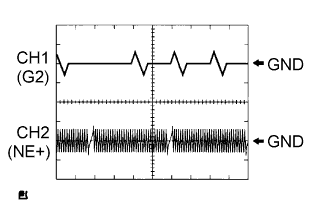
  1. A063955E02
    Reference: Inspection using an oscilloscope

    HINT:
    1. The correct waveform is shown on the left.
    2. G2 stands for the Camshaft Position (CMP) sensor signal, and NE+ stands for the CKP sensor signal.

    Items
    Contents
    Terminals
    CH1: G2 - NE-
    CH2: NE+ - NE-
    Equipment Settings
    5 V/Division, 20 ms/Division
    Conditions
    Cranking or idling

MONITOR DESCRIPTION

If there is no signal from the CKP sensor despite the engine revolving, the ECM interprets this as a malfunction of the sensor.
If the malfunction is not repaired successfully, a DTC is set 10 seconds after the engine is next started.

MONITOR STRATEGY


Related DTCs
P0335: Crankshaft position sensor range check during cranking
P0335: Crankshaft position sensor range check during engine running
Required Sensors/Components (Main)
Crankshaft Position (CKP) sensor
Required Sensors/Components (Related)
-
Frequency of Operation
Continuous
Duration
Conditions met for 3 times
MIL Operation
Immediate
Sequence of Operation
None

TYPICAL ENABLING CONDITIONS


Monitor runs whenever following DTCs not present
None

Crankshaft Position Sensor Range Check during Cranking P0335: 
Starter
ON
Minimum battery voltage while starter ON
Less than 11 V
Number of camshaft position sensor signal pulse
6 or more

Crankshaft Position Sensor Range Check during Engine Running P0335: 
Engine speed
600 rpm or more
Starter
OFF
Time after starter from ON to OFF
3 seconds or more

TYPICAL MALFUNCTION THRESHOLDS


Crankshaft Position Sensor Range Check during Cranking P0335: 
Number of crankshaft position sensor signal pulse
132 or less, or 174 or more

Crankshaft Position Sensor Range Check during Engine Running P0335: 
CKP sensor signal
No signal

COMPONENT OPERATING RANGE


CKP sensor
  1. CKP sensor output voltage fluctuates while crankshaft revolving
  2. 34 CKP sensor signals per crankshaft revolution

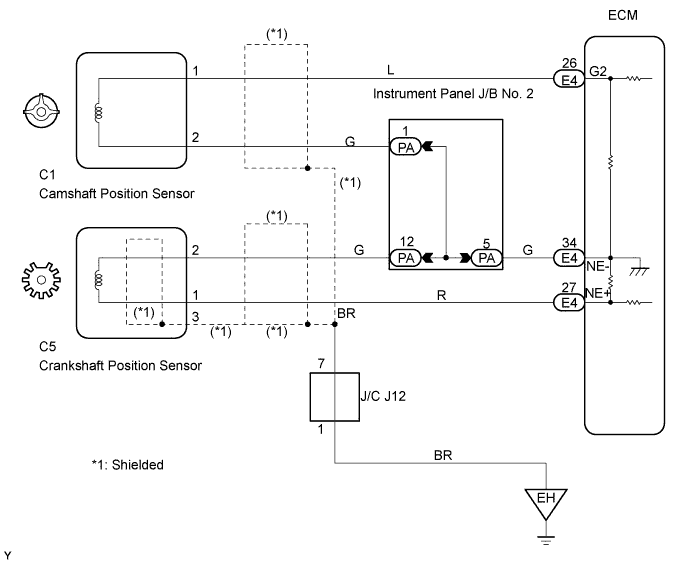
WIRING DIAGRAM


A121744E01


INSPECTION PROCEDURE

HINT:
  1. If no problem is found by this diagnostic troubleshooting procedure, troubleshoot the engine mechanical systems.
  2. Check the engine speed. The engine speed can be checked by using an intelligent tester. To check, follow the operation below:
    (a) Connect an intelligent tester to the DLC3.
    (b) Start the engine.
    (c) Turn the tester ON.
    (d) Select the following menu items: DIAGNOSIS / ENHANCED OBD II / DATA LIST / PRIMARY / ENGINE SPD.
    The engine speed may be indicated as zero despite the engine revolving normally. This is caused by a lack of NE signals from the Crankshaft Position (CKP) sensor. Alternatively, the engine speed may be indicated as lower than the actual engine speed, if the CKP sensor voltage output is insufficient.
  3. Read freeze frame data using an intelligent tester. Freeze frame data record the engine condition when malfunctions are detected. When troubleshooting, freeze frame data can help determine if the vehicle was moving or stationary, if the engine was warmed up or not, if the air-fuel ratio was lean or rich, and other data, from the time the malfunction occurred.

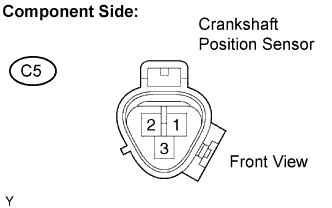
1.INSPECT CRANKSHAFT POSITION SENSOR (RESISTANCE)
G037726E02
  1. Disconnect the C5 Crankshaft Position (CKP) sensor connector.

  1. Measure the resistance between terminals 1 and 2.

    Standard Resistance:
    Tester Connections
    Specified Conditions
    1 - 2
    1,630 to 2,740 Ω at cold
    1 - 2
    2,065 to 3,225 Ω at hot

    HINT:
    Terms cold and hot refer to the temperature of the coils. Cold means approximately -10° to 50°C (14°to 122°F). Hot means approximately 50° to 100°C (122° to 212°F).

  1. Reconnect the CKP sensor connector.


NG
REPLACE CRANKSHAFT POSITION SENSOR
OK


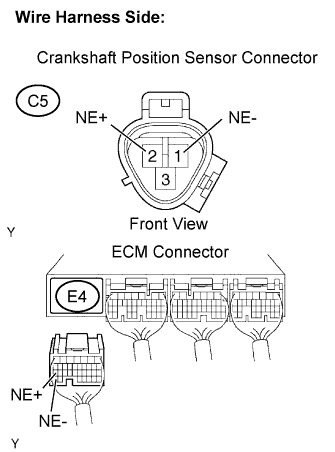
2.CHECK HARNESS AND CONNECTOR (CRANKSHAFT POSITION SENSOR - ECM)
A113506E01
  1. Disconnect the C5 CKP sensor connector.

  1. Disconnect the E4 ECM connector.

  1. Check the resistance.

    Standard Resistance (Check for open):
    Tester Connections
    Specified Conditions
    NE+ (C5-1) - NE+ (E4-27)
    Below 1 Ω
    NE- (C5-2) - NE- (E4-34)
    Below 1 Ω

    Standard Resistance (Check for short):
    Tester Connections
    Specified Conditions
    NE+ (C5-1) or NE+ (E4-27) - Body ground
    10 kΩ or higher
    NE- (C5-2) or NE- (E4-34) - Body ground
    10 kΩ or higher

  1. Reconnect the ECM connector.

  1. Reconnect the CKP sensor connector.


NG
REPAIR OR REPLACE HARNESS OR CONNECTOR
OK


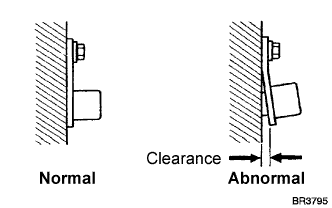
3.CHECK CRANKSHAFT POSITION SENSOR (SENSOR INSTALLATION)
BR03795E31
  1. Check the CKP sensor installation.

    OK:
    Sensor is installed correctly.


NG
SECURELY REINSTALL SENSOR
OK


4.CHECK CRANKSHAFT TIMING PULLEY (TEETH OF PLATE)
  1. Check the teeth of the sensor plate.

    OK:
    Sensor plate does not have any cracks or deformation.


NG
REPLACE CRANKSHAFT POSITION SENSOR PLATE
OK

REPLACE ECM