RADIATOR > INSTALLATION |
| 1. INSTALL NO.2 RADIATOR HOSE |
| 2. INSTALL RADIATOR HOSE INLET |
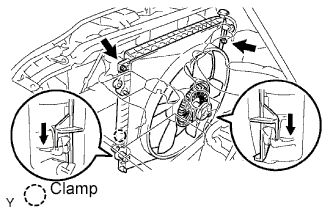
| 3. INSTALL RADIATOR ASSEMBLY |
Install the radiator with the 4 bolts.
Connect the 2 oil cooler hoses (with automatic transmission).
| 4. INSTALL FAN SHROUD |
|
Provisionally install the fan shroud together with the fan pulley.
Install the fan and generator V belt .
Install the fan pulley with the 4 nuts.
Install the fan shroud with the 2 bolts.
Install the 2 cooler hoses into the clamp (with automatic transmission).
Connect the hose to the radiator reserve tank.
| 5. INSTALL RADIATOR SUPPORT TO FRAME SEAL LH |
| 6. CONNECT CABLE TO NEGATIVE BATTERY TERMINAL |
| 7. ADD ENGINE COOLANT |
Pour coolant into the radiator until it overflows.
| Transmission | Capacity |
| Manual Transmission | 9.7 liters (10.3 Us qts, 8.5 Imp. qts) |
| Automatic Transmission | 9.8 liters (10.4 Us qts, 8.6 Imp. qts) |
Check the coolant level inside the radiator by squeezing the inlet and outlet radiator hoses several times by hand. If the coolant level goes down, add coolant.
Install the radiator cap securely.
Slowly pour coolant into the radiator reservoir until it reaches the FULL line.
Warm up the engine until the cooling fan operates.
Set the air conditioning as follows while warming up the engine.
| Item | Condition |
| Fan Speed | Any setting except OFF |
| Temperature | Toward WARM |
| Air Conditioning Switch | OFF |
Maintain the engine speed at 2,000 to 2,500 rpm and warm up the engine until the cooling fan operates.
Squeeze the inlet and outlet radiator hoses several times by hand while warming up the engine.
Stop the engine and wait until the coolant cools down.
Remove the radiator cap and check the coolant level inside the radiator.
If the coolant level is below the full level, perform the steps from (a) through (h) and repeat the operation until the coolant level remains at the full level.
Check the coolant level inside the radiator reservoir tank again. If it is below the full level, add coolant.
| 8. CHECK FOR ENGINE COOLANT LEAKAGE |
Fill the radiator with coolant and attach a radiator cap tester.
Pump it to 118 kPa (1.2 kgf/cm2 17.1 psi), then check for leakage.