Home › SUSPENSION & AXLE › TIRE AND WHEEL › TIRE AND WHEEL SYSTEM

TIRE AND WHEEL SYSTEM > INSPECTION

for Preparation Click here


1. INSPECT TIRES
  1. Check the tires for wear and proper inflation pressure.

    Standard Cold Tire Inflation Pressure:

    Tire Size
    Front Wheel
    kPa (kgf/cm2, psi)
    Rear Wheel
    kPa (kgf/cm2, psi)
    Spare Wheel
    kPa (kgf/cm2, psi)
    P215/70R15 97S
    210 (2.1, 30)
    230 (2.3, 33)
    230 (2.3, 33)
    P245/75R16 109S
    210 (2.1, 30)
    210 (2.1, 30)
    210 (2.1, 30)
    P265/70R16 111T
    200 (2.0, 29)
    220 (2.2, 32)
    220 (2.2, 32)
    P265/65R17 110S
    200 (2.0, 29)
    200 (2.0, 29)
    200 (2.0, 29)
    P255/45R18 99V
    240 (2.4, 35)
    240 (2.4, 35)
    240 (2.4, 35)
    P265/60R18 109H
    200 (2.0, 29)
    200 (2.0, 29)
    200 (2.0, 29)


    C164558
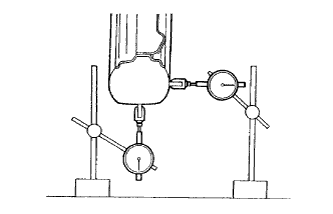
  1. Using a dial indicator, check the tire runout.

    Standard Tire Runout:
    Vertical
    3.0 mm (0.118 in.) or less
    Lateral
    3.0 mm (0.118 in.) or less


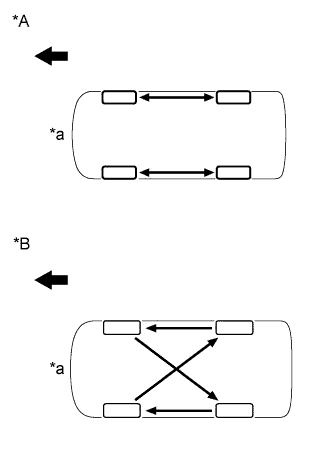
2. ROTATE TIRES


C189613E02

HINT:
Rotate the tires as shown in the illustration.

Text in Illustration 
*A
for USA
*B
Except USA
*a
Overhead View
V100135
Front of Vehicle


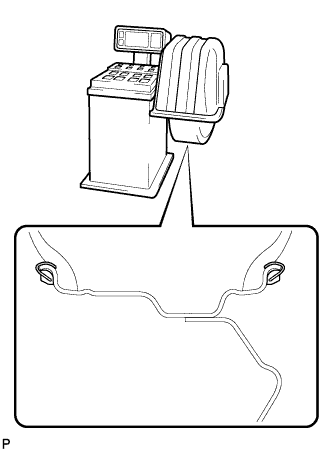
3. INSPECT WHEEL BALANCE


  1. Check and adjust the off-car balance.


      C144019
    1. 2WD 15, 18-inch Wheels:
      4WD, Pre-Runner 16, 17-inch Wheels (except TMS C&A 16-inch Wheels):
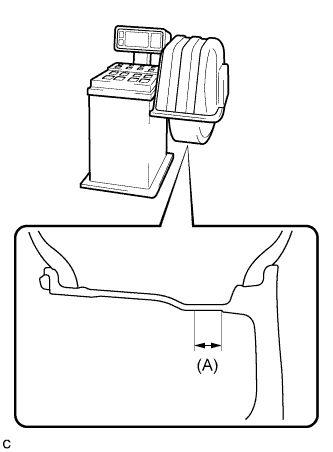
      Maximum imbalance after adjustment:
      8.0 g (0.0176 lb)


    2. C176726E02
    3. 4WD, Pre-Runner TMS C&A 16-inch Wheels:
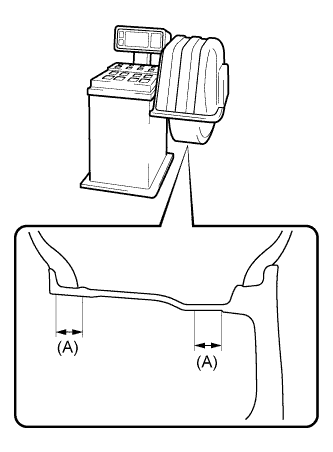
      Maximum imbalance after adjustment:
      8.0 g (0.0176 lb)

      NOTICE:
      1. Remove dirt, oil and water from the balance weight surface with cleaning detergent.
      2. Do not touch the adhesive part of the balance weight.
      3. Adhere the sticking type balance weight to the flat surface (A) shown in the illustration.

        Width (A):
        25 mm (0.984 in.)

      4. Push the balance weight securely with a finger to adhere it to the position.

        Pushing force:
        10 kgf/more than 2 seconds

      5. Do not reuse the balance weight.

      HINT:
      The inner side balance weight should be installed by clipping it to the rim.


    4. C249027E01
    5. 4WD, Pre-Runner 18-inch Wheels:

      Maximum imbalance after adjustment:
      8.0 g (0.0176 lb)

      NOTICE:
      1. Remove dirt, oil and water from the balance weight surface with cleaning detergent.
      2. Do not touch the adhesive part of the balance weight.
      3. Adhere the sticking type balance weight to the flat surface (A) shown in the illustration.

        Width (A):
        25 mm (0.984 in.)

      4. Push the balance weight securely with a finger to adhere it to the position.

        Pushing force:
        10 kgf/more than 2 seconds

      5. Do not reuse the balance weight.

  1. If necessary, check and adjust the on-car balance.

    Standard imbalance after adjustment:
    8.0 g (0.0176 lb) or less


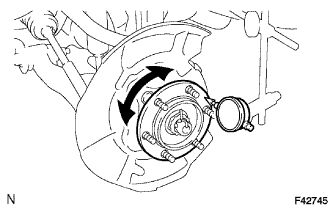
4. INSPECT FRONT AXLE HUB BEARING


F042745
  1. Remove the front wheel.

  1. for 4WD:

    1. Remove the front axle hub grease cap .

  1. for 2WD:

    1. Remove the front disc brake caliper .

  1. for 4WD and Pre-Runner

    1. Remove the front disc brake caliper .

  1. Remove the front disc.

  1. Inspect the axle hub backlash.

    1. Using a dial indicator, check the backlash near the center of the axle hub.
      Maximum:
      0.05 mm (0.0020 in.)

      If the backlash exceeds the maximum, replace the bearing.


    F042746
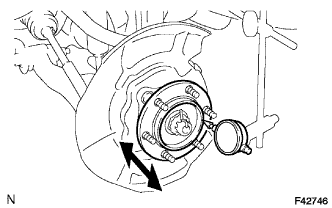
  1. Inspect the axle hub deviation.

    1. Using a dial indicator, check the distortion of the surface of the axle hub.

      Maximum:
      0.05 mm (0.0020 in.)

      If the deviation exceeds the maximum, replace the bearing.


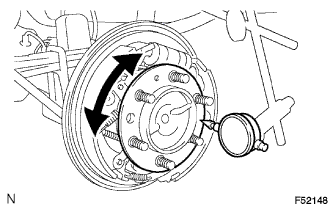
5. INSPECT REAR AXLE HUB BEARING


F052148
  1. Remove the rear wheel.

  1. Remove the rear brake drum .

  1. Inspect the axle shaft backlash.

    1. Using a dial indicator, check the backlash near the center of the axle shaft.
      Maximum:
      0.05 mm (0.0020 in.)

      If the backlash exceeds the maximum, replace the bearing.


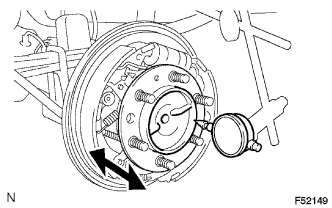
    F052149
  1. Inspect the axle shaft deviation.

    1. Using a dial indicator, check the distortion of the surface of the axle shaft.

      Maximum:
      0.05 mm (0.0020 in.)

      If the deviation exceeds the maximum, replace the bearing.