Disconnect the vent line hose from the charcoal canister.
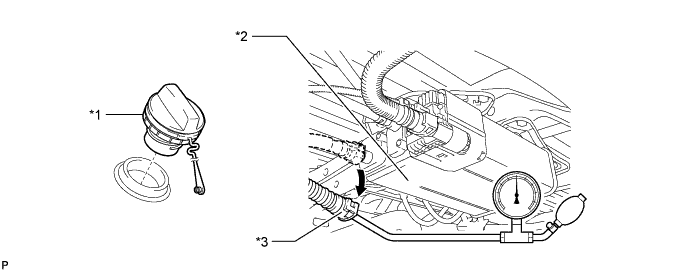
| *1 | Fuel Tank Cap | *2 | Charcoal Canister |
| *3 | Vent Line Hose | - | - |
EMISSION CONTROL SYSTEM > ON-VEHICLE INSPECTION |
| 1. INSPECT FUEL CUT-OFF RPM |
Start and warm up the engine.
Open the throttle valve and keep the engine speed at 3000 rpm.
Use a sound scope to check for injector operating noise.
Check that when the accelerator pedal is released, injector operation noise stops momentarily and then resumes.
If the result is as not specified, check the injector, wiring and ECM.
| 2. VISUALLY INSPECT HOSES, CONNECTIONS AND GASKETS |
Check that there are no cracks, leaks or damage.
| 3. INSPECT FUEL CUT-OFF VALVE AND FILL CHECK VALVE |
Disconnect the vent line hose from the charcoal canister.
| *1 | Fuel Tank Cap | *2 | Charcoal Canister |
| *3 | Vent Line Hose | - | - |
Connect a pressure gauge to the vent line hose.
Fill the fuel tank with fuel.
Apply a pressure of 4 kPa (41 gf/cm2, 0.6 psi) to the vent port of the fuel tank.
Remove the fuel tank cap and check that the pressure inside the tank drops.
If the pressure does not drop, replace the fuel tank assembly.
Reconnect the vent line hose to the charcoal canister.
| 4. CHECK AIR INLET LINE |
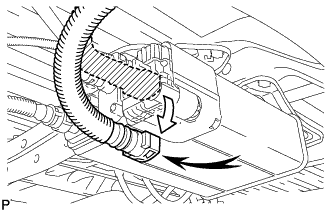 |
Disconnect the air inlet line hose from the charcoal canister.
Check that there is ventilation in the air inlet line.
If air cannot flow freely into the air inlet line, repair or replace the air inlet line.
Reconnect the air inlet line hose to the charcoal canister.
| 5. INSPECT PRESSURE SENSOR |
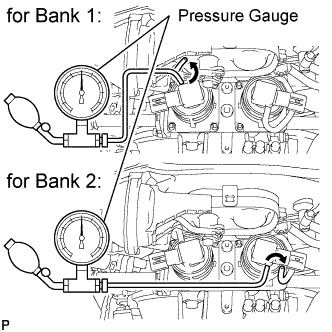 |
Connect a pressure gauge to the air pressure sensor as shown in the illustration.
Connect the Techstream to the DLC3.
Turn the ignition switch to ON and turn the Techstream ON.
Enter the following menus:
Select: Powertrain / Engine and ECT / Data List / All Data / Air pump pressure (absolute).
Check that the pressure displayed on the tester fluctuates when applying pressure to the pressure sensor with the pressure gauge.
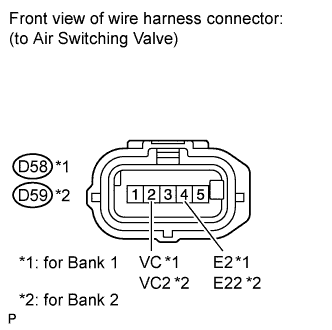 |
Check the power source voltage.
Disconnect the connector.
Measure the voltage according to the value(s) in the table below.
| Tester Connection | Condition | Specified Condition |
| D58-2 (VC) - D58-4 (E2) | Ignition switch ON | 4.75 to 5.25 V |
| D59-2 (VC2) - D59-4 (E22) |