PARK ASSIST / MONITORING BLIND SPOT MONITOR SYSTEM GENERAL GENERAL
OUTLINE
The blind spot monitor system performs 2 functions using the same blind spot monitor sensors: blind spot monitor function and RCTA function.
The blind spot monitor function and RCTA function can be enabled or disabled from the setting tab of the multi-information display.
The blind spot monitor system consists of the 2 blind spot monitor sensors, steering sensor, yawrate sensor, outer rear view mirror assembly LH and RH, RCTA buzzer (No. 1 clearance warning buzzer) and combination meter assembly.
The blind spot monitor function uses sensors to detect vehicles that are in or rapidly approaching the vehicle's blind spot, helping the driver to confirm safety when changing lanes.
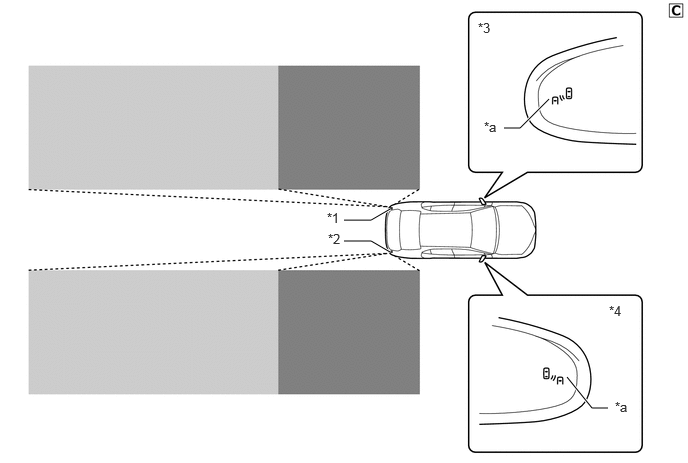
| *1 | Blind Spot Monitor Sensor LH | *2 | Blind Spot Monitor Sensor RH |
| *3 | Outer Rear View Mirror Assembly LH | *4 | Outer Rear View Mirror Assembly RH |
| *a | Outer Rear View Mirror Indicator Light | - | - |

|
Detection Area (for Vehicle in Blind Spot) | 
|
Detection Area (for Rapidly Approaching Vehicle from Behind) |
If the RCTA function detects a vehicle approaching from the right or left at the rear of the vehicle while the driver is reversing in a parking lot, the function alerts the driver by sounding the RCTA buzzer (No. 1 clearance warning buzzer) and flashing the outer rear view mirror indicator light to provide information for the driver, supporting decision making.
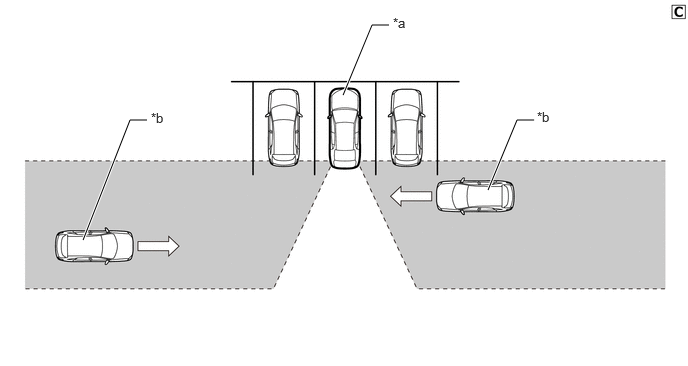
| *a | This Vehicle | *b | Target Vehicle |
|
|
Detection Area | - | - |
PRECAUTION
Blind Spot Monitor Function
Cautions regarding the use of the system
The driver is solely responsible for safe driving. Always drive safely, taking care to observe your surroundings.
The blind spot monitor function is a supplementary function which alerts the driver that a vehicle is in a blind spot of the outside rear view mirrors or is approaching rapidly from behind into a blind spot. Do not overly rely on the blind spot monitor function. As the function cannot judge if it is safe to change lanes, over reliance could lead to an accident resulting in death or serious injury. As the system may not function correctly under certain conditions, the driver's own visual confirmation of safety is necessary.
Outside rear view mirror indicator visibility
In strong sunlight, the outside rear view mirror indicator may be difficult to see.
The blind spot monitor function is not designed to detect the following types of vehicles and/or objects:
Small motorcycles, bicycles, pedestrians, etc.*
Vehicles traveling in the opposite direction.
Guardrails, walls, signs, parked vehicles and similar stationary objects.*
Following vehicles that are in the same lane.*
Vehicles traveling 2 lanes away from this vehicle.
Vehicles which are being overtaken rapidly by this vehicle.
*: Depending on conditions, detection of a vehicle and/or object may occur.
- HINT:
-
In this section, the expression "this vehicle" is used to refer to the vehicle equipped with this blind spot monitor function.
The blind spot monitor function may not detect vehicles correctly in the following situations:
When the sensor is misaligned due to a strong impact to the sensor or its surrounding area.
When mud, snow, ice, a sticker, etc. is covering the sensor or surrounding area on the rear bumper.
When driving on a road surface that is wet with standing water during bad weather such as heavy rain, snow, or fog.
When multiple vehicles are approaching with only a small gap between each vehicle.
When the distance between this vehicle and a following vehicle is short.
When there is a significant difference in speed between this vehicle and the vehicle that enters the detection area.
When the difference in speed between this vehicle and another vehicle is changing.
When a vehicle enters a detection area traveling at about the same speed as this vehicle.
As this vehicle starts from a stop, a vehicle remains in the detection area.
When driving up and down consecutive steep inclines, such as hills, dips in the road, etc.
When driving on roads with sharp bends, consecutive curves, or uneven surfaces.
When vehicle lanes are wide, or when driving on the edge of a lane, and the vehicle in an adjacent lane is far away from this vehicle.
When an accessory (such as a bicycle carrier) or towing eyelet is installed to the rear of the vehicle.
When there is a significant difference in height between this vehicle and the vehicle that enters the detection area.
Immediately after the blind spot monitor system is turned on.
- HINT:
-
In this section, the expression "this vehicle" is used to refer to the vehicle equipped with this blind spot monitor function.
Instances of the blind spot monitor function unnecessarily detecting a vehicle and/or object may increase under the following situations:
When the sensor is misaligned due to a strong impact to the sensor or its surrounding area.
When the distance between this vehicle and a guardrail, wall, etc. that enters the detection area is short.
When driving up and down consecutive steep inclines, such as hills, dips in the road, etc.
When vehicle lanes are narrow, or when driving on the edge of a lane, and a vehicle traveling in a lane other than the adjacent lanes enters the detection area.
When driving on roads with sharp bends, consecutive curves, or uneven surfaces.
When the tires are slipping or spinning.
When the distance between this vehicle and a following vehicle is short.
When an accessory (such as a bicycle carrier) or towing eyelet is installed to the rear of the vehicle.
- HINT:
-
In this section, the expression "this vehicle" is used to refer to the vehicle equipped with this blind spot monitor system.
RCTA Function
Safety precautions
The driver is responsible for safe operation of the vehicle. The driver must always be aware of the surroundings to ensure safe driving.
The RCTA is a supplemental system that notifies the driver of vehicles approaching from the rear left and rear right of the vehicle. The RCTA may not function effectively in certain conditions. The driver must therefore visually confirm safety. Relying solely upon the RCTA may result in unforeseen accidents, serious injury or even death.
Hearing RCTA buzzer sound
The RCTA buzzer (blind spot monitor system) may be difficult to hear if playing audio at a loud volume or if there are other loud noises.
The following types of vehicles and objects are not detected by the RCTA.
Vehicles approaching directly to the rear.
Vehicles reversing in a parking space next to the vehicle.
Stationary objects such as guardrails, walls, signs, parked vehicles, etc.*
Small two-wheeled vehicles, bicycles, pedestrians, etc.*
Vehicles that are moving away from the driver's own vehicle.
Vehicles approaching from a parking space next to the vehicle.*
Vehicles that cannot be detected by the blind spot monitor sensor due to obstacles in the way.
- HINT:
-
*: The sensor may detect the vehicles and objects described above depending on the situation.
Situations in which the RCTA may not operate effectively
The RCTA may not effectively detect vehicles in the following situations.
A blind spot monitor sensor position or direction is misaligned because the blind spot monitor sensor or the area around it was subject to a strong impact or the like.
Dirt, snow, ice, stickers or other objects are attached to the blind spot monitor sensor or to the rear bumper near the blind spot monitor sensor.
The vehicle is being driven through puddles or on wet roads during bad weather, such as heavy rain, snow or fog.
When multiple vehicles come close consecutively over a short period of time.
There are rapidly approaching vehicles.
The vehicle is reversing on slopes with extreme changes in gradient.
When the distance between the blind spot monitor and an approaching object is too close.
When an approaching vehicle is concealed from the blind spot monitor sensor by an adjacent vehicle, etc.
When accessories such as a bicycle carrier or towing hook, etc. are installed to the rear of the vehicle.
When there is too large of a height difference between this vehicle and a vehicle entering the detection area.
In extremely hot or extremely cold weather
When the suspension has been lowered, or when using tires of a different diameter than genuine ones, etc.
When there are extreme changes to vehicle height (nose-up, nose-down)
When this vehicle is making a turn.
The vehicle is entering or exiting a diagonal parking space.
A vehicle approached while making a turn.
There may be unnecessary detections in the following situations.
Vehicles pass alongside the vehicle.
There is a metal object that easily reflects radio waves to the rear (such as a guardrail, wall, sign or parked vehicle).
A towing hook is attached to the rear of the vehicle.
When driving very close to a guard rail, wall, etc., and the guard rail or wall enters the detection area.
A moving object is making a turn in close proximity to this vehicle.
A vehicle is driving on a road facing the parking area.
There is a rotating object such as an outdoor air conditioner unit near this vehicle.
Water was sprayed toward the sensor, such as from a sprinkler.
In response to moving objects (flags, clouds of exhaust gas, large droplets of rain or snow, rainwater on the road surface, etc.)
Near a grating or drainage channel.
When the suspension has been lowered, or when using tires of a different diameter than genuine ones, etc.
When there are extreme changes to vehicle height (nose-up, nose-down)
In extremely hot or extremely cold weather
Blind spot monitor sensors are installed inside the left and right side of the vehicle rear bumper respectively. Observe the following to ensure the blind spot monitor function can function correctly.
Keep the sensors and the surrounding areas on the rear bumper clean at all times.
Do not subject a sensor or its surrounding area on the rear bumper to a strong impact. If a sensor is moved even slightly off position, the system may malfunction and vehicles may not be detected correctly. In the following situations, have this vehicle inspected by your Toyota dealer.
A sensor or its surrounding area is subject to a strong impact.
If the surrounding area of a sensor is scratched or dented, or part of them has become disconnected.
Do not disassemble the sensor.
Do not install accessories to the sensors or the rear bumper near the sensors or apply any sticker (including a transparent one) or aluminum tape.
Do not modify the sensor or surrounding area on the rear bumper.
Do not paint the rear bumper any color other than an official Toyota color.
This product conforms to radio wave regulations in each country. The stamp on the surface of the product serves as proof of this. Do not remove it.
Do not modify the product.
Modifying the product will invalidate the certification number.
Contact your Toyota dealer when removal and installation or replacement of the bumper is necessary.
- HINT:
-
In this section, the expression "this vehicle" is used to refer to the vehicle equipped with this blind spot monitor function.