BRAKE CONTROL / DYNAMIC CONTROL SYSTEMS BRAKE CONTROL SYSTEM(for HV Model) CONTROL CROSSWIND ASSIST(CWA)
SYSTEM CONTROL
Crosswind Assist (CWA) reduces the yaw moment caused by crosswinds during high-speed driving, contributing to straight-line stability.
Based on information from the speed sensors, yawrate sensor, acceleration sensor and steering sensor, when the skid control ECU detects significant deviation of the vehicle, it determines that the vehicle is in a crosswind condition. Based on the judgment result, the skid control ECU calculates the necessary brake fluid pressure according to the vehicle speed and intensity of the crosswind, and drives the brake actuator assembly to generate brake fluid pressure for the front and rear wheels on the upwind side. In this way, the yaw moment caused by the crosswind is reduced, and the deviation of the vehicle is reduced.
As a result, the time before the driver needs to make steering corrections is extended, helping to prevent the vehicle from deviating from its lane.
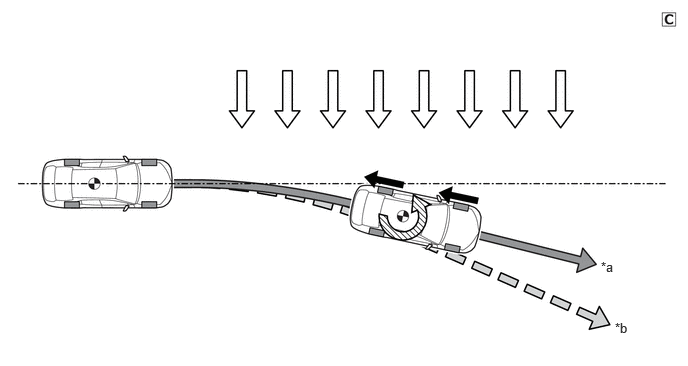
| *a | with Crosswind Assist (CWA) | *b | without Crosswind Assist (CWA) |

|
Braking Force | 
|
Crosswind |

|
Yaw Moment | - | - |
Conditions for starting Crosswind Assist (CWA) control
When all of the following conditions are met, Crosswind Assist (CWA) control begins. During operation, the slip indicator light blinks.
·
During high-speed driving ·
The driver is driving the vehicle straight ahead ·
Significant deviation of the vehicle is occurring ·
The driver is not operating the brakes ·
Brake control is not operating ·
A certain amount of time has passed since the previous Crosswind Assist (CWA) operation ·
The system is not in test mode or maintenance mode |
Conditions for stopping Crosswind Assist (CWA) control
When any of the following conditions are met, Crosswind Assist (CWA) control stops, and the slip indicator light turns off.
·
The vehicle is not being driven at high speed ·
The crosswind has weakened ·
The system has been operating for a certain amount of time ·
The brake pedal is depressed after operation begins ·
The driver steers the vehicle more than a certain amount ·
ABS is activated. |