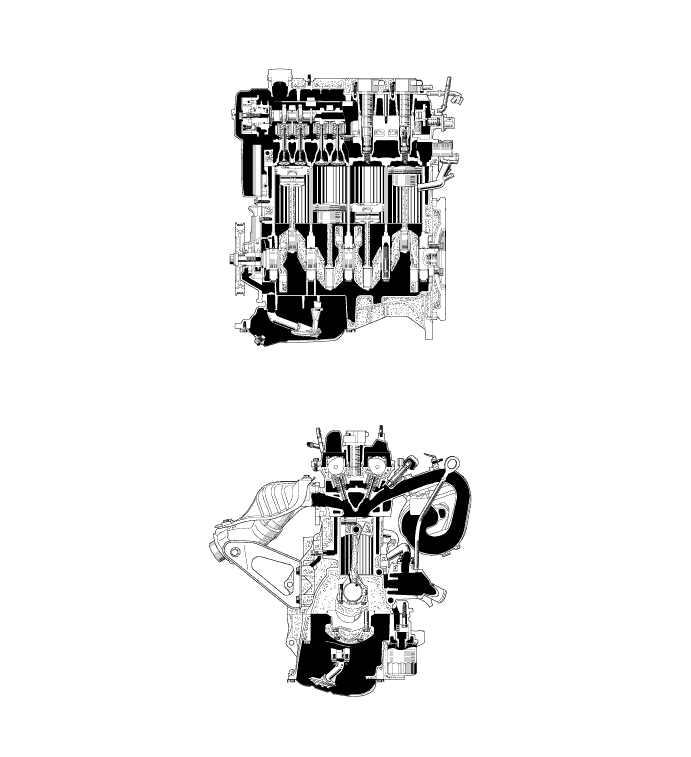
ENGINE UNIT (for Hatchback) > GENERAL |
| OUTLINE |
The 1NZ-FE engine is a 1.5-liter, 16-valve DOHC, in-line 4-cylinder gasoline engine.
The Variable Valve Timing-intelligent (VVT-i) system, Direct Ignition System (DIS) and Electronic Throttle Control System-intelligent (ETCS-i) are used on this engine in order to realize high performance, quietness, fuel economy and clean emission.

| SPECIFICATION |
| Engine Type | 1NZ-FE | |||
| No. of Cyls. and Arrangement | 4-cylinder, In-line | |||
| Valve Mechanism | 16-valve DOHC, Chain Drive (with VVT-i) | |||
| Combustion Chamber | Pentroof Type | |||
| Flow of Intake and Exhaust Gasses | Cross-Flow | |||
| Fuel System | SFI | |||
| Ignition System | DIS | |||
| Displacement | 1497 cm3 (91.3 cu. in.) | |||
| Bore x Stroke | 75.0 mm X 84.7 mm (2.95 in. X 3.33 in.) | |||
| Compression Ratio | 10.5:1 | |||
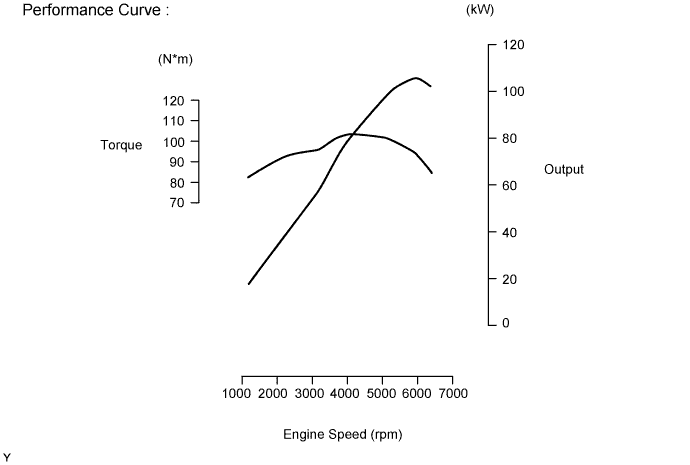
| Max. Output | SAE-NET*1 | 79 kW @ 6000 rpm (106HP @ 6000 rpm) | ||
| Max. Torque | SAE-NET*1 | 139 N*m @ 4200 rpm (103 ft. *lbf @ 4200 rpm) | ||
| Valve Timing | Intake | Open | 33°BTDC to 7°ATDC | |
| Closed | 12°ABDC to 52°ABDC | |||
| Exhaust | Open | 42°BBDC | ||
| Closed | 2°ATDC | |||
| Firing Order | 1 - 3 - 4 - 2 | |||
| Octane Rating | 87 or higher | |||
| Research Octane Number (RON) | 91 or higher | |||
| Oil Grade | ILSAC | |||
| Emission Regulation | Regulation | CARB*2 | EPA*3 | |
| Tailpipe | LEVII-ULEV | Tire2-Bin5 | ||
| Evaporative | LEVII, ORVR | Tier2, ORVR | ||
| Engine Service Mass*4 (Reference) | M/T | 83.2 kg (183.4 lb) | ||
| A/T | 77.8 kg (171.5 lb) | |||

| MAIN FEATURES |
The 1NZ-FE engine has achieved the following performance through the use of the items listed below.
High performance and fuel economy
Low noise and vibration
Lightweight and compact design
Good serviceability
Clean emission
| Section | Item | (1) | (2) | (3) | (4) | (5) |
| Engine Proper | An aluminum cylinder block sub-assembly is used. | ○ | ||||
| An offset crankshaft is used. | ○ | ○ | ○ | |||
| A taper squish shape is used for the top of the pistons. | ○ | ○ | ||||
| Valve Mechanism | A chain sub-assembly and No. 1 chain tensioner assembly are used. | ○ | ○ | ○ | ||
| The Variable Valve Timing-intelligent (VVT-i) system is used. | ○ | ○ | ||||
| Intake and Exhaust System | A plastic intake manifold is used. | ○ | ||||
| A linkless-type throttle with motor body assembly is used. | ○ | ○ | ||||
| A stainless steel exhaust manifold is used. | ○ | |||||
| 2 Three-Way Catalytic converters (TWCs) are used. | ○ | |||||
| A rearward exhaust layout is used. | ○ | |||||
| Fuel System | 12-hole type fuel injector assemblies are used. | ○ | ||||
| A fuel returnless system is used. | ○ | ○ | ○ | |||
| Quick connectors are used to connect fuel hose and the fuel pipes. | ○ | |||||
| Ignition System | A Direct Ignition System (DIS) is used. | ○ | ○ | ○ | ||
| Engine Control System | The Electronic Throttle Control System-intelligent (ETCS-i) is used. | ○ | ○ | |||
| The non-contact sensor is used in the throttle position sensor and accelerator pedal position sensor. | ○ | |||||
| The evaporative emission control system is used. | ○ | |||||
| The use of an air fuel ratio sensor allows for precise control. | ○ |