 |
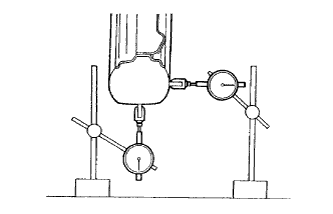
Using a dial indicator, check the tire runout.
- Tire Runout:
Vertical 1.4 mm (0.0551 in.) or less Lateral 2.0 mm (0.0787 in.) or less
REAR WHEEL ALIGNMENT (for Sedan) > INSPECTION |
| 1. INSPECT TIRES |
Check the tires for wear and proper inflation pressure.
| Tire Size | Vehicle Speed | Front kPa (kgf/cm2, psi) | Rear kPa (kgf/cm2, psi) |
| 185/60R15 84H | Driving below 160 km/h (100 mph) | 220 (2.2, 32) | 220 (2.2, 32) |
| Driving above 160 km/h (100 mph) | 230 (2.3, 33) | 230 (2.3, 33) |
|
Using a dial indicator, check the tire runout.
| Vertical | 1.4 mm (0.0551 in.) or less |
| Lateral | 2.0 mm (0.0787 in.) or less |
| 2. MEASURE VEHICLE HEIGHT |
| 3. INSPECT CAMBER |
Install the camber-caster-kingpin gauge and position the rear wheel on the turning radius gauge.
Inspect the camber.
| 4. INSPECT TOE-IN |
Bounce the vehicle up and down at the corners to stabilize the suspension.
Release the parking brake and move the shift lever to the neutral.
Push the vehicle straight ahead approximately 5 m (16.4 ft.). (Step A)
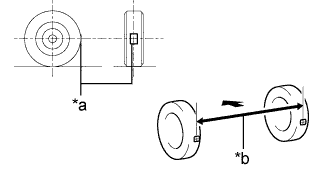 |
Put tread center marks on the rearmost points of the rear wheels and measure the distance between the marks (Dimension B).
| *a | Tread Center Mark |
| *b | Dimension B |
 | Front of the Vehicle |
Slowly push the vehicle straight ahead to cause the rear wheels to rotate 180° using the rear tire valve as a reference point.
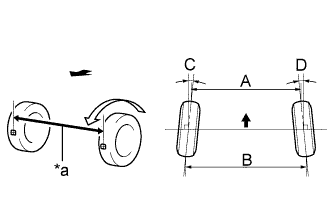 |
Measure the distance between the tread center marks on the front side of the wheels (Dimension A).
| *a | Dimension A |
| Front of the Vehicle |
| B - A | C + D |
| 2.2 +/- 3.0 mm (0.0866 +/- 0.118 in.) | 0°13' +/- 0°20' (0.22°+/- 0.33°) |