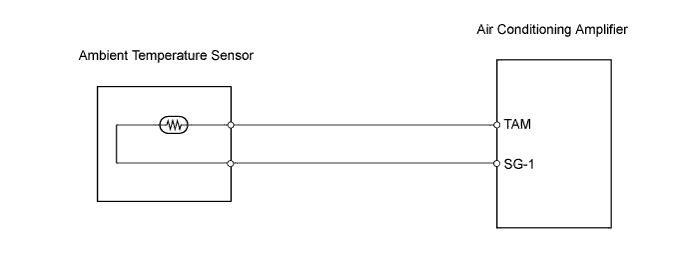
DTC B1412/12 Ambient Temperature Sensor Circuit |
| DTC No. | DTC Detection Condition | Trouble Area |
| B1412/12 | Open or short in ambient temperature sensor circuit |
|
| 1.READ VALUE USING TECHSTREAM (AMBIENT TEMPERATURE SENSOR) |
Connect the Techstream to DLC3.
Turn the ignition switch ON.
Turn the tester on.
Select the following menus: Body Electrical / Air Conditioner / Data List / Ambient Temp Sensor
According to the display on tester, read the "Data List".
| Tester Display | Measurement Item/Range | Normal Condition | Diagnostic Note |
| Ambient Temp Sensor | Ambient temperature sensor / Min.: -23.3°C (-9.94°F) Max.: 65.95°C (150.71°F) | Actual ambient temperature is displayed | Open circuit: -23.3°C (-9.94°F) Short circuit: 65.95°C (150.71°F) |
| Result | Proceed to |
| NG | A |
| OK (When troubleshooting according to PROBLEM SYMPTOMS TABLE) | B |
| OK (When troubleshooting according to the DTC output) | C |
|
| ||||
|
| ||||
| A | |
 |
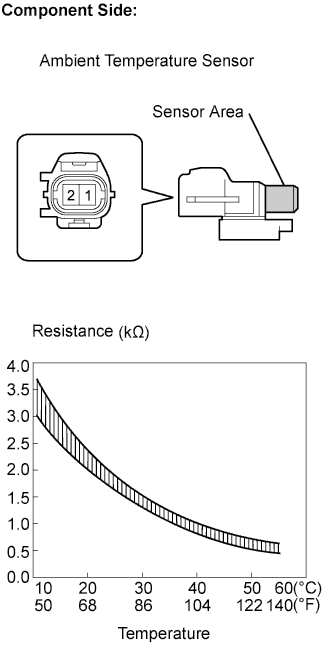
| 2.INSPECT AMBIENT TEMPERATURE SENSOR |
 |
Remove the ambient temperature sensor.
Measure the resistance.
| Tester Connection | Condition | Specified Condition |
| 1 - 2 | 10°C (50°F) | 3.00 to 3.73 kΩ |
| 1 - 2 | 15°C (59°F) | 2.45 to 2.88 kΩ |
| 1 - 2 | 20°C (68°F) | 1.95 to 2.30 kΩ |
| 1 - 2 | 25°C (77°F) | 1.60 to 1.80 kΩ |
| 1 - 2 | 30°C (86°F) | 1.28 to 1.47 kΩ |
| 1 - 2 | 35°C (95°F) | 1.00 to 1.22 kΩ |
| 1 - 2 | 40°C (104°F) | 0.80 to 1.00 kΩ |
| 1 - 2 | 45°C (113°F) | 0.65 to 0.85 kΩ |
| 1 - 2 | 50°C (122°F) | 0.50 to 0.70 kΩ |
| 1 - 2 | 55°C (131°F) | 0.44 to 0.60 kΩ |
| 1 - 2 | 60°C (140°F) | 0.36 to 0.50 kΩ |
Reinstall the ambient temperature sensor.
|
| ||||
| OK | |
|
| 3.CHECK HARNESS AND CONNECTOR (AMBIENT TEMPERATURE SENSOR - AIR CONDITIONING AMPLIFIER) |
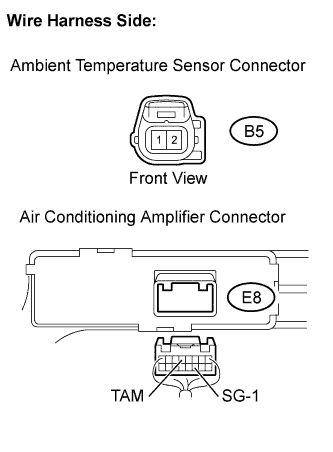 |
Disconnect the B5 ambient temperature sensor connector.
Disconnect the E8 air conditioning amplifier connector.
Measure the resistance.
| Tester Connection | Specified Condition |
| B5-1 - E8-11 (SG-1) | Below 1 Ω |
| B5-2 - E8-5 (TAM) | Below 1 Ω |
| B5-1 - Body ground | 10 kΩ or higher |
| B5-2 - Body ground | 10 kΩ or higher |
Reconnect the ambient temperature sensor connector.
Reconnect the air conditioning amplifier connector.
|
| ||||
| OK | ||
 | ||
| ||
