BRAKE CONTROL / DYNAMIC CONTROL SYSTEMS BRAKE CONTROL SYSTEM CONTROL HILL-START ASSIST CONTROL
SYSTEM CONTROL
When the vehicle starts off on a steep or slippery hill, it could descend backward while the driver switches from the brake pedal to the accelerator pedal, making it difficult for the vehicle to start off. To help prevent this from occurring, the Hill-start Assist Control temporarily (approximately 2 seconds at the maximum) applies the brakes to all wheels in order to help prevent the vehicle from descending backward.
Without the Hill-start Assist Control, the driver must quickly and precisely switch from the brake pedal to the accelerator pedal. With the Hill-start Assist Control, however, the driver can start off easily and operate the pedal in a relaxed manner, because the Hill-start Assist Control helps prevent the vehicle from descending backward.
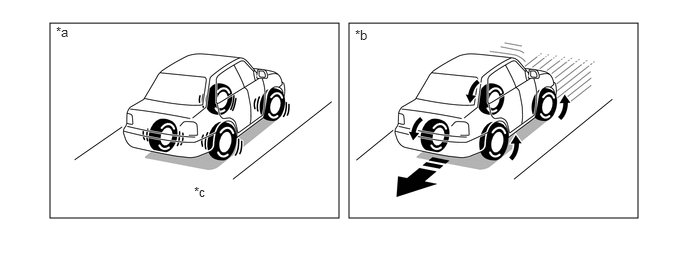
| *a | Models with Hill-start Assist Control | *b | Models without Hill-start Assist Control |
| *c | Helps prevent vehicle from descending backward by controlling brakes. | - | - |
The Hill-start Assist Control operates when all of the following conditions have been met:
|
*1: Models with CVT *2: Models with manual transaxle |
·
The shift lever is in any position other than P or N (forward climbing and backward climbing).*1 ·
The shift lever is in a position other than R when starting off forward on an upward incline or in R when starting off backward on an upward incline.*2 ·
The vehicle is at a standstill. ·
The accelerator pedal is not depressed. ·
The parking brake is released. |
If any one of the below conditions is met during Hill-start Assist Control operation, Hill-start Assist Control will be canceled.
|
*1: Models with CVT *2: Models with manual transaxle |
·
The shift lever is moved to P or N.*1 ·
The shift lever is shifted to R when starting off forward on an upward incline or from R when starting off backward on an upward incline.*2 ·
The accelerator pedal is depressed. ·
The parking brake is operated. ·
Approximately 2 seconds elapse since the operation started. |