EXTERIOR PANELS / TRIM BODY STRUCTURE DETAILS SAFETY FEATURES
CONSTRUCTION
Impact Absorbing Structure for Front Collisions
A body structure provides efficient impact energy absorption and dissipation by the frames from the front to under body to soften the impact to the passengers and helps reduce cabin deformation by the rigid cabin frames, in the event of a frontal collision.
Impact energy during a frontal collision will first be dispersed into the left and right front side members by the front bumper reinforcement. Then it will be dispersed again into the rocker reinforcements and under frames via the front torque boxes.
Impact energy from the upper members will be dispersed into the front door beltline reinforcements and front pillar reinforcement sub-assembly via the Minimum Intrusion Cabin System (MICS) bulks and then distributed to the roof side rail sub-assembly.
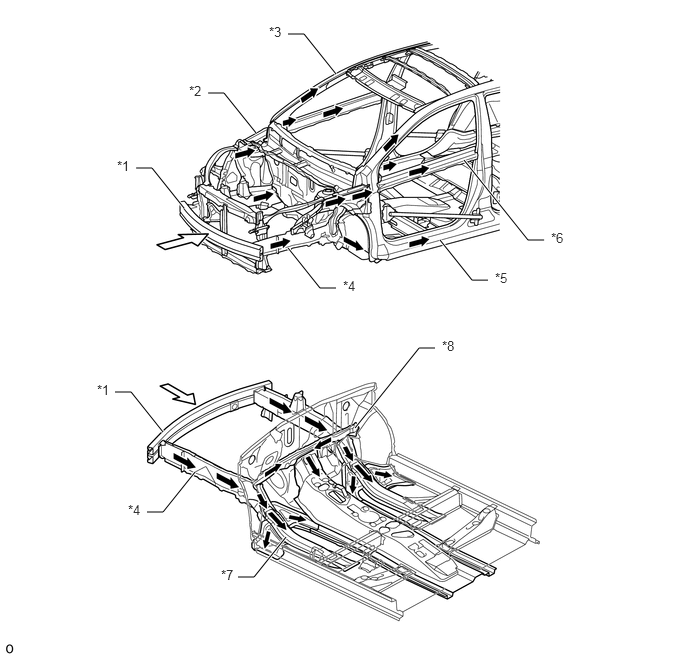
| *1 | Front Bumper Reinforcement | *2 | Minimum Intrusion Cabin System (MICS) Bulks |
| *3 | Front Pillar Reinforcement Sub-assembly | *4 | Front Side Member |
| *5 | Rocker Reinforce Sub-assembly | *6 | Front Door Beltline Reinforcement |
| *7 | Front floor kick Reinforcement | *8 | Front Panel Member Sub-assembly |

|
Path of Collision Energy | 
|
Frontal Collision |
Dash panel insulator pads are provided in the lower section of the dash panel to lessen the impact to the legs of the front passengers
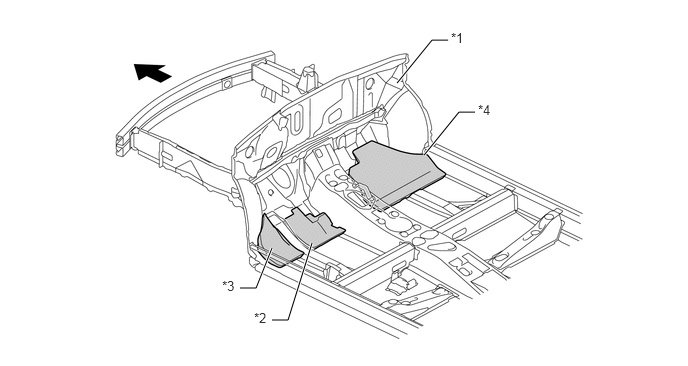
| *1 | Dash Panel | *2 | No. 2 Dash Panel Insulator Pad |
| *3 | No. 3 Dash Panel Insulator Pad | *4 | No. 4 Dash Panel Insulator Pad |
|
|
Front | - | - |
Impact Absorbing Structure for Side Collision
A structure that provides collision energy absorption efficiency, dissipates impact, and helps reduce cabin deformation during a side collision has been achieved.
Bulkheads are placed inside the rocker reinforcements to efficiently transmit impact energy to the front floor cross members as well as help reducing the rocker reinforcement deformation.
Optimal placement of the door side impact protection beams provides a construction that efficiently transmits load.
Energy absorbing pads are used inside the door trims to help dampening the impact energy applied to the abdomen and pelvis of the occupant in a side collision. The impact load applied from the side of the front door side impact protection beam will be transmitted to the opposite side of the body via the front seat rod.
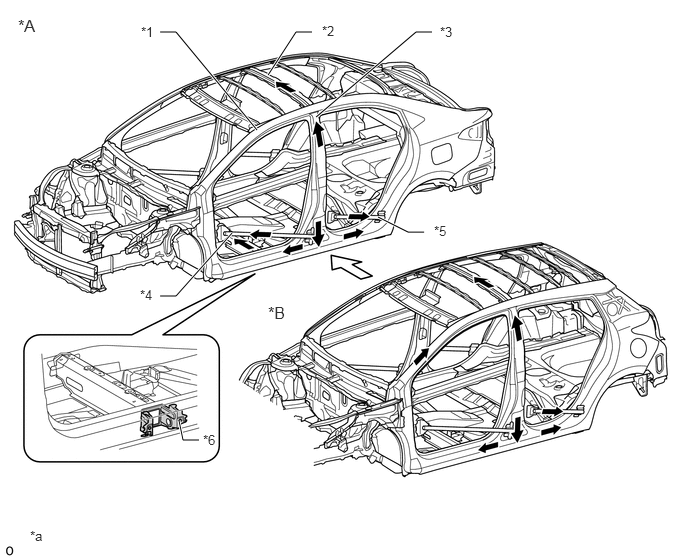
| *A | For Sedan Models | *B | For Hatchback Models |
| *1 | Roof Side Rail Sub-assembly | *2 | Roof Panel Reinforcement |
| *3 | Center Body Pillar | *4 | Front Door Side Impact Protection Beam |
| *5 | Rear Door Side Impact Protection Beam | *6 | Bulkhead |
| *a | The illustrations shown are examples only. | - | - |
|
|
Path of Collision Energy |
|
Side Collision |
Lessening Pedestrian Injury
The hood panel, front fender, cowl top panel and front bumper are designed to absorb impact energy to dampen the impact applied to the head and legs of a pedestrian in case of a collision.
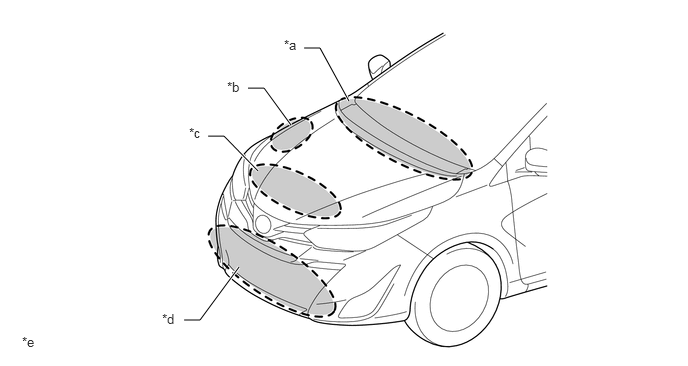
| *a | Cowl Top Panel Area | *b | Front Fender Area |
| *c | Hood Panel Area | *d | Front Bumper Area |
| *e | The illustrations shown are examples only. | - | - |
Ridges are provided in appropriate positions of the hood inner panel and hood reinforcement respectively, in order to help lessen the impact energy to a pedestrian during a collision by allowing both structures to deform and to absorb the impact energy.
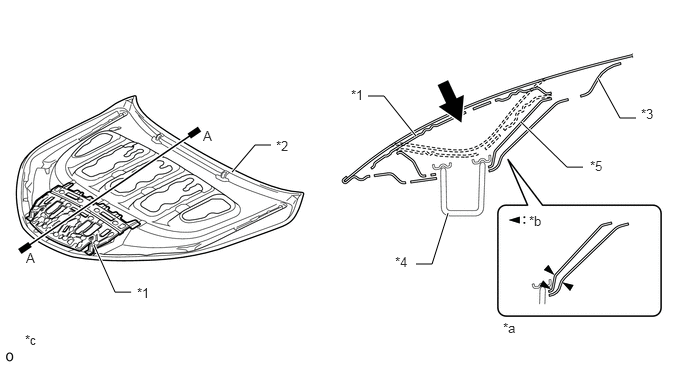
| *1 | Hood Reinforcement | *2 | Hood Panel |
| *3 | Hood Inner Panel | *4 | Hood Lock Striker |
| *5 | Hood Lock Reinforcement | - | - |
| *a | A-A Cross Section | *b | Ridges |
| *c | The illustrations shown are examples only. | - | - |
|
|
Impact | - | - |
An impact absorbing bracket is used for the mounting portion of the front fender panel to help absorb impact energy to the head of the pedestrian in a collision, thus helping to dampen the impact to the head.
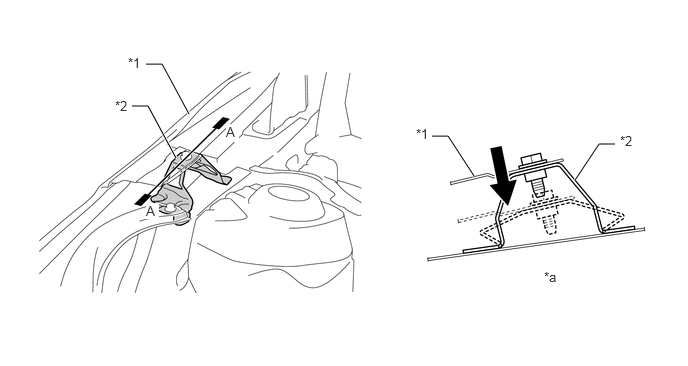
| *1 | Front Fender Panel (Front Fender Sub-assembly) | *2 | Impact Absorbing Bracket (Front Apron to Cowl Side Member Plate) |
| *a | A-A Cross Section | - | - |
|
|
Impact | - | - |
An open section structure is used for the cowl, which efficiently help absorbs the impact energy applied from the estimated direction of a collision with the head of a pedestrian, thus helping reducing the injury rate. In order to help reduce the impact applied from above, the cowl employs an energy absorbing structure with deformable ridges that are specially arranged.
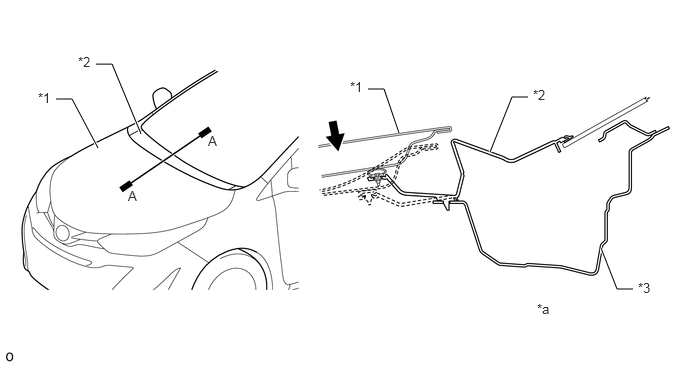
| *1 | Hood Panel | *2 | No. 1 Cowl Top Ventilator Louver Center |
| *3 | Cowl Top Panel | - | - |
| *a | A-A Cross Section | - | - |
|
|
Impact | - | - |