1NR-FE ENGINE CONTROL CAMSHAFT OIL CONTROL VALVE INSPECTION
PROCEDURE

 11101J
1.INSPECT CAMSHAFT TIMING OIL CONTROL VALVE ASSEMBLY
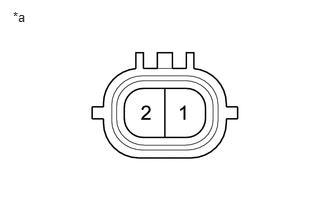
| *a | Component without harness connected
(Camshaft Timing Oil Control Valve Assembly) |
Check the resistance.
Measure the resistance according to the value(s) in the table below.
- Standard Resistance:
Tester Connection Condition Specified Condition 1 - 2 20°C (68°F) 6.9 to 7.9 Ω
If the result is not as specified, replace the camshaft timing oil control valve assembly.
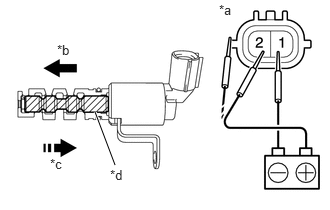
| *a | Component without harness connected
(Camshaft Timing Oil Control Valve Assembly) |
| *b | When Battery Voltage Applied |
| *c | When Battery Voltage Cut Off |
| *d | Spool Valve |
Check the operation.
Connect the positive (+) lead from a battery to terminal 2 and negative (-) lead to terminal 1, and check the movement of the camshaft timing oil control valve assembly.
- OK:
Battery Connection Condition Specified Condition Battery positive (+) → Terminal 2
Battery negative (-) → Terminal 1Battery positive (+) voltage is applied Spool valve moves in direction of left arrow shown in illustration Battery positive (+) voltage is cut off Spool valve moves in direction of right arrow shown in illustration
If the result is not as specified, replace the camshaft timing oil control valve assembly.
- NOTICE:
-
Accumulation of foreign matter can cause minor pressure leaks. Minor pressure leaks in the exhaust side camshaft timing oil control valve assembly will cause the exhaust camshaft to retard. The inappropriate camshaft timing that results from these leaks will cause a DTC to be stored.