CRUISE CONTROL LANE TRACING ASSIST SYSTEM GENERAL GENERAL
OUTLINE
The Lane Tracing Assist (LTA) system uses a forward recognition camera installed on the top of the windshield glass to recognize lane markers when driving on highways or controlled-access highways marked with lane markers. The LTA system also uses the forward recognition camera, millimeter wave radar sensor assembly and blind spot monitor sensor* to recognize preceding and surrounding vehicles, as well as to provide information to the driver, performing steering assistance according to road or driving conditions.
*: Models with blind spot monitor system
The LTA system uses the forward recognition camera to recognize the lane markers on roads and the driving path of the preceding vehicle when using dynamic radar cruise control system, and also uses the electrical power steering system to assist with a portion of steering wheel operation required for driving along the current lane according to the road shape and the driving path of the preceding vehicle, reducing the load on the driver.
The following functions in the LTA system operate according to switch operation and driving conditions.
|
*: Boundary between asphalt area and grass, dirt, curbs, etc. |
||
| Package Name | Toyota Safety Sense | |
| System Name | Lane Tracing Assist | |
| Abbreviation | LTA | |
| Lane Departure Alert Function | Lane Marker | ○ |
| Lane Boundary* | ○ | |
| Steering Assist Function | Lane Marker | ○ |
| Lane Boundary* | ○ | |
| Vehicle Sway Warning Function | ○ | |
| Lane Centering Function | Lane Marker | ○ |
| Driving Path of Preceding Vehicle | ○ | |
PRECAUTION
LTA System Handling Precautions
The LTA system provides information to the driver and performs steering assistance according to road and driving conditions. The driver cannot take his or her hands off from the steering wheel while the system is operating, so the driver must not trust solely in the system, and must always remain aware of surrounding conditions and the direction the vehicle is headed, operate the steering wheel to adjust the vehicle's path and ultimately be responsible for driving in any case.
The LTA system uses a forward recognition camera to recognize lane markers and lane boundaries, and operates by using the forward recognition camera, millimeter wave radar sensor assembly and blind spot monitor sensor*1 to recognize preceding and surrounding vehicles. The LTA system does not operate if it cannot recognize lane markers, lane boundaries or the path of the preceding vehicle. Also, since an unnecessary steering force could be applied, or steering wheel vibrations*2 or warning sounds may be produced when lane markers, lane boundaries or preceding vehicles are not recognized properly, make sure to drive appropriately using the steering wheel even when using the system. However, the steering force generated is small and does not interfere with operation of the vehicle.
*1: Models with blind spot monitor system
*2: Models with steering vibration function
The lane departure alert function and steering assist function operate when the LTA main switch is on, and lane markers or lane boundaries are recognized when driving at or above the system operation vehicle speed. However, the systems may not operate (or may stop operating) depending on road or driving conditions.
The LTA system assumes use on highways or controlled-access highways. Do not use the LTA system on general roads.
The lane centering function uses the path of the preceding vehicle to help the driver to follow the preceding vehicle, when traffic, etc. makes it difficult or impossible to see lane markers. If the preceding vehicle travels along the left or right side of the lane or changes lanes, this vehicle could follow the preceding vehicle, and either travel along the side of the lane or jut out from it. If the preceding vehicle is swaying, this vehicle could also sway or even jut out from the lane, so caution is required.
If the system detects some kind of malfunction, it notifies the driver by buzzer and display, and then the system stops. However, the vehicle can be driven normally. If the system reports a malfunction after restarting the engine (for gasoline models) or hybrid system (for HV models), have the vehicle inspected.
If not using the LTA system in order to prevent incorrect operation, turn the system off with the LTA main switch.
When zero point calibration has not been completed on the steering sensor, the LTA system does not work.
Do not use the LTA system under the following conditions.
Vehicle is driven on a road surface which is slippery due to rainy weather, fallen snow, freezing, etc.
Vehicle is driven on a snow covered road.
White (yellow) lines are difficult to see due to rain, snow, fog, dust, etc.
Vehicle is driven in a temporary lane or restricted lane due to construction work.
Vehicle is driven in a construction zone.
A spare tire, tire chains, etc. are equipped.
When the tires have been excessively worn, or when the tire inflation pressure is low.
When tires of a size other than specified are installed.
Vehicle is driven in traffic lanes other than that highways and freeways.
During emergency towing.
When the vehicle is towing a trailer.
Precautions to prevent failure or incorrect operation of the LTA system.
Do not modify the headlights or place stickers, etc. on the surface of the lights.
Do not modify the suspension etc. If the suspension etc. needs to be replaced, contact your Toyota dealer.
Do not install or place anything on the hood or grille. Also, do not install a grille guard (bull bars, kangaroo bar, etc.).
If your windshield needs repairs, contact your Toyota dealer.
Do not use the LTA system under the following conditions. Doing so could cause the system to operate improperly or could even lead to an unforeseen accident.
When the preceding vehicle changes lanes while the system is displaying that this vehicle is following the vehicle (this vehicle could follow the preceding vehicle and change lanes).
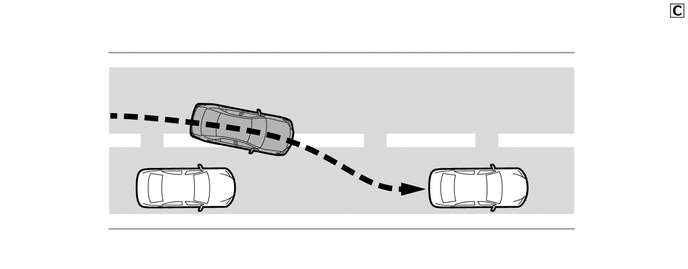
When the preceding vehicle is swaying while the system is displaying that this vehicle is following the vehicle (this vehicle could also sway or even jut out from the lane).
When the preceding vehicle travels along the left or right side of the lane while the system is displaying that this vehicle is following the vehicle (this vehicle could follow the preceding vehicle, and either travel along the side of the lane or jut out from it).
When driving around a sharp curve.
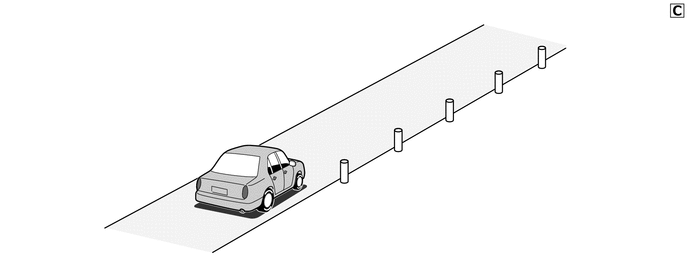
When driving on a road where structures or patterns on the side of the road could be mistaken as lane markers (such as guard rails, curbs or reflective poles).
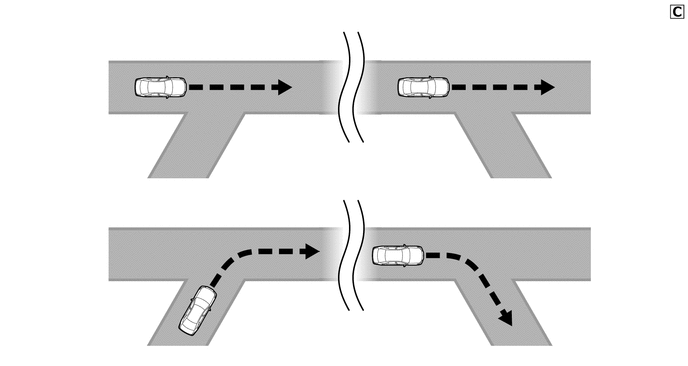
When driving through a junction or merging.
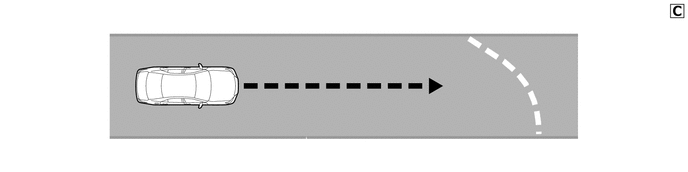
When driving on a repaired road on which there are traces of asphalt repair or old lane markers.
There are shadows on the road that run parallel with, or cover, the white (yellow) lines.
The vehicle is driven in an area without white (yellow) lines, such as in front of a tollgate or checkpoint, or at an intersection, etc.
The white (yellow) lines are cracked, "Botts' dots", "Raised pavement marker" or stones are present.
The white (yellow) lines cannot be seen or are difficult to see due to sand, etc.
The vehicle is driven on a road surface that is wet due to rain, puddles, etc.
The traffic lines are yellow (which may be more difficult to recognize than lines that are white).
The white (yellow) lines cross over a curb, etc.
The vehicle is driven on a bright surface, such as concrete.
If the edge of the road is not clear or straight.
The vehicle is driven on a surface that is bright due to reflected light, etc.
The vehicle is driven in an area where the brightness changes suddenly, such as at the entrances and exits of tunnels, etc.
Light from the headlights of an oncoming vehicle, the sun, etc. enters the camera.
The vehicle is driven on a slope.
The vehicle is driven on a road which tilts left or right, or a winding road.
The vehicle is driven on an unpaved or rough road.
The traffic lane is excessively narrow or wide.
The vehicle is extremely tilted due to carrying heavy luggage or having improper tire pressure.
The distance to the preceding vehicle is extremely short.
The vehicle is moving up and down a large amount due to road conditions during driving (poor roads or road seams).
When driving in a tunnel or at night with the headlights off or when a headlight is dim due to its lens being dirty or it being misaligned.
The vehicle is struck by a crosswind.
The vehicle is affected by wind from a vehicle traveling in a nearby lane.
The vehicle has just changed lanes or crossed an intersection.
Tires which differ by structure, manufacturer, brand or tread pattern are used.
Snow tires, etc. are equipped.
The vehicle is being driven at extremely high speeds.
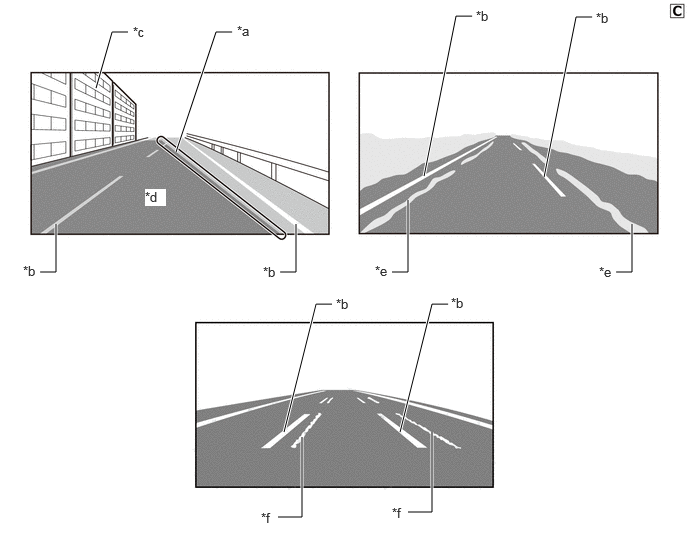
| *a | Edge of Shadow that could be Incorrectly Recognized as Lane Marker | *b | Lane Marker that should be Detected |
| *c | Structure | *d | Shadow of Structure |
| *e | Snow that could be Incorrectly Recognized as Lane Marker | *f | Trace of Erased Lane Marker that could be Incorrectly Recognized as Lane Marker |
Forward Recognition Camera Handling Precautions
It may be difficult or impossible for the forward recognition camera to recognize lane markers, lane boundaries or the path of the preceding vehicle, in the following surrounding environments.
When forward visibility is poor due to bad weather (rain, snow, fog, dust, dust clouds, blizzards, etc.).
When water, snow or dust is kicked up by a nearby vehicle, or when visibility is poor due to water vapor, sand, smoke, etc.
When the vehicle is exposed to powerful light from ahead, such as strong sunlight or the high beams of an oncoming vehicle.
In insufficiently bright environments, such as driving at night or in a tunnel.
When the headlights on this vehicle are not illuminated even at night or while driving in a tunnel.
When a surrounding surface is a single color (such as snowy landscape) and there is not enough contrast.
When the road grade changes suddenly (a sudden upward or downward slope).
When the amount of light changes suddenly, such as at the end of a tunnel.
When the top part of the windshield glass is foggy due to low temperatures.
When the vehicle-to-vehicle distance with the preceding vehicle is extremely close.
The forward recognition camera may not sufficiently recognize lane markers, lane boundaries or the path of the preceding vehicle in the following conditions.
When the vehicle is overloaded.
When the height of the vehicle has been adjusted (for example, the suspension has been modified or the tire size has been changed).
When matter such as snow, ice, dirt, frost, dust or oil is adhering to the windshield glass.
When the windshield is fogged up.
When the windshield glass has not been sufficiently cleaned during or after using windshield washer.
When lane markers cannot be completely recognized because raindrops, windshield washer fluid or wiper blades are blocking the visibility of the forward recognition camera.
When the windshield glass in front of the forward recognition camera is scratched.
When a canoe or other object is loaded on the roof, blocking the visibility of the forward recognition camera.
When dirt, ice and snow or mud is adhering to the headlights, and [it is difficult to recognize lane markers because they are not properly illuminated].
When the optical axis of the headlights is misaligned, and [it is difficult to recognize lane markers because they are not properly illuminated].
When the headlights, fog lights or other lights have been modified.
Since there are limits to forward recognition camera performance, the forward recognition camera may be unable to recognize lane markers, lane boundaries or the path of the preceding vehicle in the following conditions.
If the forward recognition camera become misaligned or warped due to an impact.
If the temperature inside the vehicle is very hot or cold (for example, if left in blazing heat or freezing cold).
Immediately after starting the engine (for gasoline models) or hybrid system (for HV models).
Refer to pre-collision system for details on the handling precautions of the millimeter wave radar sensor assembly and forward recognition camera.
Refer to blind spot monitor system for details on the handling precautions of the blind spot monitor sensor. (Models with blind spot monitor system)