BRAKE CONTROL / DYNAMIC CONTROL SYSTEMS BRAKE CONTROL SYSTEM(for Gasoline Model) DETAILS SPEED SENSOR
CONSTRUCTION
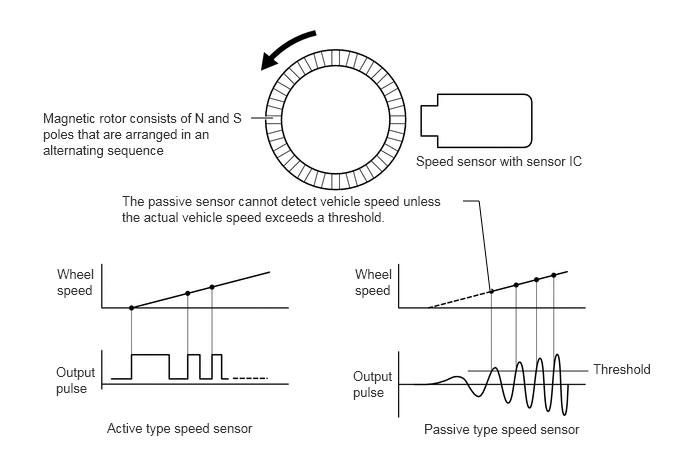
Active type speed sensors that can measure down to a very low speed are used.
The front speed sensors are installed to the steering knuckle. The front speed sensors use a magnetic rotor which consists of N and S poles that are arranged in a circle. The rotors of the front speed sensors are mounted to the inner race of the front axle hub and bearing assemblies.
The rear speed sensors which are integrated into the hub are installed to the edge of the outer race of the rear axle hub and bearing assemblies. The rear speed sensors use a magnetic rotor which consists of N and S poles that are arranged in a circle. The rear speed sensor rotors are mounted to the inner race of the rear axle hub and bearing assemblies.
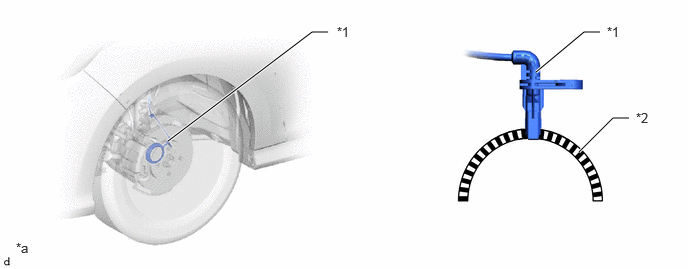
| *1 | Speed Sensor | *2 | Magnetic Rotor |
| *a | The illustrations shown are examples only. | - | - |
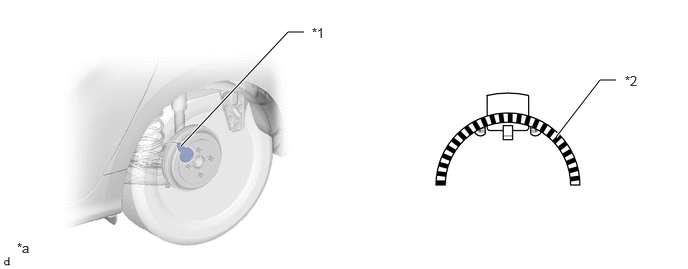
| *1 | Speed Sensor | *2 | Magnetic Rotor |
| *a | The illustrations shown are examples only. | - | - |
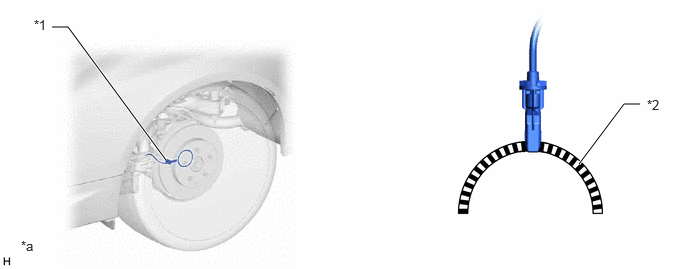
| *1 | Speed Sensor | *2 | Magnetic Rotor |
| *a | The illustrations shown are examples only. | - | - |
System Control
The magnetic rotor consists of 48 ferrite powder magnets embedded around its circumference.
The active type speed sensor uses a sensor IC to detect the changes in the magnetic field as the sensor rotor rotates, and outputs a pulse signal representing the rotational speed of the wheel.
The frequency of the pulses is used to determine the speed of the vehicle and detection down to almost 0 km/h is possible.