ON-VEHICLE INSPECTION
Inspection · Vehicles built from Nov 2005
| INSPECT BRAKE BOOSTER |

  |
Check the air tightness.
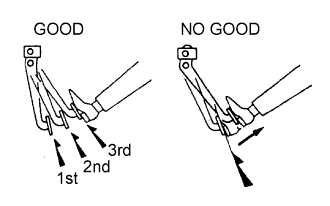
Start the engine and stop it after 1 or 2 minutes. Depress the brake pedal several times slowly.
- HINT:
- If the pedal can be depressed to the floor on the 1st time, but cannot be depressed as far on the 2nd or 3rd times, the booster is airtight. If not, inspect the vacuum check valve.
- If the vacuum check valve is normal, replace the brake booster assembly.
- If the pedal can be depressed to the floor on the 1st time, but cannot be depressed as far on the 2nd or 3rd times, the booster is airtight. If not, inspect the vacuum check valve.
Depress the brake pedal while the engine is running, and stop the engine with the pedal depressed.
- HINT:
- If there is no change in the pedal reserve distance after holding the pedal for 30 seconds, the booster is airtight. If not, inspect the vacuum check valve.
- If the vacuum check valve is normal, replace the brake booster assembly.
- If there is no change in the pedal reserve distance after holding the pedal for 30 seconds, the booster is airtight. If not, inspect the vacuum check valve.
Check the operation.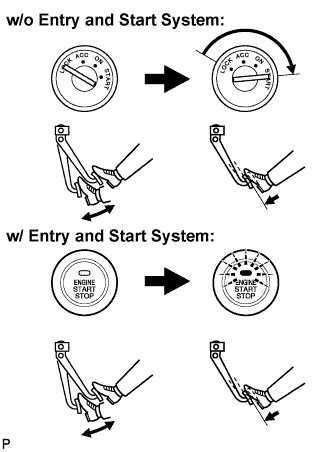
Depress the brake pedal several times with the engine stopped and check that there is no change in the pedal reserve distance.
Depress the brake pedal and start the engine.
- HINT:
- If the pedal goes down slightly, the operation is normal. If not, inspect the vacuum check valve.
- If the vacuum check valve is normal, replace the brake booster assembly.
- If the pedal goes down slightly, the operation is normal. If not, inspect the vacuum check valve.
| INSPECT VACUUM CHECK VALVE |
Check the vacuum check valve.
Slide the clip and disconnect the vacuum hose.
Remove the vacuum check valve from the brake booster.
Check that there is ventilation from the booster to the engine, and no ventilation from the engine to the booster.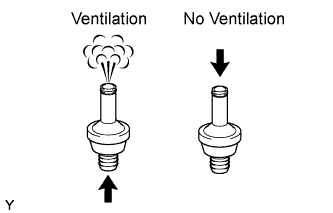
If any fault is found, replace the vacuum hose assembly.Install the vacuum check valve onto the brake booster.
Connect the vacuum hose with the clip.
| INSPECT VACUUM PUMP (for 1ND-TV) |
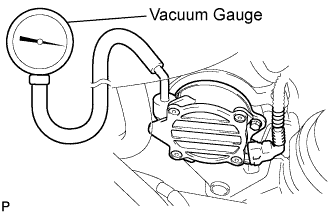 |
Disconnect the vacuum hose and connect the vacuum gauge to the vacuum pump.
Start the engine.
Measure the vacuum with the engine at idle.
- Vacuum at standard (sea-level) atmospheric pressure (1,013 mbar) when 2 minutes or more have elapsed after the engine is started:
- More than 86 kpa (650 mmHg)
- HINT:
- Replace the vacuum pump every 200,000 km (124,000 miles).