REFRIGERANT > ON-VEHICLE INSPECTION |
| 1. INSPECT REFRIGERANT VOLUME (w/ Sight Glass) |
|
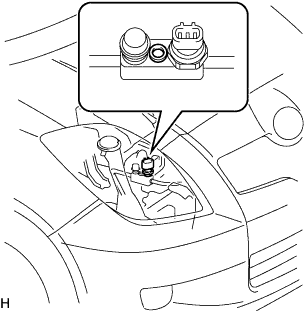
Check the sight glass on liquid tube sub-assembly A.
Test conditions:
| Item | Symptom | Amount of Refrigerant | Corrective Procedures |
| 1 | Bubbles visible | Insufficient* | (1) Check for gas leakage and repair if necessary (2) Add refrigerant until bubbles disappear |
| 2 | No bubbles visible | Empty, insufficient or too much | Refer to items 3 and 4 |
| 3 | No temperature difference between compressor inlet and outlet | Empty or nearly empty | (1) Check for gas leakage with halogen leak detector and repair if necessary (2) Add refrigerant until bubbles disappear |
| 4 | Considerable temperature difference between compressor inlet and outlet | Correct or too much | Refer to items 5 and 6 |
| 5 | Immediately after A/C turned OFF, refrigerant becomes clear | Too much | (1) Drain or discharge refrigerant (2) Bleed air and supply proper amount of purified refrigerant |
| 6 | Immediately after A/C turned OFF, refrigerant foams and then becomes clear | Correct | - |
| 2. CHECK REFRIGERANT PRESSURE USING MANIFOLD GAUGE SET |
This is a method to identify trouble areas by using a manifold gauge set. Read the manifold gauge pressure under the following conditions.
Test conditions:
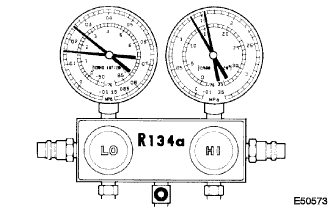 |
When the refrigerant volume is correct, the gauge reading indicates as follows:
When there is moisture in the refrigeration system:
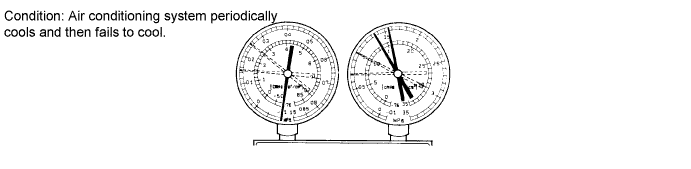
| Symptoms | Probable Cause | Diagnosis | Corrective Actions |
| During operation, pressure on low pressure side cycles between normal and vacuum | Moisture in refrigeration system freezes at expansion valve orifice, causing temporary interruption of cycle However, when melted, returns to normal condition |
|
|
When cooling is insufficient:
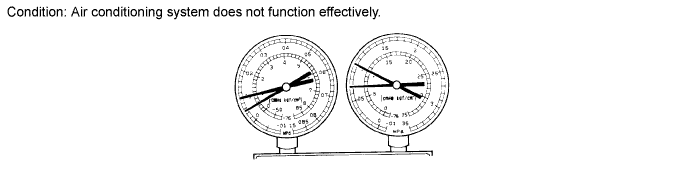
| Symptoms | Probable Cause | Diagnosis | Corrective Actions |
| Gas leakage from refrigeration system |
|
|
When the circulation of the refrigerant is poor:
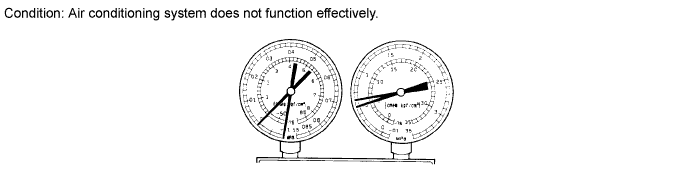
| Symptoms | Probable Cause | Diagnosis | Corrective Action |
| Refrigerant flow obstructed by dirt in condenser | Condenser clogged | Replace condenser |
When the refrigerant does not circulate:
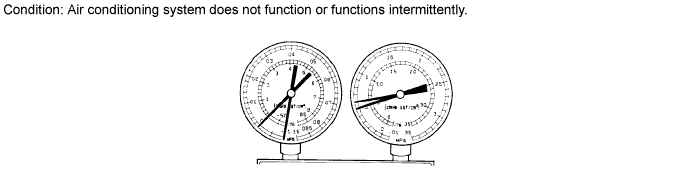
| Symptoms | Probable Causes | Diagnosis | Corrective Actions |
|
| Refrigerant does not circulate |
|
When the refrigerant is overcharged or cooling of condenser is insufficient:
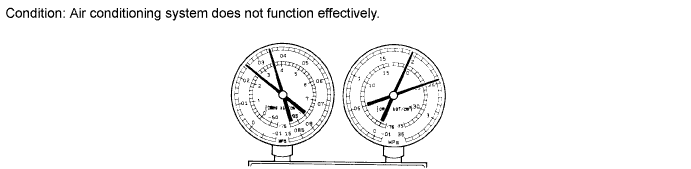
| Symptoms | Probable Causes | Diagnosis | Corrective Actions |
|
|
|
|
When there is air in the refrigeration system:
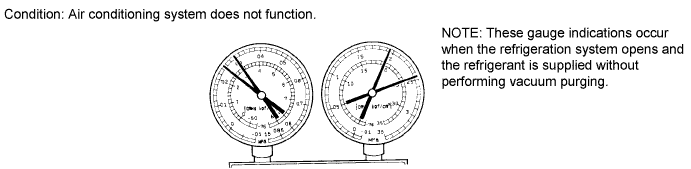
| Symptoms | Probable Causes | Diagnosis | Corrective Actions |
| Air in refrigeration system |
|
|
When the expansion valve malfunctions:
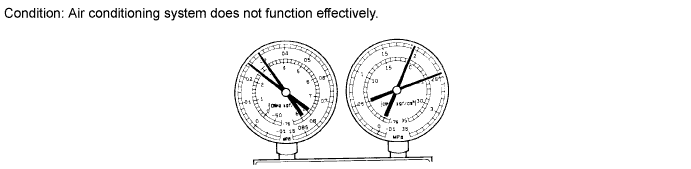
| Symptoms | Probable Causes | Diagnosis | Corrective Actions |
| Expansion valve malfunction |
| Replace expansion valve |
When the compressor is defective:
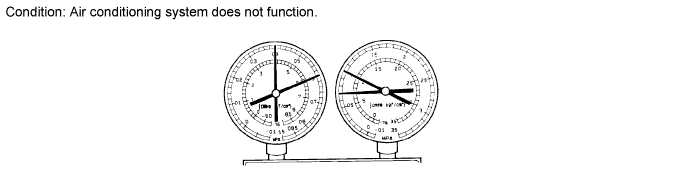
| Symptoms | Probable Cause | Diagnosis | Corrective Actions |
| Internal leakage in compressor |
| Repair or replace compressor |
| 3. INSPECT IDLING SPEED |
Warm up the engine.
Inspect the idling speed when these conditions are established.
| Condition | Idling Speed |
| Switch A/C OFF | 600 to 700 rpm |
| Switch A/C ON (A/C Lo → Hi) | 700 → 850 rpm |
| Condition | Idling Speed |
| Switch A/C OFF | 650 to 750 rpm |
| Switch A/C ON (A/C Lo → Hi) | 700 → 850 rpm |