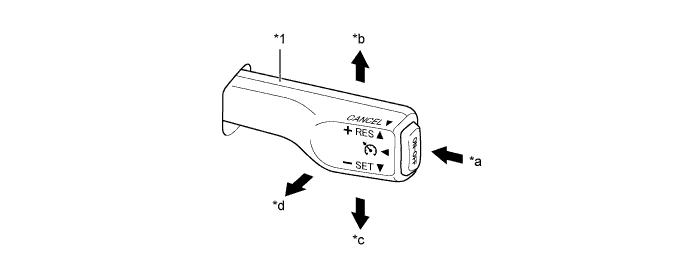
Function
| Outline
|
Constant Speed Control
| The ECM compares the actual vehicle speed and the set speed and if the vehicle speed is lower than the set speed, it uses the throttle control motor to increase the throttle opening.
|
Set Control
| When the "ON-OFF" button is turned on and the cruise control main switch is pressed in the "- SET" direction and released, the ECM stores the vehicle speed in the memory and continues to control the vehicle at that speed. The set speed is between 40 km/h (25 mph) and 200 km/h (125 mph).
|
Coast Control
| When the cruise control main switch is held down in the "- SET" direction while the vehicle is running in the cruise control, the throttle control motor is energized in the throttle closing direction, and the vehicle keeps decelerating. The ECM stores the vehicle speed when the cruise control main switch is released. From then on, the ECM continues to control the vehicle at that speed.
|
Tap-down Control
| When the difference between the actual vehicle speed and the set speed is less than 5 km/h (3 mph), the set speed can be lowered in steps of approximately 1.6 km/h (1 mph) by operating the cruise control main switch in the "- SET" direction quickly within approximately 0.6 seconds. However, if the difference between the actual vehicle speed and the set speed is greater than 5 km/h (3 mph), the set speed will change to the speed at which the vehicle was traveling at when the switch was released.
|
Accelerator Control
| When the cruise control main switch is kept pushed to the "+ RES" direction while the vehicle is running in the cruise control, the throttle control motor is energized in the throttle opening direction. The vehicle keeps accelerating and the ECM stores the vehicle speed when the cruise control main switch is released. From then on, the ECM continues to control the vehicle at that speed.
|
Tap-up Control
| When the difference between the actual vehicle speed and the set speed is less than 5 km/h (3 mph), the set speed can be increased in steps of approximately 1.6 km/h (1 mph) by operating the cruise control main switch in the "+ RES" direction quickly within approximately 0.6 seconds. However, if the difference between the actual vehicle speed and the set speed is greater than 5 km/h (3 mph), the set speed will not change.
|
Low Speed Limit Control
| The low speed limit is the lowest speed that the cruise control can be set to and is set at approximately 40 km/h (25 mph). The cruise control cannot be set below that speed. If the vehicle speed drops below that speed while running in the cruise control, the cruise control is canceled automatically. However the set speed is kept in memory.
|
Resume Control
| When the cruise control has been canceled by something other than the "ON-OFF" button operation, the cruise control can be resumed and controlled at the set speed by operating the cruise control main switch in the "+ RES" direction when the vehicle speed returns to above the low speed limit (approximately 40 km/h [25 mph]).
|
Shift down Control*1
| When the vehicle is traveling uphill using cruise control system, automatic transaxle control may cause the transaxle to shift down. During shift down control, when the end of uphill travel is determined, the transaxle will shift up after a certain period of time. When the transaxle shifts down during the accelerator control or resume control, the transaxle will shift up after the accelerator control or resume control ends.
|
Manual Cancel Control
| - If any of the following signals is sent to the ECM, the cruise control is cancelled accordingly.
- Stop light switch assembly on signal (depress the brake pedal).
- Signal to move the shift lever to any position other than D or 3.*1
- Clutch switch assembly off signal (depress the clutch pedal).*2
- "CANCEL" switch on signal.
- "ON-OFF" button off signal.
- VSC operation.*3
|
Automatic Cancel Control
| - When any of the following conditions occurs during cruise control operation, the set speed in the memory is cleared to cancel the cruise control. Furthermore, the cruise main indicator light blinks until the "ON-OFF" button is turned off, and the operation of the cruise control is disabled until the "ON-OFF" button is turned on again.
- The stop light switch assembly has an open or short circuit.
- The vehicle speed signal is abnormal.
|
- When the following condition occurs during cruise control, the speed that is set in the memory is cleared and the cruise control is cancelled. Furthermore, the operation of the cruise control will be disabled until the "ON-OFF" button is turned on again.
- ETCS-i has a malfunction.
|
- When any of the following conditions occurs during the cruise control, the set speed in the memory is cleared to cancel the cruise control. Furthermore, the cruise main indicator light blinks until the "ON-OFF" button is turned off, and the operation of the cruise control is disabled until the ignition switch is turned off.
- The stop light switch assembly input signal is abnormal.
- The cancel circuit has a malfunction.
|
- When the following condition occurs during cruise control, the speed that is set in the memory is cleared and the cruise control is cancelled.
- Vehicle speed decreases by 16 km/h (10 mph) or more below the speed at which the cruise control was set.
|
- When the following condition occurs during cruise control, the cruise control is cancelled.
- Vehicle speed is below the low speed limit (approximately 40 km/h [25 mph]).
|