Multiplex Communication
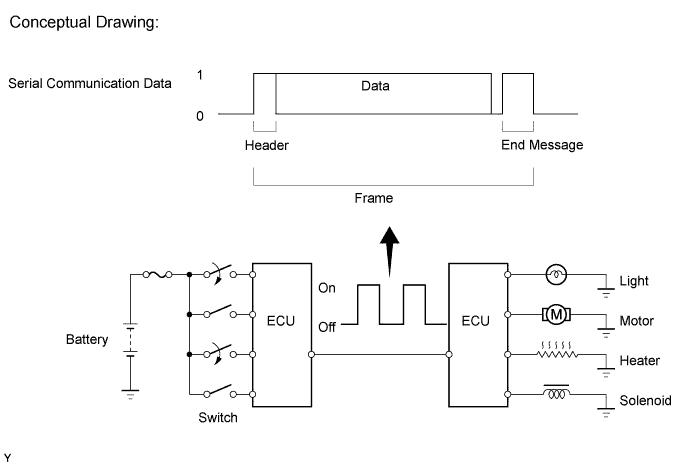
Generally speaking, multiplex communication refers to the use of serial communication data that consists of bits and frames in order to exchange information among various ECUs. This allows for a reduction of the amount of wiring on the vehicle. A bit is the basic unit of communication that is used to represent the information. A bit is represented by binary values of "0" or "1". For CAN communication, a differential voltage drive is used to represent the binary values of "0" or "1". This "Differential Voltage Drive" reduces the effects of electrical interference.
Differences between CAN and LIN
The protocols, which are the rules for establishing data communication, differ between the CAN and LIN. If the ECUs in the networks use different frameworks for their data, such as communication speed, communication wire and signals, they will be unable to understand each other. Therefore, protocols (rules) must be established among them.
Compared to the LIN, the CAN features high-speed data transmission. Therefore, the CAN is able to transmit larger amounts of data faster than other protocols. This feature makes it possible to transmit data accurately for the power train, chassis and body electrical systems, which requires large amounts of data to be transmitted in short periods of time.
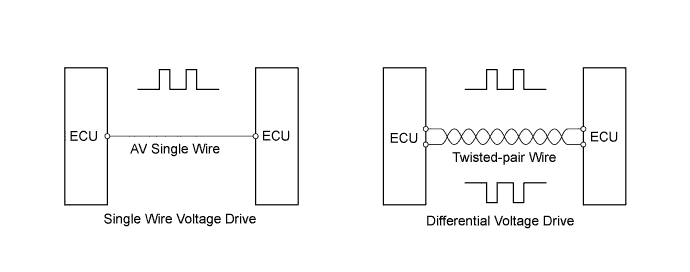
Protocol CAN LIN Communication Speed 500 kbps* 9.6 kbps* Communication Wire Twisted-pair Wire AV Single Wire Drive Type Differential Voltage Drive Single Wire Voltage Drive Data Length 1-8 Byte (Variable) 2, 4, 8 Byte (Variable) - HINT:
- bps*: abbreviation for "Bits Per Second", indicating the number of bits that can be transmitted per second.
A twisted-pair wire is used for CAN communication. An Automobile Vinyl (AV) single wire is used for LIN communication.
Communication Wire Outline Twisted-pair Wire 
This communication wire is a pair of twisted lines. Communication is driven by applying different voltages to the 2 lines in order to send a single signal. This system, which is called a "Differential Voltage Drive", reduces noise. AV Single Wire 
This is a lightweight single communication wire that consists of a single core line surrounded by insulation. Voltage is applied to this line in order to drive communication, and this system is called a "Single Wire Voltage Drive".