 |
Check for cracks, leaks or damage.
Check the engine assembly.
- HINT:
- Detachment or other problems with the engine oil dipstick, filler cap and other components may cause the engine to run improperly.
EMISSION CONTROL SYSTEM > ON-VEHICLE INSPECTION |
| 1. INSPECT FUEL CUT OFF/RESTART RPM |
Start and warm up the engine.
Open the throttle valve and keep the engine speed at 3500 rpm.
Use a sound scope to check for injector operating sounds.
Check that when the accelerator pedal is released, injector operating noise stops momentarily and then resumes.
If the result is as not specified, check the injectors, wiring and ECM.
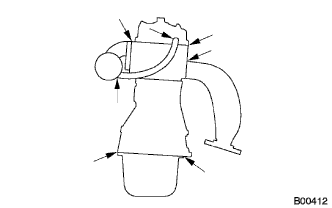
| 2. VISUALLY INSPECT HOSES, CONNECTIONS AND GASKETS |
|
Check for cracks, leaks or damage.
Check the engine assembly.
| 3. INSPECT EVAPORATIVE EMISSION CONTROL SYSTEM |
 |
Start the engine.
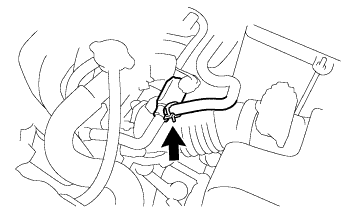
Disconnect the No. 1 fuel vapor feed hose as shown in the illustration.
Connect the intelligent tester to the DLC3.
Turn the tester on.
Enter the following menus: Powertrain / Engine and ECT / Active Test / Activate the VSV for Evap Control.
Check that a vacuum occurs at the VSV port.
If vacuum does not occur, check the following items.
Exit the Active Test mode and reconnect the vacuum hose.
Enter the following menus: Powertrain / Engine and ECT / Data List / EVAP Purge VSV.
Warm up the engine and drive the vehicle.
Confirm that the purge VSV opens.
If the result is not as specified, replace the purge valve, wire harness or ECM.
| 4. INSPECT CHARCOAL CANISTER |
Check for clogs in the air filter (when not using the intelligent tester).
Start the engine.
Warm up the engine.
Allow the engine to idle after the engine has warmed up.
After 15 minutes, open the fuel tank cap to discharge the pressure in the fuel tank.
Close the fuel tank cap and allow the engine to idle for 30 seconds.
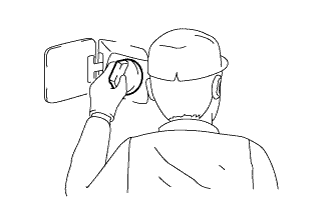 |
Open the fuel tank cap again and check for inhalation sounds.
Check for clogs in the air filter (when using the intelligent tester).
Connect the intelligent tester to the DLC3.
Start the engine.
Turn the tester on.
Enter the following menus: Powertrain / Engine / Active Test / Activate the VSV for Evap Control.
Open the fuel tank cap to discharge the pressure in the fuel tank.
Perform the "Activate the VSV for Evap Control" Active Test while the engine is idling.
Close the fuel tank cap and allow the engine to idle for 30 seconds.
Open the fuel tank cap again and check for inhalation sounds.