 |
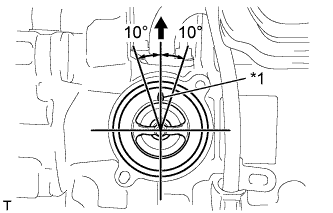
Install the thermostat with the jiggle valve facing upward.
| *1 | Jiggle Valve |
- HINT:
- The jiggle valve may be set within 10° of vertical in either direction, as shown in the illustration.
THERMOSTAT > INSTALLATION |
| 1. INSTALL THERMOSTAT |
Install a new gasket onto the thermostat.
|
Install the thermostat with the jiggle valve facing upward.
| *1 | Jiggle Valve |
| 2. INSTALL WATER INLET |
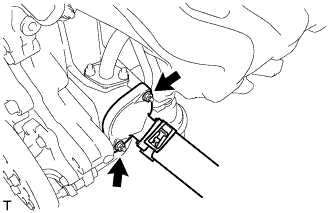 |
Install the water inlet with radiator hose with the 2 nuts.
| 3. ADD ENGINE COOLANT |
Tighten the cylinder block drain cock plug and the radiator drain cock plug.
Pour engine coolant into the radiator assembly until it is full.
Check the coolant level inside the radiator assembly by squeezing the No. 2 radiator hose and the No. 3 radiator hose several times by hand. If the coolant level goes down, add engine coolant.
Install the water filler cap sub-assembly securely.
Slowly pour coolant into the radiator reservoir until it reaches the FULL line.
Bleed air from the cooling system.
Warm up the engine until the thermostat opens.
While the thermostat is open, circulate the coolant for several minutes.
Maintain the engine speed at 2500 to 3000 rpm.
Press the No. 2 radiator hose and No. 3 radiator hose several times by hand to bleed air.
Stop the engine and wait until the coolant cools down.
If the coolant level is below the full level, perform steps (b) through (g) again and repeat the operation until the coolant level stays at the full level.
Recheck the coolant level inside the radiator reservoir tank assembly. If it is below the full level, add coolant.
| 4. INSPECT FOR COOLANT LEAK |
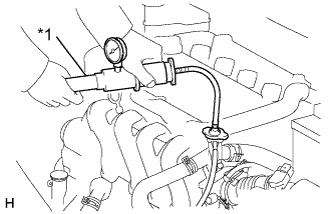 |
Fill the radiator assembly with engine coolant, then attach a radiator cap tester.
| *1 | Radiator Cap Tester |
Pump the tester to 137 kPa (1.4 kgf/cm2, 19.9 psi), then check that the pressure does not drop.
If the pressure drops, check the hoses, radiator assembly and water pump assembly for leakage. If there are no signs or traces of external engine coolant leakage, check the heater core, cylinder block and head.